
by Tomi Tolonen, Laurea University of Applied Sciences, Finland
How can students practise difficult professional encounters when the situations they need to learn from are precisely the ones that are difficult to recreate safely?
This was the challenge we started with at Laurea University of Applied Sciences. In social services education, students need to learn much more than processes and legislation. Professional encounters can involve sensitive communication, ethical decisions and unpredictable human interaction, where there is rarely one straightforward “correct” response.
We wanted to bring some of this complexity into learning while creating a safe environment where students could experiment, make mistakes and reflect on their choices. Our answer was scenario-based learning through media. But rather than teachers or media specialists simply producing learning materials for students, we wanted to create them with students and people who knew these situations from different perspectives.
Bringing different perspectives together
The production process brought together social services students, lived-experience experts, teachers and digital pedagogy expertise.
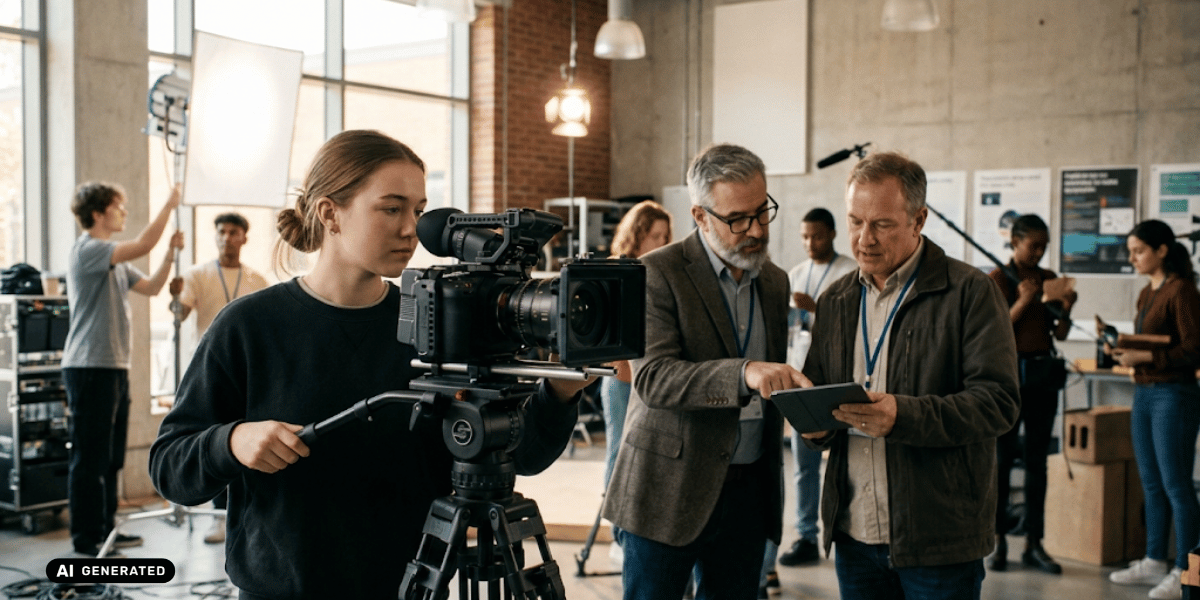
Students helped identify challenging client encounters and worked on scripts, professional processes and relevant legislation. They also stepped behind and in front of the camera, taking part in acting, filming and editing.
Lived-experience experts brought another crucial perspective. Their experiences helped introduce nuances, challenging reactions and ethical considerations into the scenarios. Small differences in gesture, tone of voice or expression could change how an encounter developed.
Teachers connected the scenarios to learning objectives and professional practice. My role as a digital pedagogy specialist was to consider how storytelling, media and gamification could transform these different perspectives into meaningful learning experiences.
This reinforced something I often return to when working with pedagogical media: authenticity does not come from having the best camera or producing the most polished video. It begins much earlier, with the people involved in deciding what the learning experience should contain.
Creating a safe space to make the wrong choices
We eventually produced five video-based scenarios covering different areas of social services, including youth services, early childhood education, family social counselling, school social work and adult social work.
The videos were integrated into interactive H5P Branching Scenarios. Instead of simply watching an encounter, students make choices that affect how the situation progresses.
Importantly, the aim is not simply to discover the “correct” path.
Students can explore alternatives, including choices they suspect might not work, observe what happens and reconsider their approach. In a real client encounter, a poorly chosen response can have real consequences. A simulated encounter creates a safe space in which those consequences can be explored.
And professional encounters are rarely predictable. The involvement of lived-experience experts helped us introduce reactions that could disrupt the expected flow of the conversation. This element of surprise matters because professional interaction is rarely a multiple-choice exercise in real life.
Learning through media and by making it
Student feedback highlighted something else that interested us. Seeing professional encounters unfold made gestures, expressions and tone of voice available for reflection in ways that written cases cannot always achieve. Students could compare different ways of approaching a situation and consider how they themselves might respond.
The scenarios were deliberately not designed to present one perfect model of professional behaviour. Sometimes seeing what not to do can be just as valuable.
But perhaps the most interesting learning happened on both sides of the camera.
The students who helped produce the scenarios were learning at the same time. They identified challenging situations, developed scripts, negotiated perspectives with others, acted, filmed and edited. This changed how I came to think about the project.
Students can learn through media, by navigating scenarios, making choices and reflecting on the consequences. But they can also learn by creating media, translating professional knowledge into a learning experience for someone else.
The production process itself becomes part of the pedagogy.
Who should be around the table?
Working in digital pedagogy, it is tempting to begin a media project by talking about cameras, platforms and tools. This project reinforced almost the opposite lesson for me. The more important questions come first.
What should students learn? Which situations are difficult to practise authentically? Whose knowledge do we need to represent them? And what can media enable that another format cannot? For me, this leaves one question worth asking whenever we begin designing pedagogical media:
Who should be around the table when we create the learning experience?
Because sometimes better educational media does not start by switching on the camera. It starts by inviting the right people into the room.
Author
 Tomi Tolonen, Expert of Digital Pedagogy, Laurea University of Applied Sciences, Finland