
by Pierre Fastrez and Jerry Jacques, UC Louvain, Belgium.
Every two years, in Louvain-la-Neuve (Belgium), our research group at UCLouvain opens its doors to ReDMIL (Research on Digital, Media and Information Literacy), its doctoral summer school. This year’s edition was a special one: a decade after the school’s first gathering, ReDMIL celebrated its tenth anniversary. True to its founding spirit, the event remains deliberately small: a limited number of PhD students from all over the world, working on new forms of literacy, come together for a few days alongside established and renowned researchers in these fields.
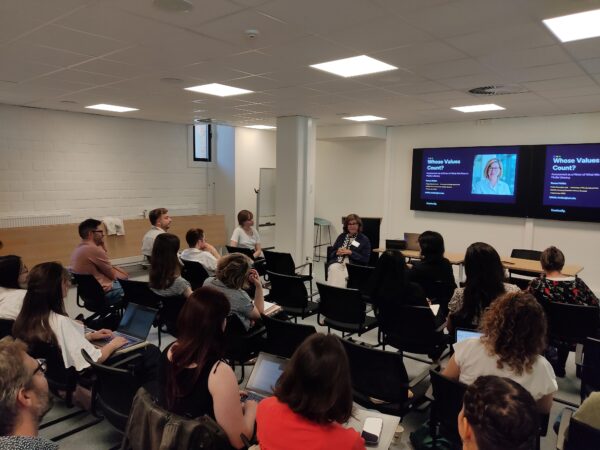
ReDMIL reverses the usual summer school format: rather than intensive expert-led training, it is the research of doctoral students that sits at the center of the discussion. Each PhD student presents their ongoing project, progress, uncertainties and explorations included, to an audience of peers and experts, with a dedicated hour as well as an opening poster session to introduce it to the group. The experts, in turn, are invited to unveil the theoretical and methodological “making of” of their own work. Throughout the event, students and mentors work collectively towards the enhancement of the students’ research.
ReDMIL was created in 2016 to honor the scientific career of our dear colleague and friend Thierry De Smedt, on the occasion of his becoming an emeritus professor. Thierry was one of the pioneers of media education research in Europe, and he devoted a large part of his long career to it. He is also allergic to any form of ostentatious celebration of his own person. The seminal idea of ReDMIL was to replace the traditional study day marking the end of a professor’s career, which brings together colleagues and friends to discuss his or her scientific contributions to the field of research, with an event putting established researchers at the service of emerging young researchers, in a format favoring collective intelligence and joint work.
So instead of focusing the spotlight on Thierry’s career, we preferred to create a dimly lit, kind space in which exchanges could be born that might, perhaps, someday, and often in others, bear fruit. Rather than occupying the space, the point was to create a new one, combining sincere listening and constructive academic standards, giving pride of place to long-form discussions. We also wanted this space to be genuinely shared and horizontal, beyond disciplinary particularities, cultural horizons, or career stages, in order to cultivate the capacity for decentering that is indispensable to anyone working in social science research. We had not anticipated it, but as the editions went by, it seems that this vision and this way of doing things — largely improvised and patched together at first — ended up making the event a success. Not a success of H-indexes, secured funding, or promotions, but a success of the spirit: that of taking the time for long, qualitative, heartfelt reflection, and of doing so within a constructive community animated by a sense of shared responsibility — that of media, information, and digital education. Because to talk shop, behind the scenes, to “open the hood” of research, you sometimes need to find yourself in a place where you can whisper. You have to go gently, feel your way, take risks while feeling safe. You have to remember that doing research means moving forward in the dark, taking advantage of the few glimmers of light you find along the way. Thierry De Smedt was not merely one of those glimmers for us. He was the one who taught us to make use of the shade to get to the bottom of things before bringing them into bloom. That is the modest legacy we hope to keep passing on through ReDMIL.
Since its first edition, ReDMIL has brought together 67 PhD students and 25 mentors who, together with our team, make up the heart of the ReDMIL alumni community. Each edition of the event has also been open to researchers and field practitioners in new literacies interested in our debates, which augment this small community.
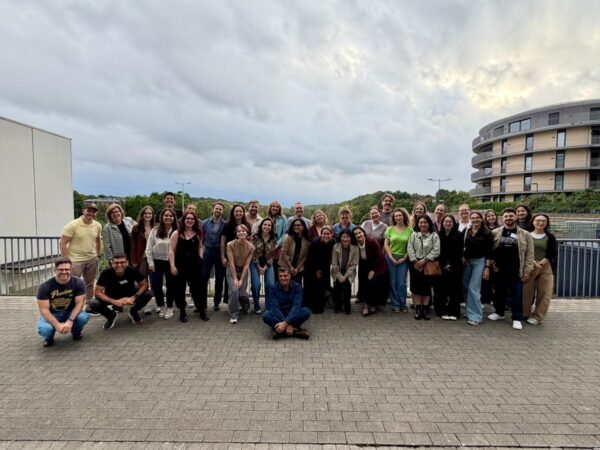
The 2026 edition, held from September 1 to 4, 2026 in Louvain-la-Neuve (Belgium), was devoted to the theme “Literacies in the Middle”, inviting participants to reflect on how information, digital, and media literacies can act as bridges between disciplines, stakeholders, and cultures, transforming their intermediary position into a source of collective agency in addressing contemporary societal challenges. It brought together 21 PhD students from 13 different countries and set them to work under the guidance of 5 experts. Both are listed below in alphabetical order.
- Kawtar Arahmouch (Ibn Zohr University, Agadir, Morrocco)
- Elena Balseiro Sollano (UCLouvain, Belgium)
- Amber Bartlett (Radboud University, The Netherlands)
- Hannah Bauer (Ludwig-Maximilians-Universität Munich, Germany)
- Daniel Berjano Rodriguez (Universitat Autónoma de Barcelona, Spain)
- Ines Boeckxstaens (KU Leuven, Belgium)
- Shannon Burth (Syracuse University, USA)
- Wong Lai Cheng (Universiti Sains Malaysia, Penang, Malaysia)
- Lemonie De Moortel (Vrije Universiteit Brussel, Belgium)
- Nina Demoustier (Université de Namur, Belgium)
- Joseph Di Vicenti (Université Libre de Bruxelles, Belgium)
- Mariana Grépinet (Université Paris-Panthéon-Assas, France)
- Renee Hobbs (University of Rhode Island, USA)
- Nico Hornig (TU Dortmund University, Germany)
- Hyeon-Seon Jeong (Gyeongin National University of Education, South Korea)
- Maarit Jaakkola (University of Gothenburg, Sweden)
- Seijin Kim (Gyeongin National University of Education, South Korea)
- Julianna Kowlessar (York & Toronto Metropolitan Universities, Canada)
- Normand Landry (Université TELUQ, Canada)
- Marie Mac Donough (UCLouvain, Belgium)
- Jad Melki (Lebanese American University, Lebanon)
- Olena Poburko (University of Groningen, The Netherlands)
- Aabha Rawat (Dr. B. R. Ambedkar University Delhi, India)
- Laura Zander (UCLouvain, Belgium)
- Xinyu Zhang (Griffith University, Australia)
- Yixi Zhao (Queensland University of Technology, Australia)
Author
Pierre Fastrez is a Senior Research Associate of the Belgian National Fund for Scientific Research and a Professor in Information and Communication at the Université Catholique de Louvain (Belgium). He has undertaken and directed research projects on media literacy that combine the development of performance-based assessment tools, and the definition of media competence based on the qualitative analysis of media practices. He directs the research journal “Recherches en Communication” and co-edited “Media Education and Media Literacy Research Methods: a Handbook”.
Jerry Jacques is an assistant professor at UCLouvain in Belgium. He is currently leading several research projects on the practices and competencies of users engaging with digital and automated media, with a particular focus on the challenges posed by technological innovations (such as algorithms and AI). His research and teaching also explore the relationships between media, information, and knowledge, with a special emphasis on science communication and the educational effects of media.