
by Janne Bosma and Dr. Fakhra Jabeen, Open Universiteit, the Netherlands
Recent reports suggest that 23% of 16- to 34-year-olds share more information with generative-AI chatbots like ChatGPT than with a significant other (Maas & van Amerongen, 2026) and 46% of 13- to 20-year-olds discuss their mental struggles with such tools (Driuch et al., 2025). In an era in which digital technology is increasingly used, it is important that young people are correctly informed about their well-being and whom they can speak to.
To explore how chatbots can support students’ well-being, we are developing Whaby, a chatbot designed to support students’ daily mental well-being, with funding from the Dutch ZonMw. Through an interdisciplinary approach, we aim to create a safe and supportive digital companion for students in higher education. This is particularly relevant as the mental health and well-being of university students have become growing concerns in public health and policy. When students enter university, they often become more independent and responsible for their future and practicalities. Some also need to establish entirely new social networks. During this transition, students may encounter various stressors in their daily lives that can affect well-being.
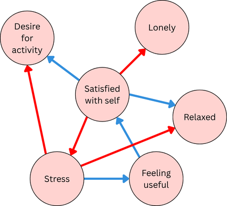
In this project, we specifically look at how aspects like self-esteem and positive emotions influence one another, from a network perspective. To illustrate, look at the image here. In this small and simple network, if a person feels satisfied with themselves at one point during the day, they will feel less lonely and less stressed, and more desire to do an activity and more relaxed at the next point that day. In this network, we can identify ‘satisfied with self’ as a central aspect, which can help us determine what kind of support a person needs for optimal well-being. We have collected rich datasets to test how such factors interact with one another from moment to moment (Bosma, Constantin, et al., 2026), and extracted many relationships from previous literature to build up a big and complex computational model of students’ well-being dynamics (Bosma, Jabeen, et al., 2026; Jabeen et al., 2025).
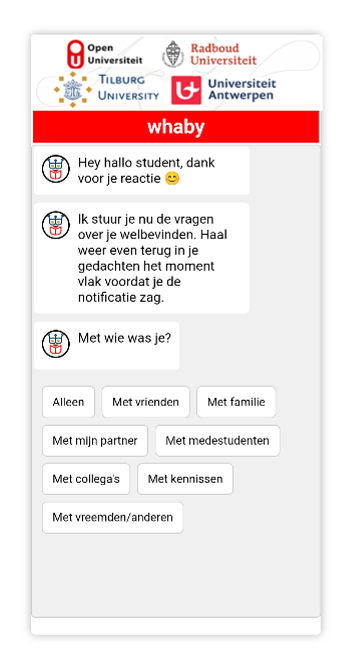
Our chatbot, which we have called ‘Whaby’, can use this information, in combination with data extracted from conversations with students, to predict how the student will respond to certain messages (De Bruijn et al., 2025). For example, if a student indicates they are feeling stressed, and the computational model predicts that physical activity can help reduce stress, Whaby will give this student the advice to go for a short walk.
An important characteristic of Whaby’s computational architecture is the separation between message selection and message generation. Unlike generative AI chatbots, which dynamically generate responses using large language models, Whaby operates through a controlled set of predefined conversational messages and decision rules. The conversational content is developed and validated in advance by the research team in collaboration with well-educated and established student counsellors as well as clinical psychologists, while the computational system determines when and under which conditions specific messages should be delivered. This architecture provides greater control over the chatbot’s communication, ensuring consistency with the theoretical foundations, empirical evidence, and intended objectives of the intervention. It also improves the transparency and interpretability of the system because individual recommendations can be traced back to specific input variables, decision rules, and underlying research findings.
From a computational perspective, Whaby integrates conversational AI techniques with a research-informed, rule-based decision framework to interpret students’ inputs and deliver personalized behavioral recommendations. By analyzing conversational patterns, emotional states, and user responses, the system provides context-sensitive support. Continuous evaluation of user interactions enables refinement of decision rules and potential predictive models, ensuring adaptability, interpretability, consistency, and researcher control without relying on generative AI.
Together with students, student counsellors, and researchers, we have studied whether Whaby could engage students in reporting their well-being multiple times a day, and concluded that some features, such as an artificial response delay, are simply disliked. Their preferences and needs regarding Whaby’s features are also personal, and in another study, we found that these depend on their willingness to disclose sensitive information to chatbots. Aligned with previous research, students are used to generative AI chatbots and therefore have high expectations of what Whaby could do (Bartali, Croes, Antheunis, et al., 2026).

Similarly, student counsellors expressed some hesitation about using chatbots to support students’ mental health and well-being, particularly regarding their ability to address complex emotional needs and how they could be effectively integrated into existing counselling services. Nevertheless, they recognized the potential of Whaby as a complementary tool within a blended therapy approach, where digital interventions support rather than replace human counselling (Bartali, Croes, Bosse, et al., 2026). In the future, we aim to collaborate more with stakeholders to improve Whaby and the well-being of students.
If you’d like to know more about the What’s BOThering You? project, you can find us on LinkedIn (https://tinyurl.com/4k7p3cpu) and visit our website (https://tinyurl.com/5fb85wf9).
References
Authors

Janne Bosma is a PhD candidate at the Open Universiteit, studying the daily mental well-being of students in higher education using a dynamic network approach.

Dr. Fakhra Jabeen, Open Universiteit, the Netherlands