
2020 EDUCAUSE Horizon Report | Teaching and Learning Edition
For sixteen years, EDUCAUSE’s Horizon Report has tried to provide foresights of educational technology in higher education, based on the discussions in a panel of experts.
Predicting the future is very difficult no matter in what field… the great
inventor Edison still gets quoted about how films would replace all teachers
within years to come, that was early 20th century. The Horizon
Report was no exception in its inaccuracy to make technology forecasts in the field
of educational technology and was therefore susceptible to criticism from the
community. From this year onwards, the report focuses less on prediction and looked
closer to potential and expected impact of those emerging technologies
and practices on the future of higher
teaching and learning. The
following items rose to the top of its list of
technologies and practices: adaptive learning; AI/machine learning; analytics; design
in pedagogy; Open
Educational Resources and
finally eXtented Reality. In the present report, the expert panels
reflect on the institutional
impact the technologies and practices would likely have along the following dimensions: equity
and inclusion, learning outcomes, risks, faculty receptiveness, and cost.
In its
chapter on eXtended Reality (AR, VR, MR, haptic) the report briefly describes
how higher education institutions are experimenting actively with XR technologies
in the curriculum, despite the relatively high cost of equipment and the amount
of effort it takes to create content. The report concludes that still the potential
for XR as a learning vehicle is high. The report refers to some European examples:
in the University of Leeds in health care and projects at Leiden University where
they are using 360-degree video for immersive interactive VR experiences in
emergency training for medical students and an AR application called
AugMedicine for anatomy studies in 3D. Interesting are the conclusions of the
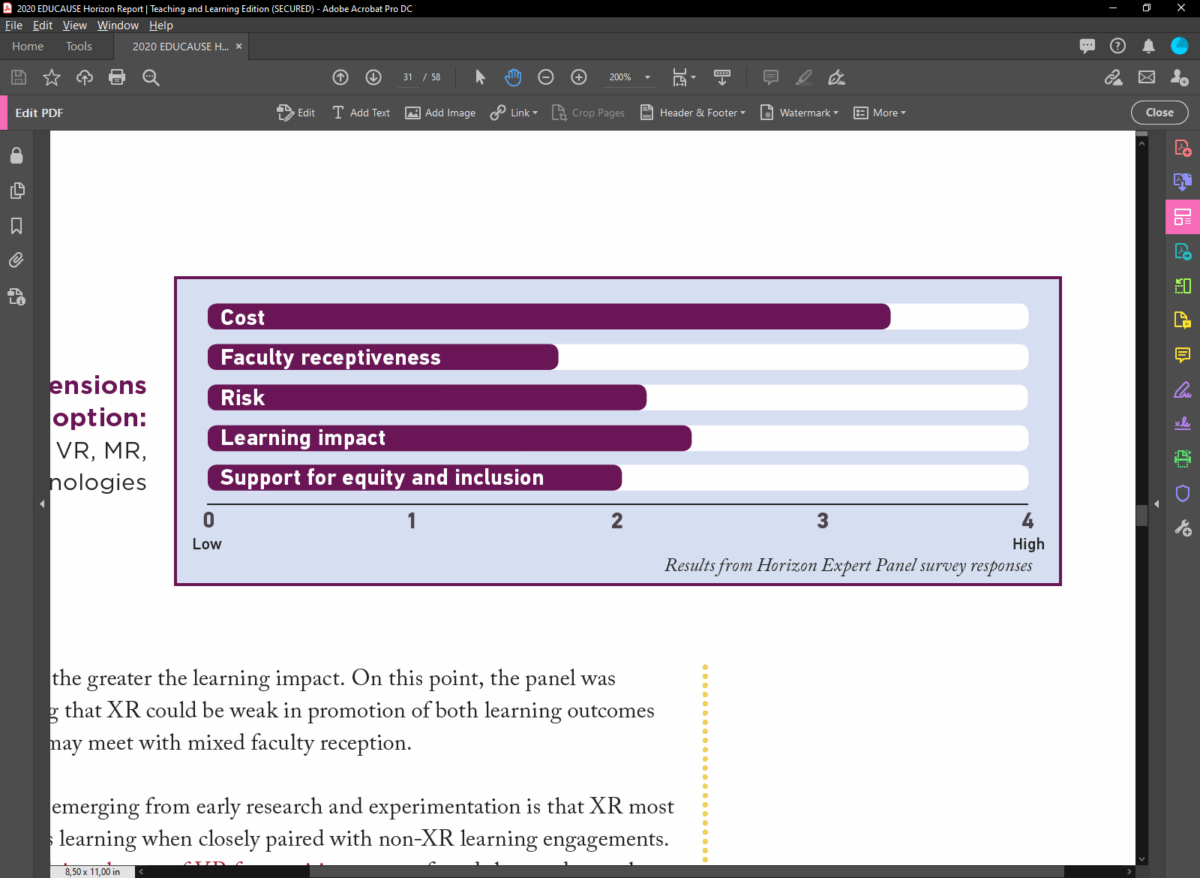
panel with regard to the five dimensions of impact : compared to the other technology
trends the Educause panel considers the XR technology the most costly while the
learning impact scores lowest.