
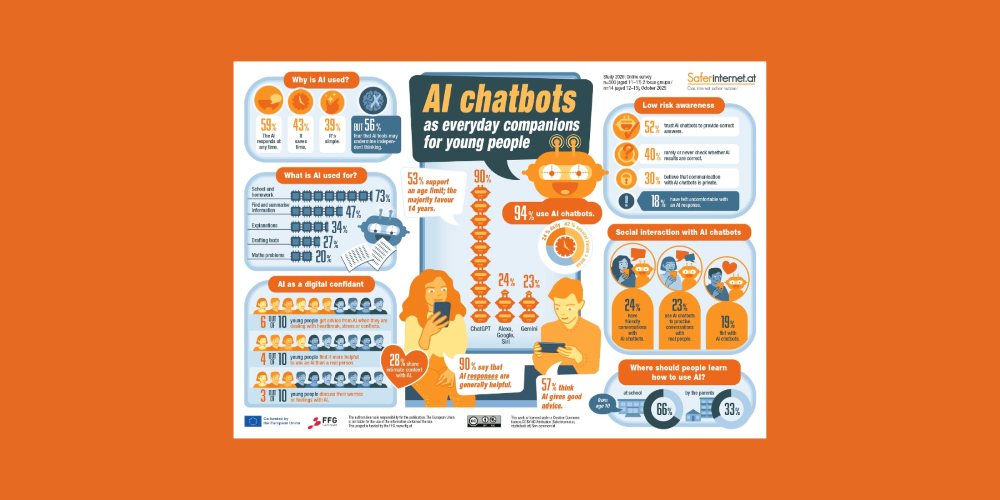
by Saferinternet.at, Austria.
Four in ten young people in Austria say they often find it more helpful to ask an AI than to ask a human being. One in four finds it easier to talk to a chatbot about personal matters than to talk to other people. These findings show that AI chatbots are no longer just tools for schoolwork but are increasingly becoming part of young people’s personal and everyday lives.
In October and November 2025, 500 young people aged 11 to 17 took part in a representative survey about their use of AI chatbots. Two focus groups with 14 young people aged 12 to 15 provided additional qualitative insights.
AI chatbots are part of everyday life
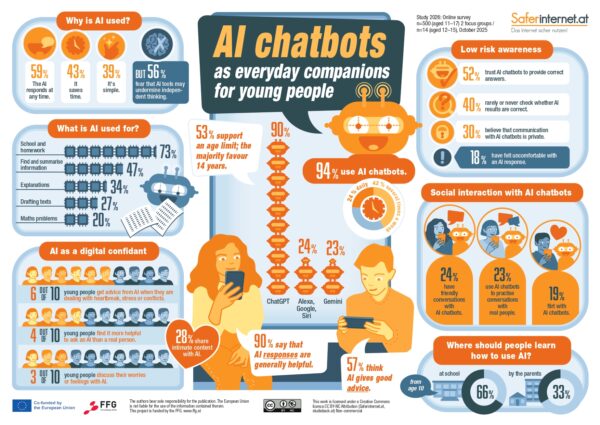
94 percent of young people surveyed use them. ChatGPT is by far the most popular, with 90 percent of respondents using it, followed by Google’s Gemini (23%) and Microsoft Copilot (11%). Almost a quarter (24%) use ChatGPT daily.
73 percent use AI tools for school and homework. Other common uses include searching for and summarising information (47%) and getting explanations (34%). Female and older respondents use AI more often across all areas.
Outside of the classroom, 55 percent turn to AI frequently or occasionally for information and advice, for instance on hobbies, health or relationships. 31 percent use it to talk about worries or problems, and 26 percent to relieve stress. The most frequently cited reason is availability: chatbots are accessible at any time (59%).
From tool to confidence
24 percent engage in friend-like conversations with AI chatbots at least occasionally, while 19 percent use them for romantic conversations. Around three in ten think that AI can be a kind of friend, and 28 percent think that it can offer comfort. Chatbots’ agreeable, affirming style plays an important role here, making them appear empathetic and conveying an apparent understanding.
Young people are aware of the downsides. One focus group participant said that confiding in AI from an early age might make it more difficult to communicate with a real adult later on.
AI can also support human contact. 23 percent at least sometimes use it to prepare for or practise conversations, such as difficult talks with teachers, parents or friends.
While a majority of young people (57%) believe that AI chatbots often provide good advice, their experiences are not always positive: 18 percent have already felt uncomfortable because of an AI response. Participants described advice that felt manipulative, or answers that amplified negative feelings instead of relieving them. “Rat auf Draht”, a helpline for children and young people, stresses that chatbot-based support may serve as a temporary stopgap for personal or mental health problems but quickly reaches its limits and cannot replace qualified counselling. The helpline also reports repeatedly encountering false information about counselling services in chatbot responses.
Trust is high, checking is low
While 52 percent trust ChatGPT and similar tools to provide correct information, 40 percent rarely or never verify their answers. 56 percent worry that AI could weaken their ability to think for themselves. One participant noted that you somehow get lazy when you can ask everything.
Data privacy is another concern: 28 percent believe their inputs are confidential and cannot be accessed or used by anyone else. The same proportion share intimate information with AI chatbots.
Overall, however, attitudes are positive: 55 percent see AI as an opportunity for themselves, while 7 percent see it as a danger.
What young people ask for
53 percent would like to understand better how AI works, yet 48 percent have never had it explained to them in an age-appropriate way. Two thirds (66%) expect support from school and a third (33%) from parents. More than half (53%) support an age limit for AI chatbots, with 14 years emerging as the most popular suggested minimum age.
The findings show that young people want more than just rules. They want solid education that helps them use AI safely, critically and responsibly.
About the study
The study was conducted by the Institut für Jugendkulturforschung und Kulturvermittlung on behalf of the Österreichisches Institut für angewandte Telekommunikation (ÖIAT) and ISPA – Internet Service Providers Austria, as part of the EU initiative Saferinternet.at. In October and November 2025, 500 young people aged 11 to 17 took part in a survey on how they use AI chatbots, representative by age, gender and educational background. In addition, two focus groups were held in youth centres, with a total of 14 young people aged 12 to 15.

Author
Saferinternet.at supports children, young people, parents and teachers in the safe, competent and responsible use of digital media. Together with Stopline (online reporting centre for depictions of sexual abuse involving minors and content endorsing National Socialist ideology) and Rat auf Draht (helpline for children and young people), Saferinternet.at forms the Safer Internet Centre Austria. It is the Austrian partner in the Safer Internet Network of the European Union.