
by Naomi Grewan and Dhashen Moodley, Radio Workshop
Storytelling is something we all relate to, and it’s evolved over the years. From nursery rhymes to novels, to movies and narrative podcasts. We all know what a story is. We grew up hearing them, reading them, watching them. But what does it take to make one? And more than that, what does it take to make a good one?
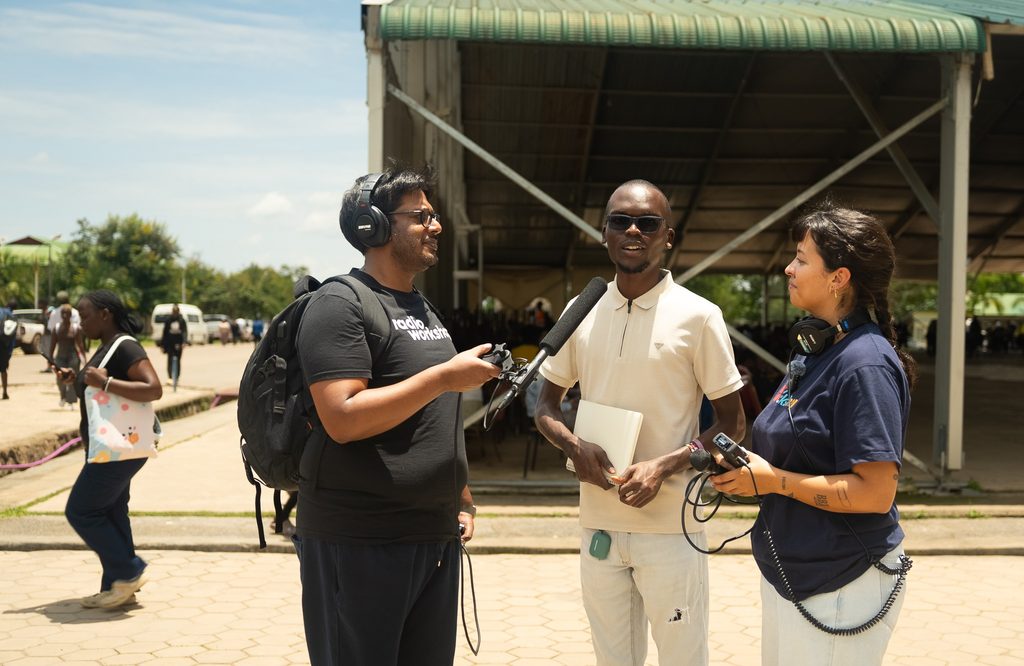
From left to right: Dhashen Moodley, Jobrin Nyirenda and Naomi Grewan at Copperbelt University, Kitwe, Zambia. Photo courtesy of Sunshine Cinema / Kamvalihle Stemela.
Like a lot of journalists, we are drawn to narrative podcasting because it lets us tell in-depth, long-form stories in a world increasingly defined by bite-sized content. But it’s not easy to produce an audio-rich, immersive, character-driven story.
We know. We’ve been there. It took us a year to produce Copper Town – a documentary-style episode that reveals the stories of young Zambians – in the booming mining town of Kitwe – who hope that copper mining will be different this time. We spent months wading through news articles, expert research, and talking with potential characters before we even set foot in the town. What took us the most time was writing and re-writing the story. We’ve learned a lot along the way, and we want to share what we’ve learned with you.
That’s the idea behind Audio Storytelling, Step by Step, a six-part series that pulls back the curtain on Copper Town to reveal the full arc of audio documentary production: finding a story, research, pre-production, interviewing, writing and editing, and distribution. Each 5-minute episode is jam packed with all the skills you need to start telling audio stories. We want to show you how we do it, so you can do it too.
In episode one, we break down the five key elements of a great narrative story.
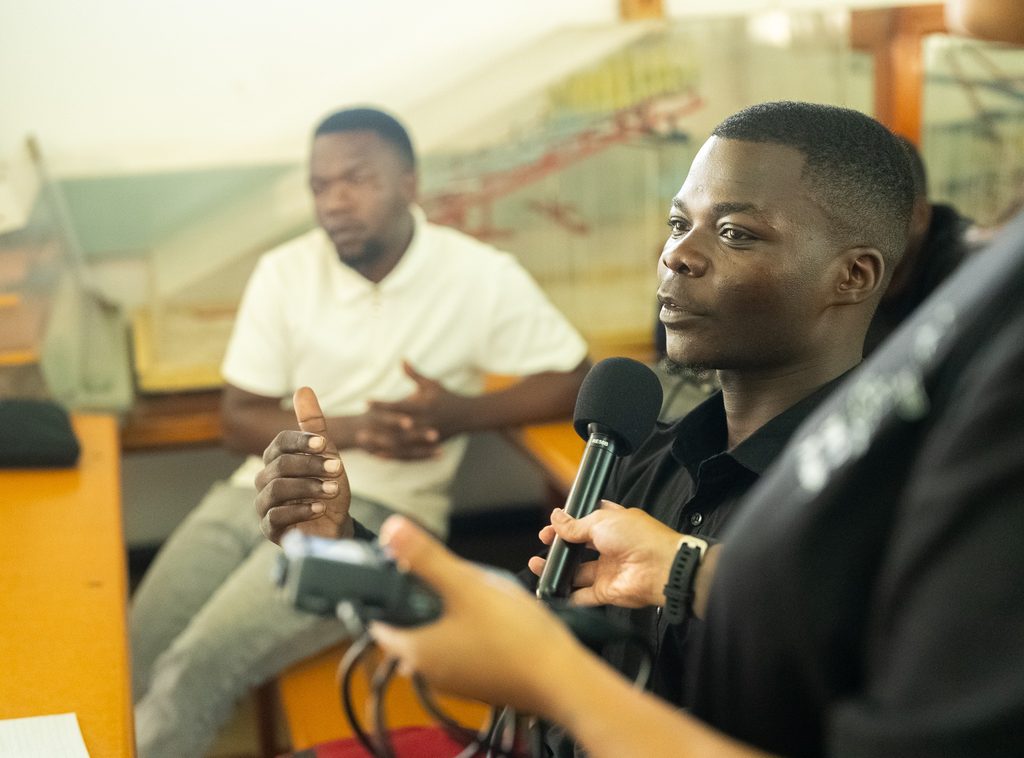
David Mulenga being interviewed by Naomi Grewan in Kitwe, Zambia. Photo courtesy of Sunshine Cinema / Kamvalihle Stemela.
The 5 Key Elements of Storytelling
The very first thing you need is a character. Every story has a character. They’re the person your audio documentary will follow and it’s through their story that you’ll explore whatever topic you’re looking into. Most importantly, your character must want something, and should be doing something to get it. In our episode, Copper Town, our character wants to get rich from mining, and so they enroll in an engineering program at university and they’re interning at a mine.
Next up? Tension. This is what’s standing in the way of your character getting what they want. Our character faces multiple obstacles: they’re aware that mining comes with immense health and safety risks to themselves and their community. Historically, countries with the most resources have seldom become rich, but our character thinks it can be different this time. That kind of complexity is what makes a character really compelling.
The next thing on your list is significance. That’s about asking yourself: why does this story matter now and why are you the right person to tell it? In our story, we know that the world is in a race to get their hands on copper because it’s essential in building AI data farms, solar power and electric vehicles.
What you need next is change, because no good story ends in the same place it started. Will our character change along the way? Will we find an answer to the question we set out to answer? That’s what you need to figure out, what’s going to change in my story?
And lastly, your story needs a strong sense of place. Sometimes a location, such as Kitwe in our story, is so much a part of the story, that it almost becomes a character. Audio stories are usually grounded in place, it’s what makes an intangible medium feel tangible.
Once you’ve got those five things, you’ve got your start. Now you turn it into a story which takes research, planning and reporting. All things we cover in future episodes of the series.
When we set out to make this series we wanted to make something that felt accessible and demystifies audio documentary making. You’re likely already a journalist, a communicator, a storyteller. It’s time to tell the story you were born to tell.
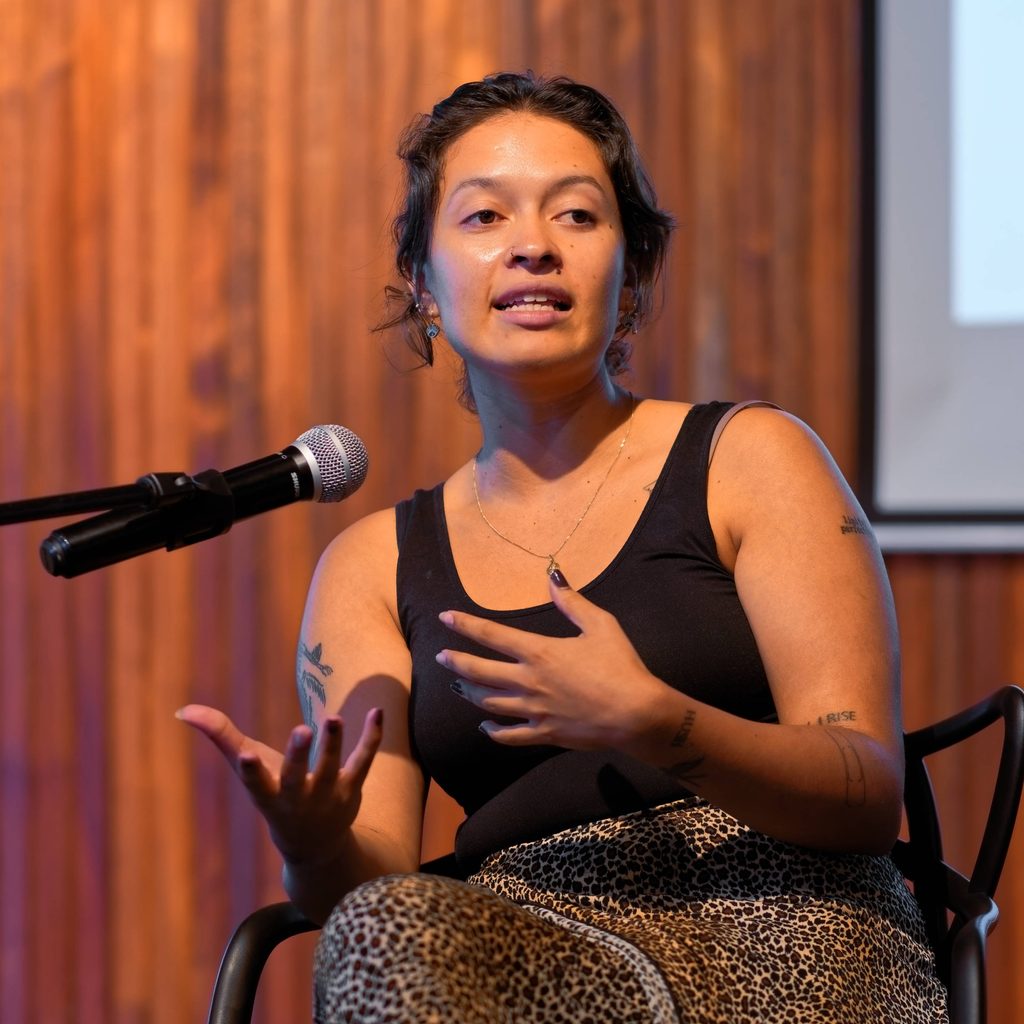
Naomi Grewan is a producer and trainer for the Radio Workshop podcast team and is Communications Manager for the organisation. Naomi has produced stories on climate change, LGBTQI+ rights, mental health and civic participation. She was a 2025 participant in the École Nationale Supérieure Louis-Lumière Sound Documentary Summer Program in Paris, and has since continued producing audio documentaries with the Radio Workshop team in South Africa and facilitating narrative podcast training across the African continent.
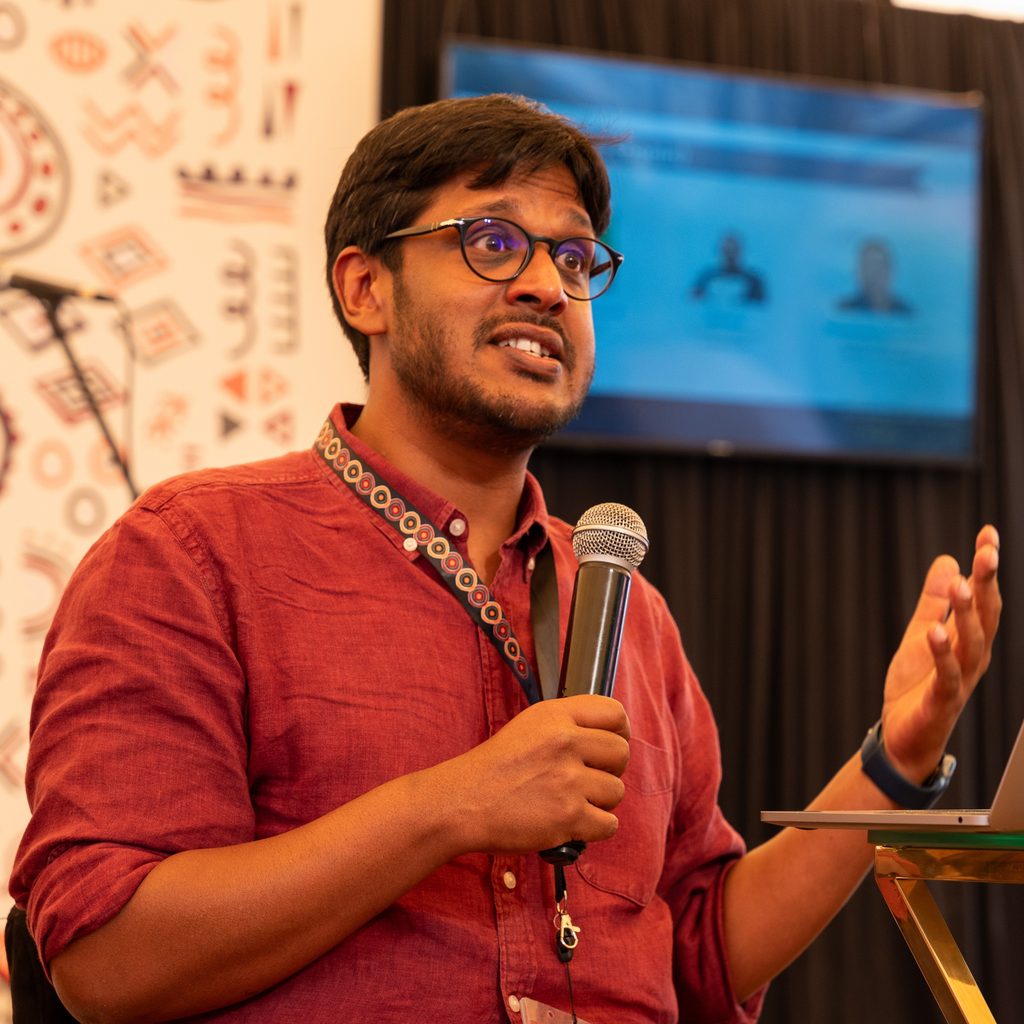
Dhashen Moodley is senior producer for Radio Workshop, a non-profit that produces narrative audio documentaries with young people across Africa while training the next generation of audio storytellers. He started working as a journalist in 2004, and has extensive experience in nearly every newsroom position in radio and tv from reporter to editor and prime-time anchor. He’s been awarded fellowships from the United Nations, Bloomberg, Radio Netherlands, US State Department (IVLP), Earth Journalism Network, and several universities. Previously, Dhashen was a special correspondent to the United Nations in New York. He has contributed to the New York Times, NPR, RadioLab, 99% Invisible, BBC, Foreign Policy, Audible, Channel 4 News UK, Voice of America, Vanity Fair, Vice and Dateline.