by Lana Scott, MIT Open Learning, US.
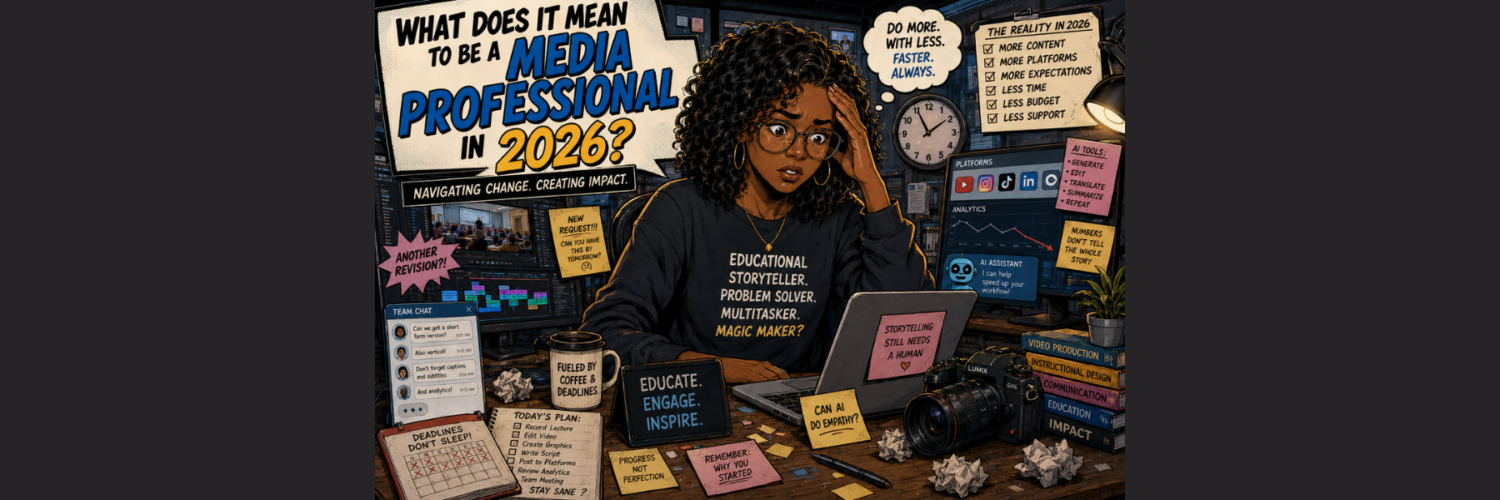
If you’ve worked in educational media recently, you’ve probably felt it. Walk into almost any university media office today and you’ll hear the same conversations. “Can AI do this?” “Can we produce more with fewer people?” “Does everyone need to become a jack-of-all-trades?”
The deadlines are getting shorter. Content requests keep multiplying. AI tools seem to launch every week. And somehow, everyone expects more video, more platforms, and more engagement, often with fewer resources.
In my session, The New Media Professional in 2026: Navigating AI, Organizational Change and Creative Complexity, at the 2026 Media & Learning Conference in Brussels, I explored a question many media professionals are quietly asking:
What is our role now, and what is our value?
Artificial intelligence has arrived in media production with remarkable speed. It can draft scripts, generate captions, remove background noise, create graphics, organize footage, and assemble rough edits before you’ve finished your morning coffee.
Rather than framing AI as the villain, I offered a more balanced perspective. AI can automate repetitive tasks, accelerate editing, improve accessibility through captioning, and help creators prototype ideas more quickly. Used thoughtfully, these tools free professionals to spend more time exercising creativity, judgment, and strategic thinking. AI may change how media gets made, but professionals still determine why and how it should be made
Four Tensions Defining the Future
Rather than viewing AI as either hero or villain, today’s media landscape is better understood as a series of competing forces that professionals must navigate.
The first is quantity versus quality. Institutions want more content than ever before, delivered faster and across more platforms. Audiences, however, still expect polished, engaging productions.
The second is professional versus non-professional production. Sophisticated creative tools are now available to nearly everyone, dramatically lowering technical barriers. Yet accessibility doesn’t replace experience. Knowing which story to tell, how to tell it, and why creative decisions matter remains distinctly human.
The third tension is speed versus craft. Rapid turnaround has become the norm, but meaningful storytelling still requires planning, collaboration, revision, and careful execution.
Finally, there is specialization versus generalization. Can everyone simply pitch in and perform every role, or does that expectation overlook the expertise that makes professional media production successful?
A Real-World Case Study: When Teams Merge
To explore this question, I shared my experience at MIT Open Learning, where multiple specialized video production teams are being consolidated into a unified media group, a trend reflected across higher education. On paper, the goals make sense: increase efficiency, improve flexibility, and maximize limited resources.
Reality, however, is more complicated.
Editors, producers, cinematographers, motion graphics artists, and instructional storytellers each contribute expertise developed over years of practice. Treating these roles as interchangeable may simplify organizational charts, but it doesn’t simplify the work itself.
I offered this comparison. We wouldn’t ask a cardiologist to perform general surgery simply because “they’re both doctors.” The same logic applies to media professionals. Different specialties exist for a reason. Specialization isn’t a luxury reserved for ideal circumstances. It’s what enables quality, consistency, and innovation.
When expertise is flattened in the name of efficiency, institutions may gain flexibility on paper while risking lower production standards, professional burnout, and the gradual erosion of institutional knowledge.
Designing for the Future
AI is already transforming media production, and I see enormous opportunity in embracing it. Automation can eliminate repetitive tasks, accelerate production, and expand creative capacity without sacrificing professional judgment.
Success, however, depends on building organizations that recognize both technological advancement and human expertise.
That means defining roles more clearly instead of blurring them, mapping team skills strategically rather than assuming universal interchangeability, and aligning institutional expectations with the actual time, resources, and creative capacity available.
Technology will continue evolving at breathtaking speed, but sustainable media organizations will still depend on people who understand storytelling, audience engagement, visual communication, and ethical decision-making.
The Big Takeaway
The future of media work isn’t really about AI. It’s about identity.
As educational institutions navigate rapid technological change, one thing seems increasingly clear. The media professional of 2026 won’t be defined by the software they use, but by the judgment, creativity, and expertise they bring to every project.
The cameras may change. Workflows will certainly evolve. But great storytelling, and the professionals behind it, remain very much in focus.
The media professional isn’t being replaced.
We’re being redefined.
Lana Scott, MIT Open Learning, US