
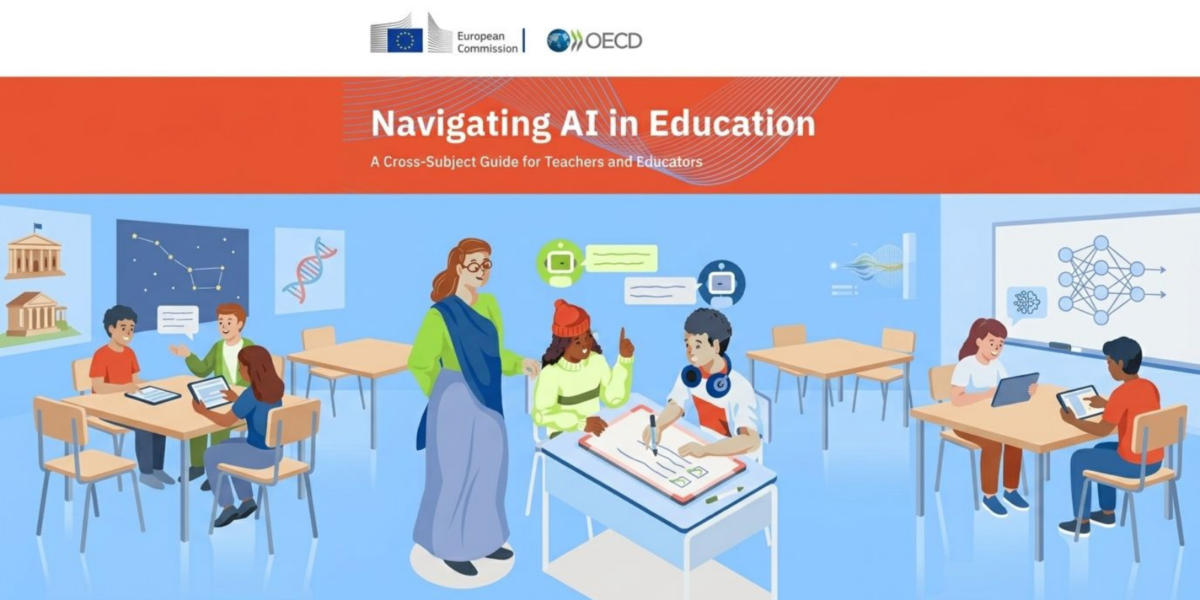
The OECD has published a new 20-page companion guide to its AI Literacy (AILit) Framework, aimed at helping teachers integrate AI literacy into their existing curricula rather than treating it as a standalone subject.
Titled Navigating AI in Education — a Cross-Subject Guide for Teachers and Educators, the guide’s central premise is that AI literacy doesn’t require new class time or a dedicated course. Instead, it can be woven directly into subjects teachers already teach.
The guide covers six subject areas (Language Arts, Humanities and Social Studies, Mathematics, Science, Arts and Creative Disciplines and Computer Science), each paired with “Learning Connections”, classroom examples mapped to specific AILit Framework competencies. In Language Arts, for example, students read a complex text independently, generate an AI-produced summary, and compare it against their own notes, evaluating where the AI’s output aligns or diverges, and deciding whether to accept, revise, or reject it. This exercise is tied to the competency “Engage with AI 3: Evaluate whether AI outputs should be accepted, revised or rejected.”
Each subject section in this guide concludes with a set of Key Questions designed to support teachers in assessing and deepening learners’ AI literacy. These questions can serve as discussion prompts, formative checks or reflective activities throughout a unit or lesson. They are organised as such:
- In the Moment – observing what the AI actually does
- Reflective Use – examining questions of trust and reliance
- Exploring Further – considering how the underlying systems might be designed differently
The guide positions AI literacy not as a technical add-on, but as a lens for deepening critical thinking already embedded in subject-area learning.