
by Matteo Angeloni, PhD Candidate, University of Tuscia, Italy
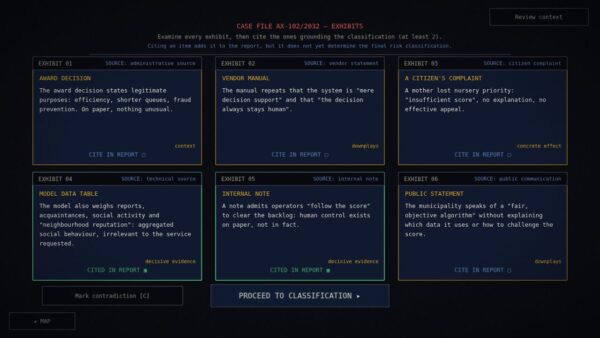
A mother loses priority for a nursery place after an automated system assigns her an ‘insufficient’ score. The notice gives no meaningful explanation. The supplier describes the software as “decision support”, while an internal note suggests staff simply follow its recommendations. Which evidence matters, and who should answer for the outcome?
This is the kind of question I wanted NO AI ACT to raise. As a PhD candidate studying artificial intelligence and decision-making, I was interested in whether AI literacy could move beyond definitions and lectures. Could an investigation encourage learners to weigh conflicting information, consider rights and defend a judgement?
That idea became NO AI ACT, a free, open-source investigative serious game inspired by the European Union’s AI Act.
A fictional Europe without the AI Act
The game takes place in an alternative Europe in 2032, where the AI Act was never adopted. Players step into the role of inspectors investigating the consequences of automated decisions in employment, education, healthcare, public services and surveillance.
There are 14 case files. Each presents a situation involving an AI system, supporting documents and information that may point in different directions. Players examine evidence, identify potential risks and responsibilities, select measures and sign an inspection report.
One investigation concerns an automated system influencing access to a public service. A supplier’s account, technical documentation and the experience of an affected person do not necessarily tell the same story. Players must separate relevant evidence from reassuring claims and explain their judgement.
The setting is fictional, but the regulatory concepts are drawn from the EU AI Act. The game deliberately simplifies legal procedures; it is not legal advice or a comprehensive account of the law.
The answer is not enough
One design challenge has followed the project from the beginning: how can a serious game remain a game rather than become a lesson with clickable buttons?
In NO AI ACT, reaching the right conclusion is only part of the task. Players must cite evidence and explain why a risk classification, an allocation of responsibility or a corrective measure is justified. A plausible conclusion can still be weakly supported.
The city also reacts. After a report is signed, players can see how their choice affects indicators such as fundamental rights, public trust, efficiency and social control. A debrief links the decision back to the reasoning and the relevant regulatory principle.
Feedback from people who tested earlier versions was particularly helpful here. Some found the interface dense and the relationship between the investigative mechanics and the educational purpose unclear. Recent revisions have focused on contextual guidance, clearer evaluation criteria and more legible consequences, rather than adding more theory to the screen.
A possible classroom conversation
I am particularly interested in the game’s potential for teacher education and digital literacy activities. A group could work through the same case, compare which exhibits participants cited, identify claims that lack evidence and discuss why they proposed different measures. The educator could facilitate a conversation about accountability, human oversight and fundamental rights, rather than simply announcing the correct answer.
The game runs directly in a browser, is available in Italian, English and French, and requires no account. Educators can use a single case as a starting point for a facilitated discussion without having to complete the entire game.
These are design characteristics, not proof that learning has occurred. The educational effectiveness of NO AI ACT has not yet been formally evaluated. Structured playtests and piloting with educators are needed to identify where learners struggle and whether the experience supports its intended objectives.
An independent experiment, open to feedback
I developed NO AI ACT independently, using generative AI to support coding, testing and iteration. It has helped me prototype a project that would have been harder to build alone, while keeping editorial decisions and responsibility in human hands. AI tools also supported the preparation and language editing of this article; I reviewed the final text and remain responsible for it.
I hope NO AI ACT can become a useful starting point for discussing automated decisions. I would particularly welcome educators and trainers interested in testing it and sharing structured feedback on clarity, engagement and how players justify their choices.
Perhaps the most important question is not simply whether a player’s decision was correct, but what evidence justifies it, and who is responsible for its consequences.
🔗 Play NO AI ACT in English: https://www.no-ai-act.eu/play/?lang=en

Author
Matteo Angeloni is a PhD candidate at the University of Tuscia, Italy, researching the impact of artificial intelligence on learning, decision-making and organisational change. His background combines public affairs, digital communication and technology. He developed NO AI ACT, a free, independent and open-source investigative serious game inspired by the EU AI Act. His work explores how interactive experiences can encourage critical thinking and reflection on AI governance.