by Jacqui Edwards, University of Amsterdam, the Netherlands.
When generative AI first hit our lecture halls, the questions from colleagues were strikingly similar:
“Should I ban it in my essay course?”
“Do I need to redesign my entire course now?”
“What does ‘responsible’ even mean here?”
It became clear we didn’t just need tips and tools. We needed a structured way for teachers to work on their own AI dilemmas in their own courses, while staying close to sound educational practice. That is how our BKO+ Track AI in Education started.
What the BKO+ track is
At the University of Amsterdam, a BKO+ track is a cohort‑based professional development trajectory that builds on the regular BKO qualification. The AI in Education track runs across several months and combines shared sessions with work in participants’ own courses.
Lecturers who join the track:
- Meet regularly to discuss AI‑related dilemmas from their teaching
- Work with educational literature and practical examples linked to assessment, feedback, metacognition, self‑regulated learning, and critical thinking
- Take part in AI Teaching Labs, where small groups design, test, and debrief interventions in their own courses
- Complete a final assessment in which they report on a concrete intervention they implemented
The focus is on the teacher’s own course. Throughout the track, participants analyse how AI affects their specific context, design AI‑resilient or AI‑enhanced learning activities, and develop a personal, evidence‑informed approach to “responsible AI use” in higher education.
In the final assessment, each participant gives a live presentation, supported by a brief written reflection, in which they present their AI‑related dilemma, explain the intervention they designed, and show how student feedback and other evidence influenced their choices. Interventions need not be perfect; what matters is that the reasoning is explicit and grounded in literature and their actual teaching practice.
How we engaged colleagues
From the start we knew that “come to my AI course, I’ll tell you what to do” was the wrong message. Colleagues already had strong opinions about AI, the field develops quickly, and the impact of AI on teaching differs between disciplines and assessment formats.
We therefore built the track around three simple principles:
- Work with your own dilemmas, not ours. Everything you do in the track should connect directly to your own course and students.
- Treat doubt and disagreement as normal. People could be skeptical, enthusiastic, or conflicted; all of that was welcome.
- Base decisions on existing pedagogy, not just on shiny tools. Wherever possible, we linked AI choices back to established educational literature.
In practice, teachers experimented in their own courses in small AI Teaching Lab groups. Each group chose a focus such as metacognition, self‑regulated learning, academic writing, or critical thinking, and designed an intervention to run while the course was ongoing.
Examples included an in‑class activity where students compared AI‑generated summaries with original scholarly articles, and duo essay writing done in class to reduce “copy‑paste and submit” behaviour and make reasoning more visible. These interventions were deliberately small scale: the aim was not to “fix” everything in one go, but to test something real, look closely at what happened, and share the results with colleagues.
What colleagues did with it
Several participants used the track to start larger discussions in their programmes.
One colleague worked with her team to write an “AI manifesto” for their programme and turned it into a lecture for about 180 first‑year students. She was nervous, but found that simply naming the tensions around AI was already helpful. She also discovered the limits of a big lecture setting for this topic and later shifted to smaller groups for more honest discussion.
Another participant used the track to design a programme‑wide AI literacy trajectory for a BA. She started by mapping current practices with students and staff, and ended with a plan showing where AI‑related skills and attitudes are addressed across the curriculum and how that might grow over time.
Taken together, these examples show two levels at which the track operates: the small‑scale course experiment and the longer‑term programme discussion.
What I learned from the first cohort
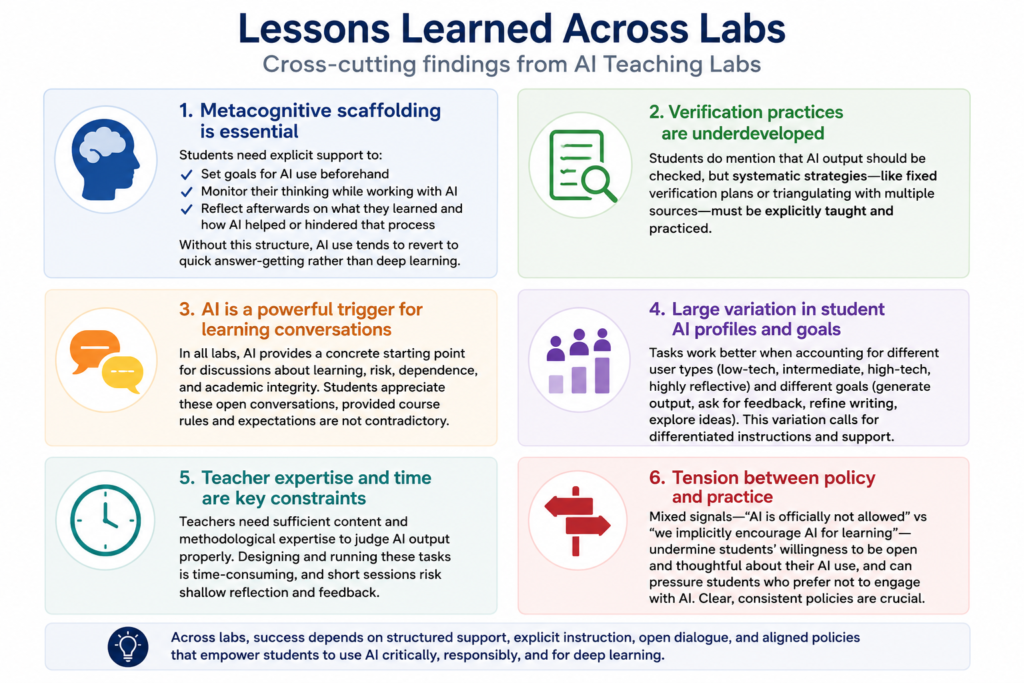
Looking back on this first cohort, a few things stand out for me.
1. Real problems are a better starting point than generic training.
Because everyone worked on a real issue from their own teaching, the discussions stayed concrete, and lines of enquiry were more relevant: plagiarism detectors that don’t really help, supervisors unsure how to respond to AI‑assisted drafts, students who rely heavily on tools but can’t explain their own work.
2. Small changes are often enough to learn a lot.
Some of the most useful learning came from modest tweaks: a single in‑class reflection task or a rephrased assignment. These are changes people can actually make during a busy semester, and are an important first step.
3. Not solving the problem can still be progress.
One colleague ended the track more aware of the limits of their assessment setup and still unsure how to fully address AI‑related issues; another found it liberating to know in advance that not “solving” the entire problem was acceptable. It allowed people to rule out dead ends, see more clearly what was achievable and start there.
4. AI highlights the real problems; it doesn’t cause them all.
The track showed that many issues are not caused by AI, but exposed by it. When colleagues examined their AI‑related dilemmas, they often found the real problem in existing assessment formats, expectations about independent work, or underprepared or disengaged students. Throwing unrelated AI solutions at the problem is a bit like blaming the fire alarm for the smoke: you can switch off the alarm, but the fire is still there. This let us redirect towards more relevant pathways.
5. Involving students is not optional.
Across projects, the most insightful moments came when students were invited into the conversation rather than treated as potential rule breakers. Asking them how they actually use AI, what they find helpful or worrying, and how they see its impact on their learning gave teachers a more realistic picture of what was happening. One student comment in particular stayed with us: “Although it might be a bit uncomfortable, it’s very useful to have an open conversation about AI use, because we all use it but we never talk about it.”
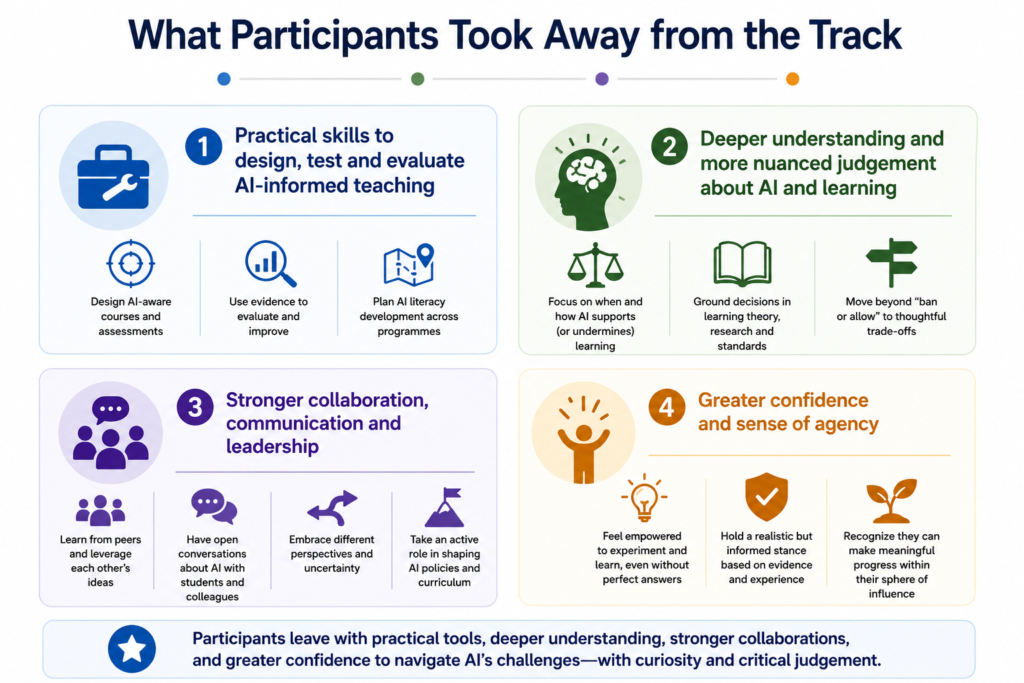
Teachers described the track as eye opening and practically useful, especially valuing concrete experiments in their own courses and cross‑disciplinary discussions about AI. Several started out ambivalent or sceptical, but became more confident in designing small, realistic interventions. Others have joined program level committees and presented their work at department meetings. In evaluations, respondents rated the track 4 out of 5 overall and scored the usefulness of the knowledge, skills, materials, and guidance mostly 4s and 5s, indicating they found it valuable and relevant to their practice.
As we prepare to start our second BKO+ cohort in November, you will not find a panel of AI specialists handing out the “right” answers. Rather, lecturers from the humanities, sciences, and social sciences, plus curriculum designers, comparing notes, asking each other hard questions, and trying out concrete steps in their own courses. For me, that is what this BKO+ track has uncovered: professional development around AI is less about mastering a toolset and building something cool, and more about steadily improving our judgement, together, within the real constraints of our classrooms and programmes.
Author

Jacqui Edwards is an educational advisor and trainer at TLC Central, where she works across the GenAI Living Lab and Teacher Professionalisation teams. As the didactic link between the two, she translates developments in generative AI into practical, evidence-informed approaches to teaching, assessment and teacher professionalisation. Her work focuses on educational design both with and around AI, helping lecturers make informed choices that account for the changing ways in which students learn and use technology. Jacqui also designed and developed the BKO+ Track on AI in Education, in which lecturers investigate a challenge from their own teaching practice and design, test and evaluate an intervention in response.
The banner image is generated by AI.