

by Lucia Mesquita, Lusófona University, Portugal.
As universities consider how best to integrate artificial intelligence into higher education, one message is becoming increasingly clear: the challenge extends far beyond adopting new technologies. The more important question is how institutions, teachers and students can make sense of AI and use it in ways that support meaningful learning, critical thinking and responsible knowledge production.
Many higher education institutions have already introduced guidelines and incorporated AI-related content into programmes ranging from marketing and law to medicine. Yet, while technological adoption is advancing rapidly, the human dimension of AI integration remains comparatively underdeveloped. Questions concerning human agency, critical judgement, teacher preparedness, assessment and institutional responsibility are still not being addressed consistently.
A bit of context
Some answers to this challenge are emerging from research conducted by the AI-LITERATE project in Croatia, Italy, Poland and Portugal. The project’s research team examined how AI is being integrated into higher education through a macro–meso–micro analysis covering national frameworks, institutional policies and course syllabi. This analysis identified several patterns across the four countries, which were subsequently confirmed, challenged and expanded through national roundtables involving members of the higher education community.
Each national team has now produced a report presenting the findings from its roundtable. Taken together, the reports reveal a strong cross-country consensus: the main challenge posed by AI in higher education is not simply technological. Instead, AI is exposing—and frequently intensifying—existing weaknesses in teaching, learning, assessment and institutional preparedness. The findings suggest that meaningful AI integration will depend not only on access to tools, but on universities’ ability to preserve human agency, strengthen critical verification and rethink how knowledge and learning are evaluated.
The national reports
The reports bring together findings from national roundtables conducted in Croatia, Italy, Poland and Portugal. Participants included academics, educators, researchers, policymakers and professionals working in areas such as digital education, communication, cybersecurity and artificial intelligence.
Although each national discussion reflected its particular educational and institutional context, a comparative reading identified several points of agreement. Across all four countries, participants questioned approaches focused primarily on prohibiting AI or detecting its use. They instead called for pedagogical and institutional responses that preserve human judgement, strengthen critical verification and make students’ learning processes more visible.
One of the clearest shared findings is that AI should be understood as an accelerator rather than the sole cause of current educational problems. Concerns about declining critical-thinking skills, passive learning, weak source verification and outdated assessment practices existed before the widespread adoption of generative AI. However, these technologies have made such weaknesses more visible and more urgent.
AI literacy was therefore understood as much more than the ability to operate tools or formulate effective prompts. Participants across the four countries emphasised the importance of disciplinary knowledge, source verification, awareness of AI’s limitations and the ability to critically evaluate convincing but potentially inaccurate outputs.
Assessment emerged as another common priority. The national discussions highlighted the limitations of relying exclusively on written assignments or attempting to identify AI-generated work through detection systems. Suggested alternatives included oral examinations, discussions of submitted work, reflective accounts of AI use and greater attention to the reasoning and decisions behind the final product.
The reports also show that responsibility cannot be placed exclusively on individual students and teachers. Responsible AI integration requires clear and adaptable institutional policies, continuous professional development, curricular revision, appropriate infrastructure and opportunities for interdisciplinary collaboration.
Shared findings across the four countries
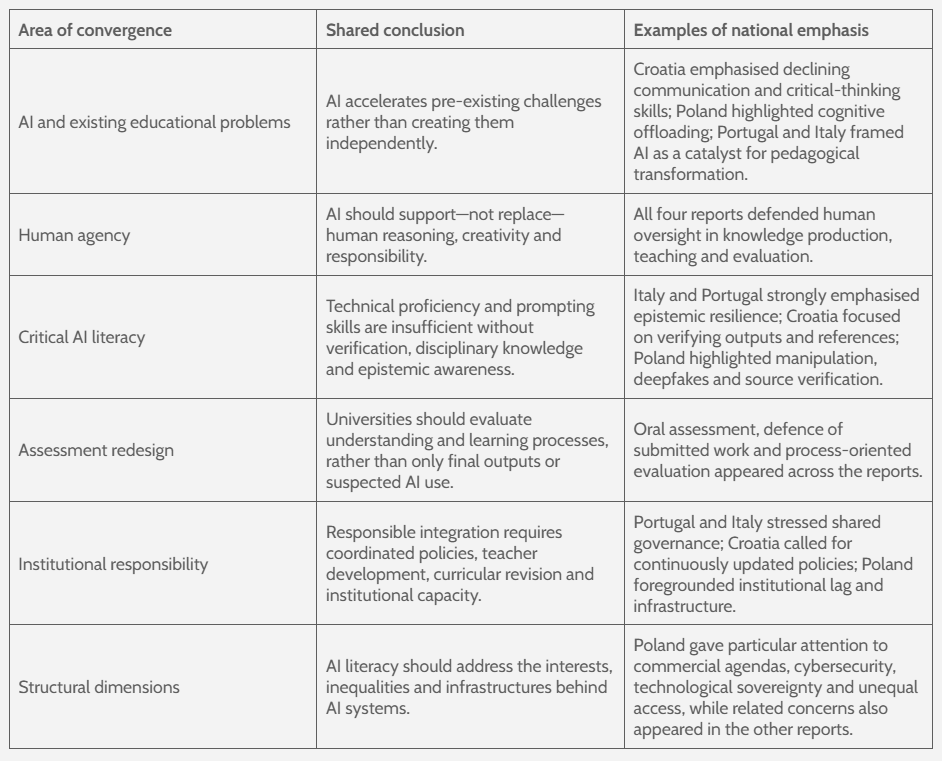
Alongside this broad agreement, each report adds an important dimension to the comparative picture. The Portuguese discussion presents AI as an opportunity to rethink pedagogy and preserve meaningful learning. The Croatian report stresses the foundational importance of communication skills and the need to begin capacity-building before students reach university. The Italian roundtable advances a model of collaborative human–AI learning grounded in experimentation and epistemic resilience. The Polish report expands the debate by foregrounding cognitive offloading, commercial influence, cybersecurity, technological dependency and unequal access to advanced tools.
Towards meaningful AI integration
Taken together, the findings suggest that meaningful AI integration cannot be measured simply by how many tools universities adopt. Its success depends on whether institutions can use AI to strengthen learning, critical judgement and human agency while addressing the ethical, economic and infrastructural conditions surrounding these technologies.
The four national reports will inform the next stages of AI-LITERATE, including the development of recommendations to support a more critical, responsible and educationally meaningful approach to AI in European higher education.
Read the full reports
All four national roundtable reports,from Italy (University of Modena and Reggio Emilia), Portugal (Lusófona University), Poland (Adam Mickiewicz University, Poznań), and Croatia (Algebra Bernays University), are now published and freely available on the AI Literate project website. Readers interested in the full transcrbipts of participant discussions, the detailed thematic analyses, and each country’s specific policy recommendations are encouraged to explore the complete reports at National Round Table Reports.
Declaration of Generative AI use
Generative AI tools were used during the drafting and editing process of this news piece to support text organisation, language refinement, and stylistic revision. The author reviewed, edited, and verified all content, and factual information prior to publication and retains full responsibility for the final version.

Lucia Mesquita, Lusófona University, Portugal.
Researcher at AI-Literate Project

Funded by the European Union. Views and opinions expressed are however those of the author(s) only and do not necessarily reflect those of the European Union or the European Education and Culture Executive Agency (EACEA). Neither the European Union nor EACEA can be held responsible for them.
Project Number: 2025-1-PL01-KA220-HED-000357941