by Janne Länsitie, EDIT Challenge Producer.
My journey with video pedagogy began in the 80s and 90s with silly home videos of pretty much anything. By my teens, I was exploring cult horror movies (illegal in Finland at the time) creating edits of the scariest jump-scares for school presentations. This work took place in a local education department equipment room, where the heavy smell of cigarette smoke clung to the walls and the air. Years later, during my university studies, digital editing remained a test of patience; we would trigger a render and head out for coffee just to pass the time.
The mid-90s introduced us to video conferencing, which we as communication science students experienced as an everyday practice—though nobody knew then that it would become a major part of many educator’s workload for decades to come. At that time, the university’s TV channel production was not yet digital, yet video was already becoming an essential tool for communication studies. In drama education, we experimented with live video feeds and security cameras to create illusions of distant worlds. A pivotal workshop in the early 2000s combined improvisational theater with video production, effectively liberating the storytelling from the pre-production and heavy constraints of the editing process. Video was transforming from a specialist’s craft into a versatile tool for everyone in education.
The mobile revolution and the birth of EDIT Challenge
By the early 2000s, while the use of video was a common practice and tools were increasingly available, it still remained a tool for the fairly few teachers. Technical hurdles—tangled cables, dead batteries, and agonizingly slow production—created a high barrier to entry. Finding the people who wanted to be in front of the camera, or someone who took care of the editing process, was a challenge. The arrival of mobile devices and high-speed internet finally allowed students and teachers to embrace video as a natural part of the learning process. Many younger people were actually quite comfortable both in front of and behind the camera. Teachers, perhaps less so. The era of lecture captures and webinar recordings was still to come.
During an Erasmus teacher exchange in 2012, in Linz, Austria, I got to know Christian Kogler. We shared a similar nerd-like interest in cinema and video production. We felt strongly that instead of “educational tourism,” we’d like to create something tangible and sustainable. It started as a simple educational video production course but expanded quickly from two universities into several others. My colleague Blair Stevenson suggested a “hackathon” style format, where we launched the “Challenge” simultaneously in every country. We aimed at time-limited creativity, guided by shared digital materials and live webinars. After a few test runs, the EDIT Challenge format was officially finalized in 2014.
Lessons from a decade with EDIT
- Technology still needs a human guide. Confidence is often a greater barrier than hardware. Technical friction remains, making guidance and encouragement essential for both teachers and students throughout the production process.
- Entertainment vs. Education. Visually stunning or narratively immersive videos can easily distract from pedagogical goals. We noticed that both the production team and the juries sometimes prioritized entertainment over substance, proving how difficult it is for pure pedagogy to compete with media entertainment standards. While storytelling aids learning, the “show” must not overshadow the “lesson.”
- Human connection is the true content. The most impactful videos capture collaboration, authenticity, and genuine insight. While AI can streamline production, AI content often lacks the human spark that creates a lasting connection with the audience and the team that created the video.
- The price is right. Without any external funding, all the participants of EDIT have provided the time of their teachers and the resources of the university. We have been given time to do this as part of our work, as the instructors are invested in the process, so are the students.
EDIT and Media & Learning
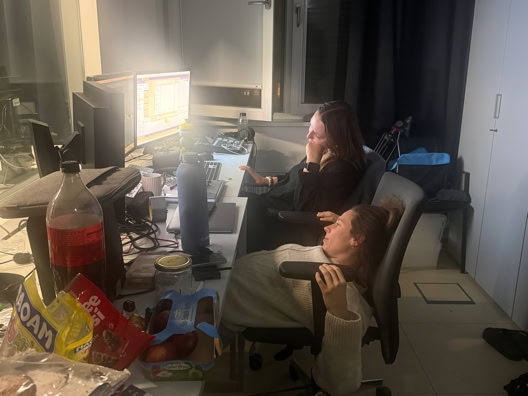
The Media & Learning Association has been a vital companion throughout the entire EDIT journey. As organizers, our physical meetings at M&L conferences have been essential touchpoints for sharing our findings on video pedagogy and hosting hands-on workshops. These conferences have also served as a prestigious stage for few of our winning students, who have had the opportunity to present their educational videos in the M&L conference!
Over the past four years, the EDIT Challenge has expanded into Erasmus+ Blended Intensive Programs (BIP), taking participants to Linz (2023), Rhodes (2024), Mainz (2025), and the latest in Cluj (2026). Shared video production has proven to be an exceptional focus for these blended intensive programs; the EDIT framework provides a solid foundation for participants and a growing international network of like-minded educators.
As we explore the AI frontier with simultaneous excitement and hesitation, I am confident that video pedagogy remains fundamentally about the people creating and watching the video, and the authentic human connection it enables. I look forward to continuing these conversations with you all at the conference next summer!
Editor’s note: Janne will share the lessons learned from the EDIT challenge at our annual Media & Learning Conference, taking place on 17–18 June in Leuven, Belgium.

Janne Länsitie is a Senior Lecturer and eLearning Advisor at the Oulu University of Applied Sciences, School of Professional Teacher Education.