
by Mario PIACENTINI and Luis Francisco VARGAS-MADRIZ, Organisation for Economic Co-operation and Development (OECD).
The Upcoming PISA 2029 MAIL Framework
In a world where internet users regularly encounter false or manipulated information, the urgency for robust Media and Artificial Intelligence (AI) Literacy (MAIL) is clear. The convergence of misinformation, algorithmic personalisation, and the rise of generative AI is quickly transforming civic discourse, education, and cultural participation. Although these technologies undoubtedly offer meaningful opportunities, they also pose risks.
This is why promoting critical, ethical, and responsible engagement with media platforms and AI systems is essential to safeguarding societies against manipulation and bias. “One of the strengths of MAIL is that it captures competences that matter in and for everyday life: from judging credibility of social media posts to reflecting on AI-generated content. That makes the assessment highly relevant for education systems as a marker of effectiveness worldwide,” said Samuel Greiff, Technical University of Munich, and member of the expert group.
Building upon the expertise for global benchmarking of the OECD’s Programme for International Student Assessment (PISA), its forthcoming innovative domain on MAIL charts new territory by not only evaluating knowledge, but also the practical competences essential for navigating today’s ever-changing digital landscape. “Robust empirical evaluations are key to the development of high-quality educational materials and curricula,” said Jon Roozenbeek, University of Cambridge, another member of the expert group. He continued, “the MAIL framework sets forth to not only develop an integrated understanding of digital media and AI literacy, but also pathways to developing comprehensive assessments and continuous quality control.”
Developed collaboratively by the OECD and by these international experts in the fields of education, media, and AI, the work started in the Summer of 2024. Since its inception, the collaboration has been grounded in the shared commitment to empowering individuals to navigate a complex real-life digital world full of complex media-AI messages.
In this regard, the MAIL framework reflects a bold common vision: to nurture citizens who can interpret and engage with digital content thoughtfully, who can participate responsibly in online discourse, and who can not only reflect ethically on the role of technology in society but who can also act responsibly when creating or sharing digital content. “As the information environment becomes increasingly difficult to navigate, there is an acute need to equip the public with skills to think critically, evaluate credibility, and recognize uncertainty,” said Emlen Metz, University of California—Berkeley, from the expert group.
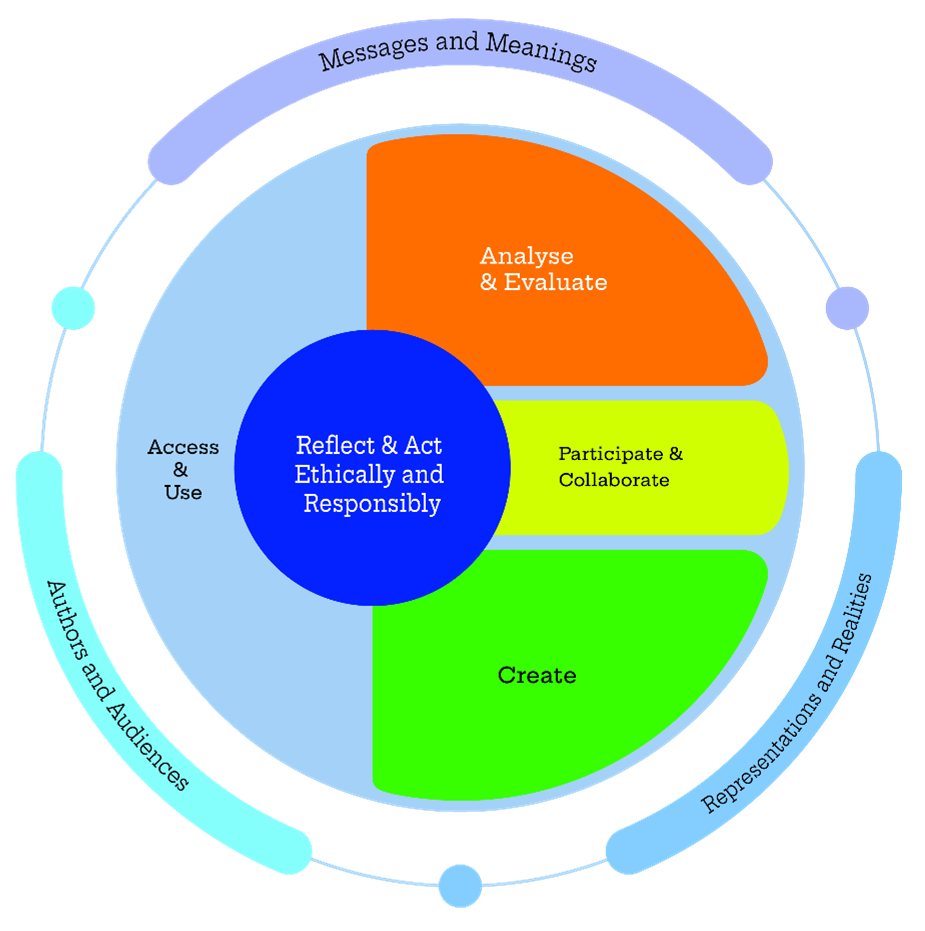
At its core, one of the key conceptual positions of the MAIL framework lies in explicitly integrating media literacy (i.e., encompassing critical understanding, and analysis) with AI literacy (i.e., covering awareness of algorithms, data ethics, and the complexities of machine decision-making and how generative AI contributes to media content). Cathy Adams, University of Alberta, another expert group member, notes, “MAIL is distinctive because it positions AI as integral to young people’s contemporary media environments. As a result, it foregrounds critical judgment, ethical reflection, and human agency in students’ engagement with AI-mediated systems.”
Furthermore, the framework incorporates changing trends in information and technology by focusing on diverse types of media and highlights the diversity of uses by introducing a diversity of contexts and purposes for using media platforms and AI systems. In this regard, the MAIL framework also describes a literacy shaped by cultural diversity and inclusion, in recognition that varying perspectives inform what it means to be digitally literate in today’s world. In the words of another expert group member, “the MAIL framework is the result of an intentional, theory-driven integration that weaves together well-established dimensions of media literacy with emerging dimensions of AI literacy, recognizing that these domains are fundamentally interconnected, and that their synthesis yields something greater than the sum of its parts,” said Panayiota Kendeou, University of Minnesota.
So, sitting at the intersection of digital culture, democracy, and well-being, the MAIL framework embodies a commitment to values that underpin resilient societies. For this reason, the primary goal will be to inform and empower policymakers and educators with robust, evidence-based insights, and to serve as a catalyst for developing more effective educational strategies. In this way, the authors hope that by tailoring international benchmarking to the specific contexts and values of each society, policies can be shaped to draw on global best practices while remaining sensitive to local needs and cultural diversity, and to foster genuine agency among citizens in an increasingly complex media and AI-augmented world.
PISA results offer a powerful foundation for shaping policy and practice across national education systems around the world by delivering robust data on “what works”. The findings from this assessment also have the potential to empower governments, educators, and researchers to craft strategies and curricula that are grounded in evidence. “Around the world, educators across a range of subject areas are coming to appreciate the need to integrate media and information literacy along with fundamental competencies with digital media and AI,” said Renee Hobbs, University of Rhode Island, member of the expert group. Data from the MAIL Assessment can help inform the refinement of teacher training programs, ensuring educators are equipped to foster media and AI literacy in their classrooms.
Looking to the future, both media and AI literacy are indispensable for active participation in democratic societies. These are no longer optional skills, but vital competencies required to navigate and contribute meaningfully to the digital age. As Andreas Schleicher, Director for Education and Skills at the OECD, stated, “Freedom, democracy and the rule of law are not diplomatic ornaments or beautiful words, they are the pillars on which we build our societies. And if education doesn’t protect them with determination, AI could wash away the very foundations of our societies. The best way to secure this is to equip every young person with strong media and AI literacy.” As we step into an era increasingly defined by AI, it is imperative that educators, cultural leaders, and policymakers join forces to nurture citizens who can think critically, question thoughtfully, and create responsibly.
To learn more about this assessment framework, that will be published this coming February, visit the following PISA 2029 Media and Artificial Intelligence Literacy link at the OECD.
Authors
Mario Piacentini, Senior Analyst. Mario leads the work on the PISA assessments of transversal, 21st century skills. He is the lead author of the frameworks for the PISA 2018 assessment of Global Competence and for the PISA 2021 assessment of Creative Thinking. He also authored several PISA analytical reports, including the first report on the well-being of students. Mario joined the OECD in 2009 as a Young Professional. Before moving to the PISA team in April 2015, he worked for the Public Governance Directorate and the Statistics Directorate of the OECD, the University of Geneva and the World Bank. Mario has contributed to several large OECD and inter-agency projects on gender and well-being, and led the definition and development of international indicators on metropolitan areas, inequality, entrepreneurship and trade. He holds a PhD in economics from the University of Geneva. Mario speaks Italian, English, French and is currently learning Spanish.
Luis Francisco Vargas-Madriz, Analyst. Francisco joined the PISA team in August 2022 to support the Research, Development, and Innovation (RDI) Programme, and more recently to support the development and implementation of the PISA 2029 Innovative Domain Assessment. He was born and grew up in Costa Rica, where he completed his bachelor and licentiate degrees in psychology (Universidad de Costa Rica). He then moved to Canada to pursue a master’s degree in educational technology (University of Alberta), followed by a doctorate in human development (McGill University). Before joining the OECD, he worked on a variety of quantitative, qualitative, and mixed-methods research projects in the areas of educational technology, educational psychology, and human development (social-emotional learning) in both secondary (middle, and high school) and tertiary (college, and university) school settings. Fran speaks Spanish, English, and French.