by Cesar Lorino and Emily O’Connor, The Elves Design Studio.
A brief scope
In the fight against mis- and disinformation, facts alone are rarely enough. As information disorders escalate globally, the polarization of society and the stability of democratic foundations are increasingly at risk. To address this, we must equip citizens with the tools to navigate a world overtaken by manipulated narratives.
Our study, Improving Social Media Information Literacy Among 18–25-Year-Olds in Estonia, examines how user-centered interventions can engage young adults outside formal education. While this demographic is digitally fluent, they remain vulnerable to information attacks due to a specific behavioral blind spot: passivity.
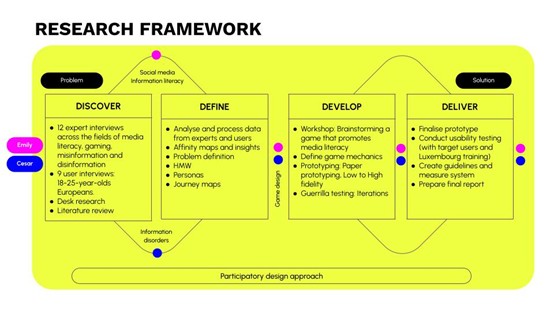
Using the Double Diamond framework, we designed “Fake or Nah”—an intervention that works with social media patterns rather than against them to drive critical engagement.
1. Discover: The Passive Scroller
Our research involved 20 qualitative interviews with experts and target users, alongside a mapping of the media literacy landscape in Estonia and Europe. We discovered that Estonians aged 18–25 do not lack the technical skills to identify false information; they lack the active engagement to do so.
In an overstimulated digital environment, social media is primarily used for relaxation and escapism. This “relaxed mindset” lowers cognitive defenses. When users are in a passive scroll mode, their critical appraisal process becomes dormant, making them highly susceptible to sensationalised content regarding politics, health, and celebrity culture.
2. Define: The Appraisal Dimension
To analyze this behaviour, we utilized the Social Media and Information Literacy (SMIL) framework, which categorises literacy into six dimensions:
- Navigation
- Curation
- Appraisal
- Comprehension
- Creation
- Social Interaction
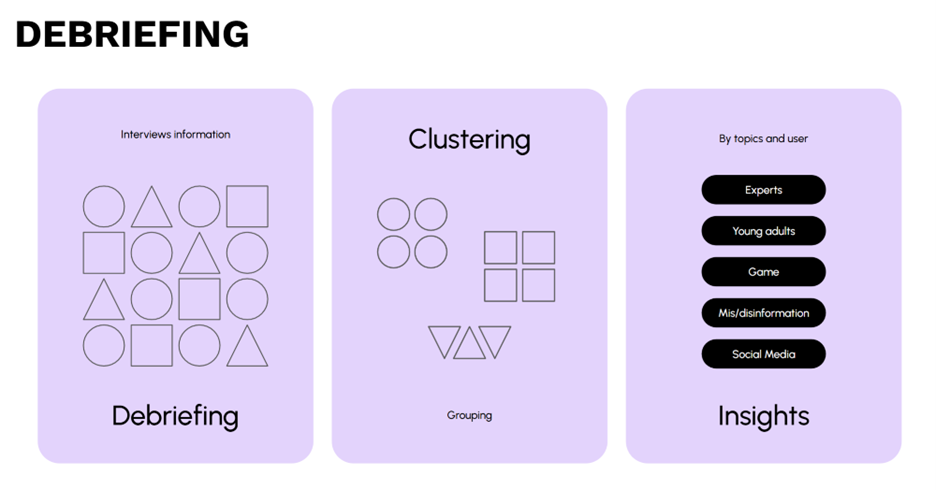
Our analysis revealed that the core challenge is a breakdown in the Appraisal dimension—the ability to evaluate information and understand media intent. To solve this, we reframed our design challenge:
How might we encourage young adults to critically engage with and assess Instagram and TikTok content through play and games?
Problem Statement
Young adults in Estonia often use social media as a form of distraction, engaging in passive scrolling for entertainment. This pursuit of effortless content reduces critical engagement with information and unintentionally contributes to the spread of misinformation.
3. Develop: Co-Designing for Friction
Central to our design process was co-design with both the target group and experts. We conducted collaborative workshops with young adults, media literacy specialists, and game designers to develop an intervention. To address passive behaviour, we applied the Triadic Game Design and MDA (Mechanics, Dynamics, Aesthetics) frameworks to guide the workshops and balance educational value with enjoyment. During these sessions, participants prototyped game concepts informed by insights from the discovery phase, including:
- Mobile-first & Casual: Short core loops (≤ 20 minutes) for on-the-go play.
- Humour-Driven: Using irony and satire to spark conversation.
- Social & Competitive: Multiplayer modes, voting mechanics, and shareable results.
- Aesthetics: A “childhood game” vibe mixed with modern social media simulation.
These sessions explored how game mechanics can simulate real-world social pressure, ensuring the final solution was genuinely user-centred rather than top-down.
4. Deliver: The Game
The result is “Fake or Nah,” a digital card game that simulates a social media feed to disrupt passive scrolling. It creates a safe “sandbox” where players evaluate content, turning hesitation into deliberate critical thinking.
The game features three distinct modes:
This digital card game simulates a social media feed to disrupt young adults’ passive scrolling, creating a safe sandbox where players actively evaluate content on politics, well-being, and celebrity gossip, turning hesitation into deliberate critical thinking.
Game Modes
- Mode 1: Absurd, inspired by Cards Against Humanity, has players assemble the most ridiculous social media post using Headline, Source, Data, Likes, and Comments cards. The group votes on the funniest creation, revealing how easily sensational elements can be combined to create “fake news.”
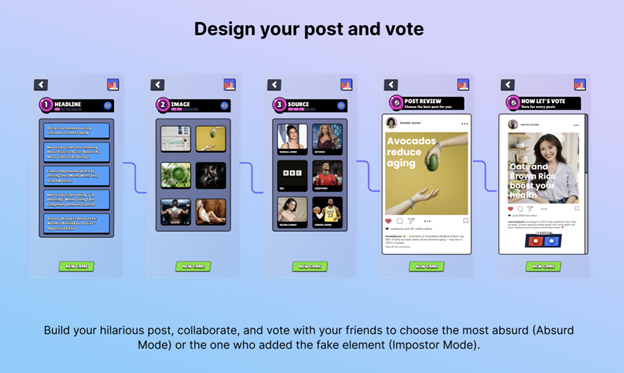
- Mode 2: Impostor (Spot the liar) A detective mode where players need to identify which component in the post shared is the Fake one.
- Mode 3: Fake or Nah? (The Speed Run) A rapid-fire Tinder-style mode where players swipe left or right to identify “Real” or “Fake” posts under time pressure.
Conclusion
In the current unstable environment and amid growing information disorder threats, media literacy interventions are more critical than ever. Our research shows how a user-centred, service design–guided approach can shape effective interventions. By involving the target group early, we co-designed an intervention they perceived as fun, while grounding it in theoretical frameworks to add depth. Looking ahead, innovative approaches are essential to fully equip citizens with the skills needed to navigate an increasingly media-overloaded world.
The Results (So far)
Proven Traction:
The idea was born after we secured 2nd place at the Kaleva Media hackathon (€3,000 prize), received an Honourable Mention in the Digital Intelligence Award (DIA) China, and became a finalist in the Arctic Bright Minds startup competition (Finland), demonstrating its relevance. We are now seeking partnerships to further develop the idea and make it profitable.
2026 will be a crucial year for this work: in Latin America, Peru and Colombia have elections, and with the rise of AI, the spread of fake news is intensifying, particularly during these periods.
If you want to learn more about our project, you can find more information here.
Authors
Cesar Lorino
UX/UI Designer with 5+ years of experience across fintech, SaaS, healthcare, and education. He began his career in social impact projects, shaping a strong human-centered approach. He designs intuitive, scalable interfaces and design systems in Figma, combining research and execution. He has led end-to-end projects in Europe and Latin America and holds a Master’s in Service Design Strategies and Innovations, studied in Latvia, Finland, and Estonia.
Emily O’Connor
Emily holds an MA degree in Service Design Strategies and Innovation and has a diverse background. She is currently the Digital Transformation Lead for the Museum Standards Program for Ireland (MSPI) in the Heritage Council of Ireland. Previously, she worked in sales and marketing at companies like Google and Microsoft. She specialises in digital transformation and innovation.