byZac Woolfitt, Inholland University, the Netherlands.
What do the very latest technology-enhanced educational environments look like? How are universities leveraging new technical possibilities? And how are these spaces designed and used in practice?
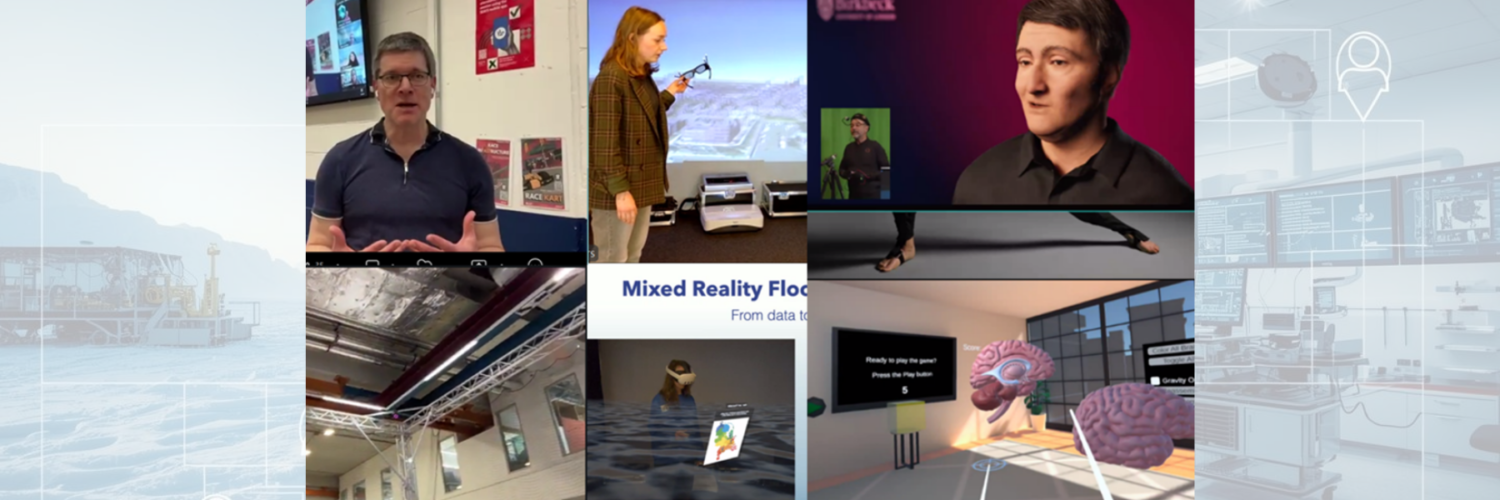
On Thursday March 26th Media and Learning ran their annual tour of advanced learning spaces: Virtual tour of advanced learning spaces – Media and Learning Association
This report reviews the three visits and reflects on the discussion:
- Birkbeck University London – James Cull
- City St. George’s, University of London – Dominic Pates
- Erasmus University Rotterdam – Marie Kegeleers
Birkbeck University London – James Cull
Home – Birkbeck, University of London
James Cull is a Digital Education Consultant embedded in the Immersive Learning Centre at Birkbeck. In his informative webinar, James showcased their innovative teaching spaces for teaching and teaching with immersive technology. Their avatar recreation of their founder, George Birkbeck, is definitely worth watching – it shows how a historical figure can be animated, brought to life to engage with the current generation.
James showed us around all three spaces in the Immersive Learning Centre – the first was the Immersive Learning Classroom with 20 VR workstations and large screens for VR/AR experiences. With circles on the floor to guide users to stay in the correct physical space and tethered and untethered capabilities, students have been enjoying 360 videos, simulations and experiences that wouldn’t have otherwise been possible, including 120 students getting to dissect a brain from the inside using VR headsets! They also have an Immersive Learning Studio for creating VR/AR content using motion capture, 3D scanning, photogrammetry and 360 and binaural audio, and this was used to create the George Birkbeck avatar (watch their address to HRH Princess Anne here). Finally, The Immersive Learning PC Lab has 18 high-spec PCs for teaching VR/AR, editing, video, and graphic production skills, and is accessible to students at any time when teaching is not going on. It also is possible for students to borrow equipment from the Library Help Desk such as VR headsets, 360 cameras, digital recorders, and other production equipment so they can learn at their own pace and explore possibilities for augmenting their assessments with visual tools.
From <https://www.bbk.ac.uk/library/immersive-learning-centre/about>
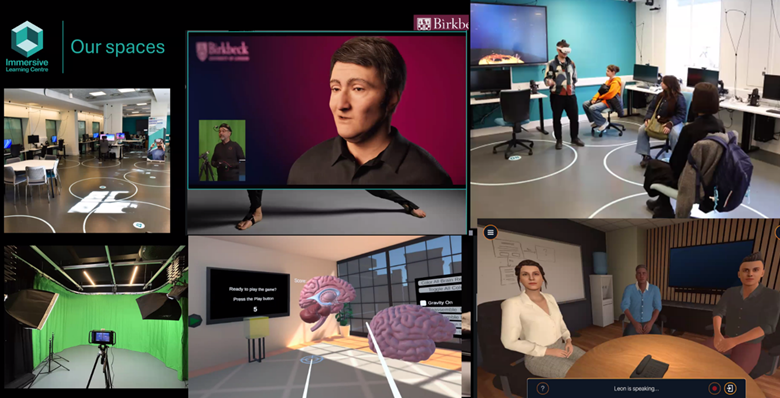
Birkbeck’s creative use of technology includes creating historical avatars and brain surgery from within!
Using £1.25 million of funding from the Office for Students (OfS), they have created a service that seeks to facilitate engaging learning experiences across the whole university, not just for a specific faculty of subject area. They are also leading the charge within Birkbeck on diversifying assessment possibilities and finding new ways to run and manage assessments.
The specifications for the Centre were set up in 2023, feasibility pilots ran throughout 2024 and 2025, equipment was secured in 2025, they ‘soft-launched’ in September of that year and the official launch was in February 2026 – 34 months from start to finish, involving 25 pilots – a mammoth undertaking! Since it opened, they have had over 100 module bookings and engaged over 700 students, including seven ‘whole term’ bookings (where rooms are booked for an entire 10-week module).
To highlight one experience that they have found particularly impactful, BodySwaps allows students to practice interviews with AI-powered avatars to develop career skills, including real-time responsive mock interviews where they are given actionable advice on how to improve. Additionally, with the AI Studio feature where you can create your own scenarios using prompts, they are encouraging experimentation, the Counselling Centre exploring how to make AI roleplays with patients part of official assessment for 26/27. They’ve run virtual field trips to inaccessible places (filmed with drones) and have run away day training with a range of teams.
All in all, there were many interesting examples used and this was inspiration for not only the process of setting up the Immersive Learning Centre, but to see that it is being used by student and staff in creative ways. Well worth a visit next time you are in London! To get in touch, reach out to them at immersive-learning@bbk.ac.uk.
City St. George’s, University of London – Dominic Pates
City St George’s, University of London
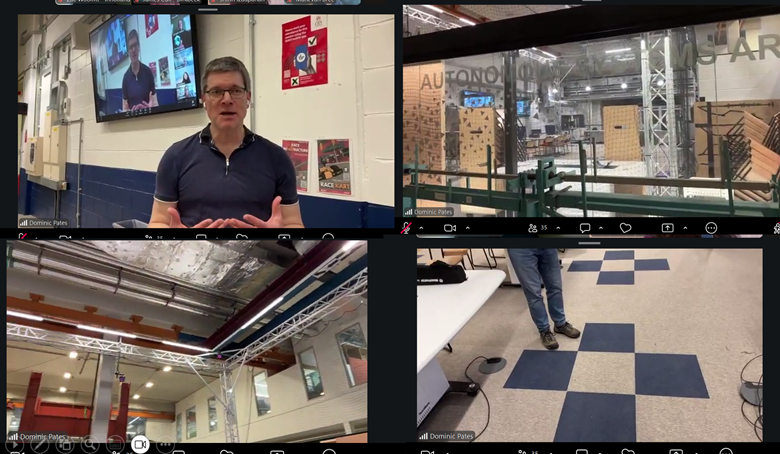
Dominic Pates takes us through the shared lab space internal drone flying centre, with nets for drone flying and floor markings for VR boundary marking.
Dominic Pates is Senior Educational Technologist and manages the digital education relationship with three schools. Dominic took us through the basement of their civil engineering building which has been set up for several innovative educational functions. He explained how this environment has been designed to support immersive learning, while also accommodating a range of other technical and teaching activities.
The space is a flexible AR and VR lab that can be reconfigured as needed. They have an arena for drone operations, with protective netting installed within a large steel frame. Dominic explained that the same area is used for multiple purposes, which has at times led to interruptions between different activities, such as VR work and engineering use.
A key feature of the room is a professional grade motion capture system. Cameras are mounted across the ceiling in a fixed grid to capture movement throughout the space. This system has been used for a variety of applications, including recording dancers, wheelchair users, and sports activities such as basketball, as well as supporting VR scenarios.
The teaching infrastructure within the space includes moveable tables, high specification laptops, and projection facilities that allow users to cast content from their devices onto shared screens. A WolfVision system is installed to enable instructors to display live feeds, including the visual perspective from within a VR headset. The session also highlighted the requirement for a dedicated WiFi network with guaranteed bandwidth to support these activities effectively.
Dominic showed us some of the available VR equipment, which includes approximately fifty Pico 4 headsets, supported by UV cleaning units to maintain hygiene between uses. Floor markings and carpet tiles have been introduced to define safe boundaries for users wearing headsets, reflecting practices developed in collaboration with other institutions.
Next to this space are facilities aligned with digital manufacturing and Industry 4.0. These include a large-scale industrial laser cutter, multiple industrial grade 3D printers, and advanced scanning equipment. Together, these resources make the area as a shared facility serving several disciplines across the institution.
We discussed the broader development of the space. It required significant investment to get the equipment and infrastructure set-up. However, the pedagogical application is still developing. Current use includes activities such as virtual field trips, and a fully coordinated institutional strategy for immersive learning is still in discusion. He noted that similar initiatives exist across different parts of the university, though these have not been fully aligned.
The session concluded with an emphasis on the need to define clear learning objectives to guide the future uses of the space. Establishing a stronger connection between technology and pedagogy was identified as a priority for the next phase of development.
Erasmus University Rotterdam – Marie Keegelers
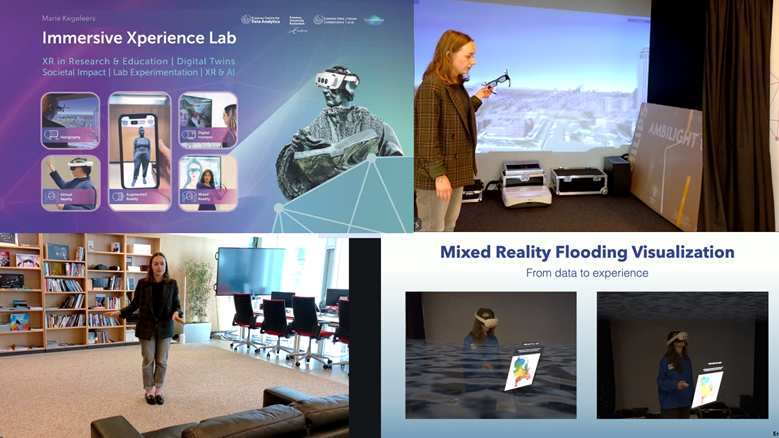
Marie Kegeleers runs the Immersive Xperience Lab at Erasmus University Rotterdam, a lab dedicated to exploring how immersive experiences can bridge the gap between technology and society.
Marie took us through a set of learning spaces that are deliberately positioned at the intersection of technology and society. She explained the lab’s position of framing immersive technologies not as ends in themselves, but as tools for exploring human behavior, decision-making, and public impact.
She showed how the lab builds “data experiences” that make complex systems tangible. One example was the use of campus Wi-Fi data to visualize patterns of movement and space usage – transforming abstract datasets into narratives that help us reflection on how students actually move through the university. This is also used in larger-scale applications, such as urban planning simulations and a digital twin of Rotterdam. This is projected onto a holographic wall that supports shared, collaborative exploration rather than isolating users in headsets.
They emphasise collaboration since the lab does not overly rely on fully immersive, individual XR setups. Instead, they combine several devices, from VR headsets to smart glasses and large-scale projection environments. This helps them create experiences that can be discussed, questioned, and interpreted in real time. Immersion in higher education is not only about realism, but about participation.
The lab tries to operate at the edge of the curriculum, rather than being fully embedded within it. Student engagement usually happens through workshops and exploratory sessions. At one point, over 150 students participated in a single week. These sessions are often done in partnership with external organizations. This is a flexible and outward-facing approach. There are limited internal resources but these are balanced by strong regional collaboration. Erasmus has set up a number of external partners across South Holland. This immersive network finds ways to share facilities, such as the Cotton House XR hub.
Marie showed a few applied cases and the lab’s potential to impact outside the university. In greenhouse environments, mixed reality overlays allow workers to visualize live data in situ which can speed up onboarding. In another case, a lightweight mixed reality application simulates flooding scenarios, enabling users to see what happens when infrastructure fails. Although these immersive technologies are not yet mainstream, they can help extend learning into places that may be inaccessible or too abstract.
According to Marie, universities do not need to build comprehensive XR infrastructures from scratch. By partnering with regional hubs, renting specialized equipment, and working with external experts, they have found a way to be share costs and equipment. In this exploratory phase, they are testing, identifying use cases, and understanding where they can move beyond the hype, and really add value with immersive learning.
Conclusion
There were several detailed questions from the audience on technical aspects. In our closing reflection, the panel looked at where we are in the process of standardization. Although we are not there yet, there are still many opportunities to experiment in meaningful ways. This webinar was an opportunity to get insights into that. The next step will involve moving from these interesting demonstrations into a pedagogical model that is well thought out, constructively aligned with course goals, and closely linked to the affordances of the various technologies.
Previous tours
Disclosure: this is a subject very close to my heart! As a member of the Media and Learning advisory committee, I have been involved in several of these webinars over the years. See my previous reports on virtual tours of advanced learning spaces here:

Zac Woolfitt, lecturer and researcher, Inholland University in the Netherlands