by Divina Frau-Meigs, Savoir*Devenir, France
The Algowatch project has just been completed after two years (2023-2025) of intense creation of resources and dissemination in schools and museum exhibits. It was funded under the European Commission’s Creative Europe program, as part of the CREA-MIL component. Four partners came together, 2 from civil society and 2 from academia: Savoir Devenir (France), Dublin City University (Ireland), DKMK (Croatia) and University Institute of Lisbon-ISCTE (Portugal).
It focused on educating students and citizens about the challenges of algorithms and Artificial Intelligence in the field of information and digital citizenship. It used a Media and Information Literacy framework and design to demonstrate the effectiveness of MIL in imparting AI-literacy. The ALGOWATCH work plan included four main activities:
- Produce interactive quizzes and games for raising awareness and knowledge and for fighting disinformation with four themes (democracy, climate change, well being, online relations).
- Engage participants in co-creative activities in exhibit spaces to share knowledge and experience with conversations.
- Deploy resources in workshops and exhibits with multiplier professionals in formal settings (schools) and in informal settings (libraries, museums)
- Evaluate the resources from the perspective of students, teachers and intermediaries (librarians, curators, MIL experts…)
The results have by far surpassed expectations, as the key performance indicators show in their overall achievements. It won the Best Media Literacy Initiative for Young People at the annual Media Literacy Ireland (MLI) Awards. In all four partner countries, it was praised for its relevance, originality, timeliness and impact.
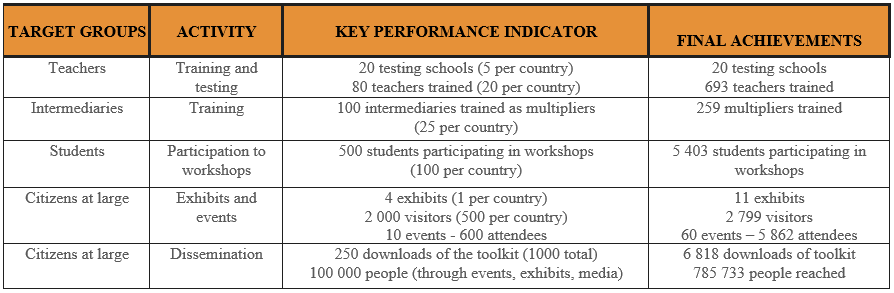
The Algowatch toolkit offers a competence framework (aligned on DigComp 2.2) and materials for teacher training as well as validated interactive resources (quizzes, Eunopia game, poster set) to be used in formal and non-formal settings for exhibits.
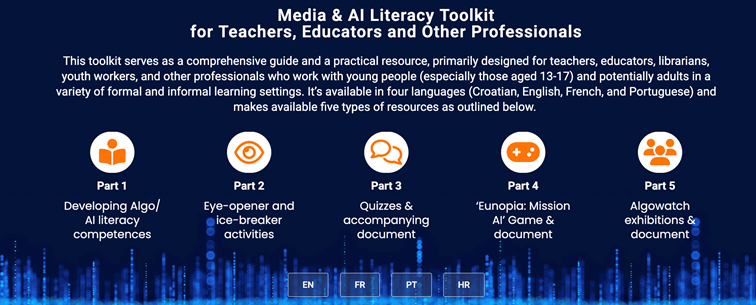
The project had a three-pronged research objective, focused on students, teachers and intermediaries (librarians, curators…) seen as multipliers in the deployment of MIL initiatives in non-formal education. It used prior research in which teachers in particular report that lack of training, lack of pertinent resources, and lack of support from their administration are obstacles to their engagement in MIL and AI-literacy. Though there were some differences across the partner countries, the research results successfully show that these lacks can be addressed with a series of competence-based resources and activities, in a 3–4-hour intervention in secondary schools (20 in all, for students 15+).
For the students, the test results showed significant gains in knowledge acquisition (identifying AI deepfakes, riding recommendation algorithms), but mitigated gains at attitude change related to strategies to fight disinformation and push for platform regulation (probably due to a shift from excessive confidence to an increased critical awareness of the challenges associated with combating disinformation. However, their evaluation of the intervention overall showed a high level of effectiveness and satisfaction with the workshops and the embedded resources as well as the competences and knowledge of their teachers.
For the teachers, they overwhelmingly felt empowered by the Algowatch toolkit and reported a change in the support from their administration. They particularly appreciated the glossary and the slideshow, as well as the set of posters, all deemed easy to use and suitable for classroom constraints. They noted the impact on their teaching relationship with students, as the intervention improved dialogue with youth about their everyday use of algorithms. They encountered difficulties in the 3-4 hour block format, difficult to integrate into timetables and they pointed at program constraints due to the lack of MIL in the official school curriculum.
For the intermediaries, the results show that many of them felt they lacked sufficient financial and technological resources, and while some felt competent, others expressed a strong need for more training to understand and effectively convey complex and rapidly evolving AI concepts and contents. Additional support in the form of digital tools, comprehensive training, and networking opportunities was felt as crucial for enhancing their capacity to organize and deliver educational content. Most of them included schools and teachers in their networking process, thus coming full circle with the school intervention.
The overall findings highlight the need to design MIL interventions in a holistic manner, involving teachers, multipliers, designers and academics, inside and outside schools, as critical strategic actors to engage with rapidly evolving AI- systems.
If you are interested in using the toolkit (an Open Educational Resource), don’t hesitate to contact us: contact@savoirdevenir.net

Divina Frau-Meigs is professor emerita of media sociology at Sorbonne Nouvelle University, France. She is a world renowned researcher in Media and Information Literacy, the media uses and practices of young people as well as information disorders (radicalization, disinformation, hate speech…). She holds the UNESCO chair “Savoir Devenir” and is president of the NGO Savoir Devenir, that led the Algowatch project .