by Shirin Izadpanah, MLA and Melissa A. Lark, Leiden University, the Netherlands.
On 20 November, the Media & Learning Association hosted an online event titled “Driving Educational Innovation: The Role of Teaching and Learning Centres.” The session brought together four speakers from across Europe to discuss how Centres for Teaching and Learning (CTLs) are transforming educational practice. Despite differences in size, structure and mission, each centre highlighted its growing strategic importance in supporting teachers, strengthening digital competence and responding to rapid technological change.
VU Amsterdam: Building Visibility and Leadership for Educational Change
Charlotte Meijer opened the event with an overview of the VU Centre for Teaching and Learning at Vrije Universiteit Amsterdam, one of the largest CTLs represented. Serving 33,000 students and 3,000 teaching staff, this CTL brings together eighty staff members – from didactical trainers and advisors to IT, AV and communications specialists, including a strong cohort of students.
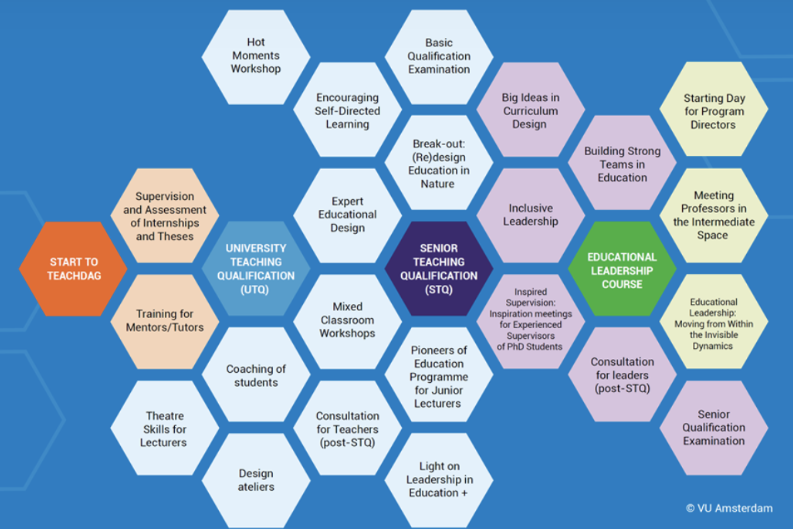
Teacher Development Pathway in VU Centre for Teaching and Learning
Formed through the merger of an innovation unit and a teacher-professionalisation centre, the CTL now supports the entire university under one structure. Among its key initiatives are a structured Teacher Development Pathway, an Education Lab producing student – staff knowledge clips, accessible pop-up video studios and new AI workshops that help teaching staff first manage integrity concerns and then explore innovative uses of generative AI.
Charlotte acknowledged ongoing challenges common across CTLs: research priorities often overshadow educational development, resources remain limited and teaching staff struggle to find time for professional learning. Still, she emphasised two overarching success factors:
(1) CTLs must cultivate a strong reputation and be widely known within their institution; and
(2) supportive leadership is essential for securing a clear mandate and meaningful impact.
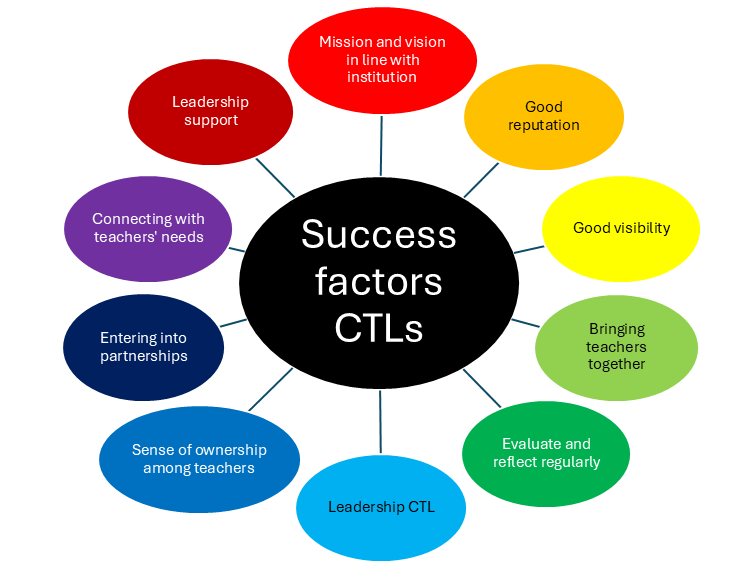
Success factor for a Center for Teaching and Learning
When working with students, Charlotte highlighted that a key component for the VU CTL was the careful onboarding of students and building empathy into these partnerships – recognising pressures around housing, exams and time constraints.
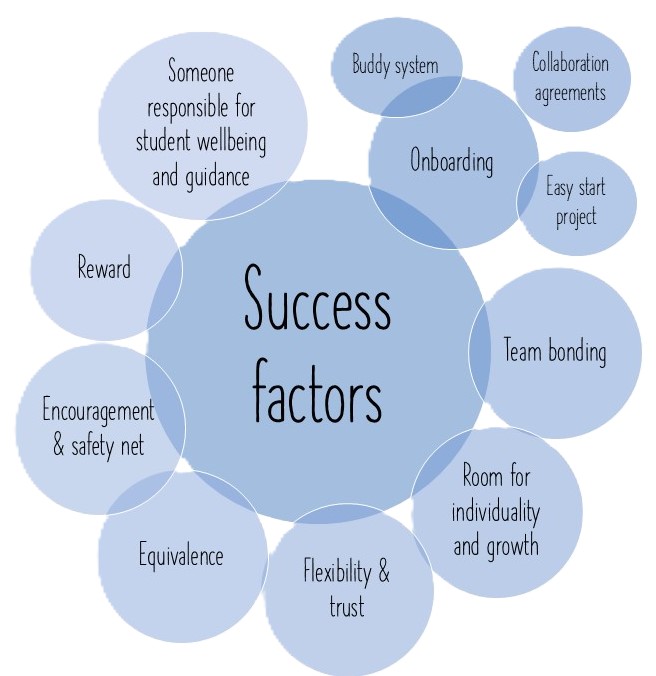
Success factors when working with students
virtUOS (University of Osnabrück): A Longstanding Commitment to Digital and Open-Source Innovation
Representing the University of Osnabrück, Rüdiger Rolf introduced virtUOS, an independent department that has evolved from a small virtual-teaching initiative in 2002 into one of Germany’s most technically oriented CTLs. Today, the centre supports 13,500 students with a team of sixty-five staff plus student assistants, funded largely through third-party projects.
Its development spans major milestones: adopting Stud.IP as the university’s LMS in 2003, co-founding the Opencast video-management system in 2008, and integrating higher-education didactics in 2017. A strong open-source ethos underpins its current work on privacy-preserving AI through tools such as LibreChat and RagFlow.
virtUOS also supports a large infrastructure, including two video studios, 30 automated lecture halls and an Education Makerspace offering VR, 3D printing and rapid prototyping. Collaboration is central to its identity, with partnerships across Lower Saxony’s 20 universities and active participation in open-source communities and national networks. Looking forward, the centre is focusing on AI, digital well-being and new learning-space design.
LINK (University of Oslo): Cross-Institutional Collaboration and AI Preparedness
The third presentation came from Mirjana Coh, LINK – the Centre for Learning, Innovation & Academic Development at the University of Oslo. Established in 2017 through the merger of pedagogical, digital and media-production units, LINK now delivers around 180 annual projects with a staff of about thirty professionals and interns.
Its work covers university pedagogy, innovation in teaching, research dissemination, media-rich production and digital competence. LINK places strong emphasis on inspiration and knowledge sharing, organising events and networks that connect faculties, pedagogical centres and Centres for Excellence in Education. The University of Oslo’s participation in the Circle U Alliance further strengthens cross-European collaboration.
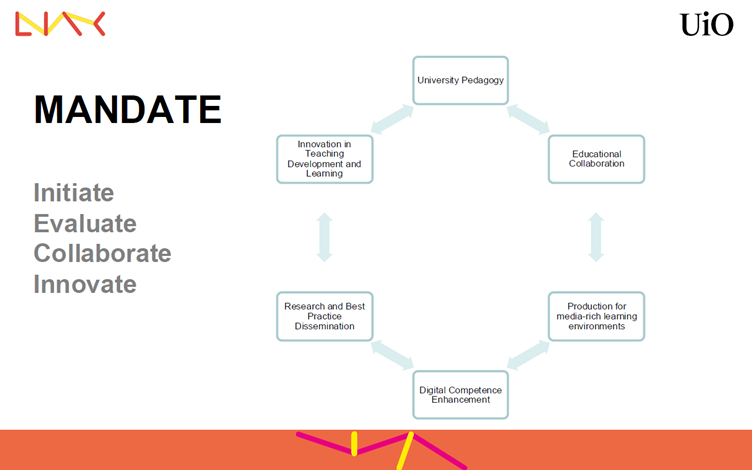
LINK’s Mandate
A major initiative, AI Across the Network, launched in 2023, has grown into a university-wide collaboration involving all faculties, research administration, students and communications teams. The project provides teachers and students with shared resources, policy summaries, events and experience-sharing forums. Its impact includes stronger cross-faculty dialogue, unified communication and a larger community ready to collaborate on development projects. However, the centre faces rising expectations and the need to expand research capacity while managing unpredictable challenges such as AI.
Karlstad University: Meeting National Pedagogical Requirements through Empathy and Flexibility
The final contribution came from Jörg Pareigis of Karlstad University centre for teaching and learning, where Sweden’s national requirement for university teaching staff to complete 200 hours of pedagogical training shapes the centre’s work. With half of the university’s 20,000 students studying fully online and a strong national emphasis on lifelong learning, the CTL is deeply embedded in everyday academic life.
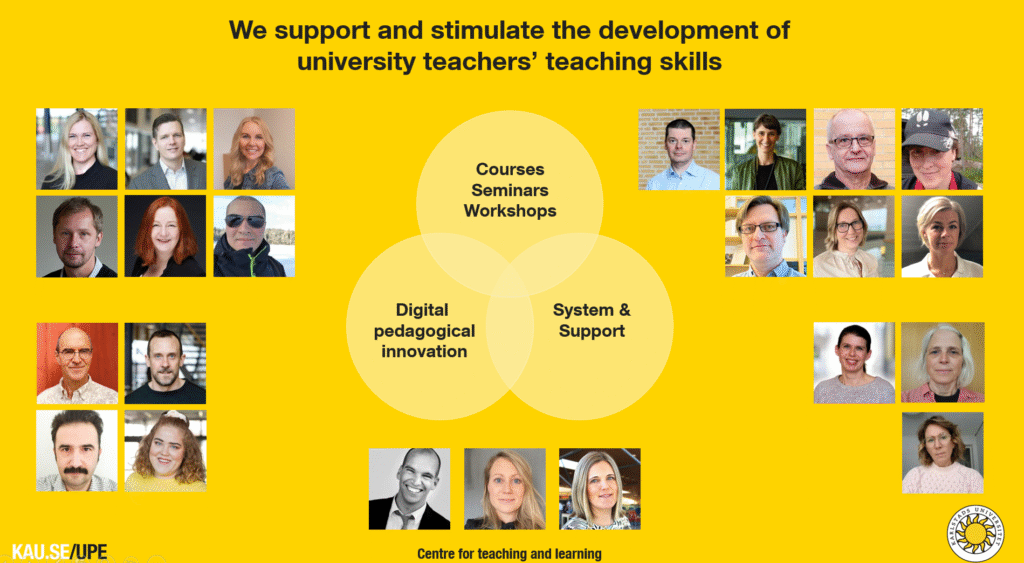
The structure of Karlstad University CTL
To make the heavy training load more manageable, the centre redesigned the requirement into two smaller courses taken over two years, giving teaching staff flexibility to choose topics aligned with their interests. Their activities include seminars, validation sessions, pedagogical cafés, conferences and an open-access report series. Collaboration – national, international and institutional – is at the core of their model, supported by a strong preference for open-source digital tools.
As we wrapped up the discussion led by Melissa A. Lark, from Leiden University, it became clear how closely the experiences of these centres align despite their diverse contexts. Almost all of the CTLs represented have been formed through mergers of previously separate support, pedagogical and media-production units, a shared transition that highlights how interconnected these areas have become in supporting modern teaching. Across countries and institutional structures, the challenges described were strikingly similar. The rapid rise of AI in education has created significant pressures, yet it has also increased the visibility and strategic importance of CTLs and encouraged more teaching staff to reach out for support.
A recurring theme was the importance of visibility, availability and trust. CTLs can only thrive when they are understood not just as providers of mandatory training but as active, reliable partners within the academic community. It was also encouraging to hear how many centres are already collaborating within their regions, at the national level or through university networks, and how willing they are to share resources, insights and solutions.
With the launch of the Media & Learning CTL Special Interest Group, these conversations now have a dedicated space to continue. There is much to address, but also a wealth of shared pathways and opportunities. If you would like to stay involved, learn more or work together on strengthening CTLs, the SIG is the place to be.

Shirin Izadpanah, Media and Learning Association

Melissa A. Lark, Leiden University, the Netherlands