by Päivi Rasi-Heikkinen, University of Lapland’s Faculty of Education, Finland.
Media and Robot Literacies of People Over 65 Years of Age (MediaRoboLit 65+) is a research project funded by the Research Council of Finland for the years 2023–2027 (grant number 355063). The project is coordinated by the University of Lapland, Finland, and implemented in cooperation with the University of Jyväskylä and Tampere University.
Aim and approach of the project
The aim of the project is to co-produce new knowledge about the nature, scope, and practices of the media and robot literacies of people aged 65+ living in Finland. The project focuses on dimensions of media literacies that are particularly significant for senior citizens: news literacy, health media literacy, robot literacy, and media literacy in online communication and the recreational use of media.
The project is one of the few existing initiatives to map older adults’ media literacies on a large national scale, and the first effort to map robot literacy at the level of a national population. Furthermore, the project is unique in its inclusiveness of people in vulnerable life situations: the oldest population, residents of sparsely populated areas, older Indigenous Sámi people, and older people with health issues and illnesses.
In MediaRoboLit 65+, robots are considered the next new media, as they are becoming increasingly common providers of information and services. The premise of the project is that the increasing use of—and hype surrounding—robots require adults and older adults to possess robot literacy to operate, communicate with, and interact with robots, as well as to make informed judgments and decisions about the meaningfulness, appropriate roles and boundaries of robots in society, in their own lives, and in the lives of their family members.
What is robot literacy?
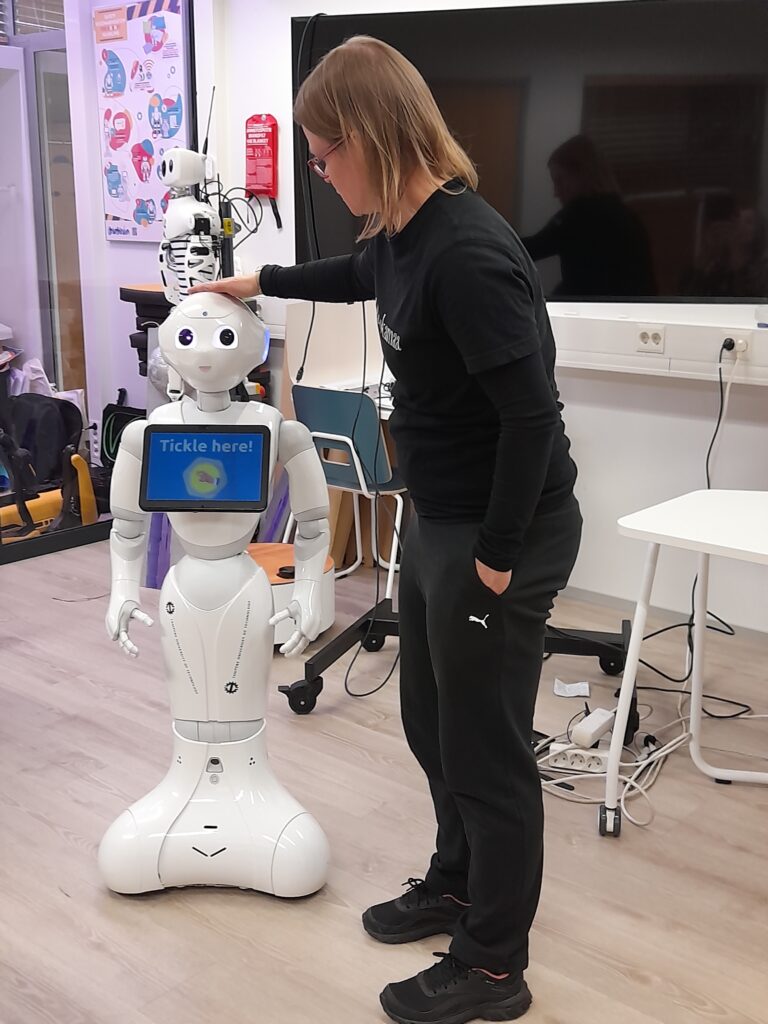
One of our first results in MediaRoboLit 65+ is a definition of robot literacy among older adults. The definition focuses on physical robots—that is, robots with a physical embodiment that are capable of performing useful tasks in older adults’ everyday lives. Examples include domestic robots, customer service robots, and nursing robots. Our definition of robot literacy also covers humanoid robots with human-like appearances and human–robot interaction abilities such as speech, facial expressions, and bodily expressions and movements.
A MediaRoboLit 65+ team member interacting with a Pepper robot (photo: Päivi Rasi-Heikkinen)
The definition of robot literacy is intended as a tool to support the evaluation of robot literacy among adults, in particular older adults (aged 65+), and to promote awareness-raising and educational practices aimed at strengthening their robot literacy.
We define robot literacy through the following seven skill dimensions:
- Awareness of robots; knowing what a robot is and awareness of different types of robots and their possible functions;
- Interaction with robots; competencies needed when interacting with robots verbally and nonverbally;
- Understanding and evaluation of the information robots provide; the ability to evaluate the information regarding, e.g., quality, credibility, and origin, as well as a broader understanding of the social, economic, and historical context in which the robot provides the information or performs the tasks;
- Understanding the data security and privacy of robots; knowing how robots collect, use, store, and share users’ personal data;
- Programming of robots; an understanding of the programming language and skills such as coding and mathematics;
- Ethical reflection; ability to reflect on the uptake, use, and consequences of robotics from the viewpoints of, e.g., well-being, care, justice, and the good life;
- Providing and receiving social support; the ability to provide and receive social support on robotics-related questions.
Robot literacy among people aged 65+ in Finland
The results concerning robot literacy from our national survey have recently been published in an article titled “Adults’ Robot Literacy—Results from a Finnish Survey.” The findings indicate that, despite developments in AI and predictions of further advances in humanoid robotics, robot literacy remains limited among Finnish older adults and is not primarily based on direct personal experience with robots.

The findings also show that age, education level, and internet use are connected to robot literacy: younger respondents and those with higher levels of education and internet use exhibit greater robot literacy.
Older adults demonstrated uncertainty in several dimensions of robot literacy, including ethical reflection, knowledge of interacting with robots, and the ability to interpret and critically assess information produced by robots. They also reported having low to very low competence in providing social support related to robotics.
Our research on robot literacy continues. In addition to the survey, we have gathered data through focus group discussions, interviews, and Robotour for Seniors workshops. However, our results so far already point to the need for adult educators—along with researchers, the media, robotic service providers, robot developers, and other stakeholders—to take an active role in fostering robot literacy within the adult population.


Päivi Rasi-Heikkinen, PhD, SScD, is a Professor of Education at the University of Lapland’s Faculty of Education, Finland, and the leader of the MediaRoboLit 65+ project. Rasi-Heikkinen has 25 years of experience in research and development projects in the field of media education. She is an expert and pioneer in the digital inclusion, media literacies, digital competences, and media education of older people. For more information, please visit here.