by Merel Pompe, University of Amsterdam, the Netherlands.
UvA AI Chat is the University of Amsterdam’s institutionally developed generative‑AI tool (GenAI), created by an internal team to provide equitable, privacy‑preserving access for students and staff. This article explains what the tool is, why it was built, how it is used in teaching and learning, and what we have learned from using it.
Why build our own tool
The rapid rise of GenAI is changing how we teach, what we teach, and how we assess. Public GenAI models are powerful and widely available, yet they do not always align with UvA values or privacy regulations. If GenAI is to be part of everyday study and work, we need a trustworthy and equitable option that supports learning. That is why UvA chose to develop an inhouse tool, to maintain control over data, ensure privacy, support academic freedom, and to contribute to conscious and responsible use of GenAI in education.
What UvA AI Chat is
UvA AI Chat is a tool developed in‑house (product lead: Rik Jager; programme manager AI: Frank Benneker) providing safe access to GenAI-models. By building and operating the tool ourselves, we are not dependent on commercial platforms, and we keep control over our digital infrastructure. Prompts and chat history are not used to train external models. The service is available since 1 September 2025 for all UvA students and staff, and it is free, so that access is genuinely equitable.
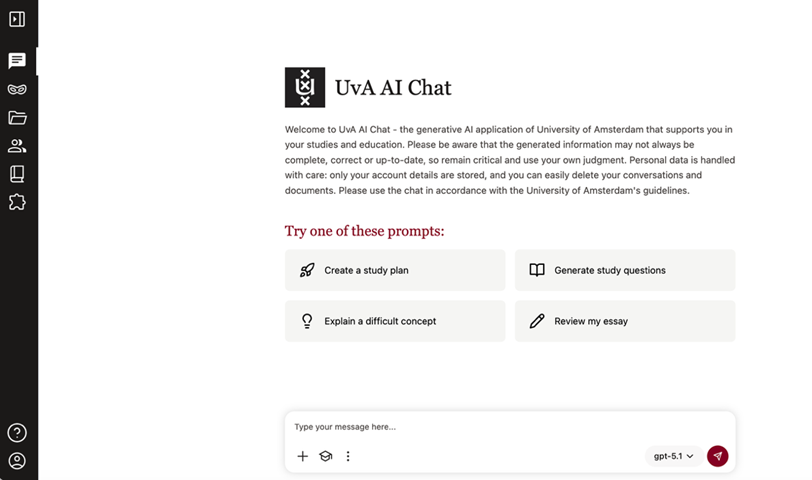
Print screen of the interface of UvA AI Chat.
Pedagogy first
Because the service is developed by our UvA team, we prioritise features that matter in the classroom. A key feature is personas: Personas are predefined ‘characters’ (CustomGPT’s) to provide directly relevant answers. By giving a persona clear instructions, you set its role, expertise, tone, background knowledge, and function. Examples include a study tutor that quizzes key concepts and points back to course materials; a brainstorming partner that tests the feasibility of an experiment and challenges assumptions, or a debate partner that articulates opposing viewpoints and asks for argumentation (find these and more examples here.
Over the last two years, we have run 19 pilots across courses at the Science Faculty to experiment with these personas, and in many courses, these personas now form part of the design, enriching the student learning experience while keeping lecturers and students in charge.
Beyond personas, UvA AI Chat supports working in collaborative groups to work together on shared projects, a study mode that acts as a supportive tutor, “artifacts” for co‑writing with GenAI in a dedicated workspace, model selection (e.g., GPT‑5, GPT‑4o) appropriate to the task with attention to energy use, and more features coming up to support teaching and learning, like an integration with Canvas.
How we integrate it into courses
We treat UvA AI Chat like any other pedagogical tool. Activities using the tool are connected to learning outcomes and assessment, with the GenAI tool used for formative practice, feedback, and preparation, not for summative shortcuts. Where personas are integrated, students receive clear instructions and support. We also teach AI literacy through e‑learning modules and tutorials on responsible use, limitations, and verification to make sure lecturers and students are well informed. In practice, the tool becomes an additional practice space that complements seminars and labs and gives students more control over their learning process, rather than encouraging the misuse of GenAI tools to pass a course.
Some benefits that we observed during our pilots were:
- Faster improvement of drafts through immediate, personalised feedback aligned to learning goals and rubrics.
- Stronger argumentation and engagement with contrasting viewpoints.
- Increased project engagement and productivity.
- Enhancing understanding of course content.
Across pilots we also saw consistent patterns: formative feedback was more coherent, students were better prepared for seminars and lab sessions, and repetitive questions decreased, creating room for higher‑order discussion.
Challenges and how we address them
What we have learned
GenAI is not suitable for every task. And a lot of the times in class you want to focus on real-life conversations and discussions between students and lecturers, where laptops are closed. Study programmes specify when and how GenAI may be used, and assessments are adjusted accordingly. Many students already use public tools, so adoption of UvA AI Chat requires clear communication of its benefits: privacy, equitable access, course‑aligned personas, and institutional support. Staff vary in confidence and experience, so our Teaching and Learning Centres provide support varying from examples, templates, and workshops, to also one-on-one didactical advice on changing assessment, integration of GenAI into their course or even at programme level looking at exit qualifications and learning trajectories where we systematically co-design AI learning trajectories that match needs and challenges of a specific programme. Read more here.
We recognise a common tendency toward quick fixes or small “band‑aid” changes. Our advice is to define or revise the learning outcomes first, align it with meaningful assessment, and then design the GenAI interaction that serves it. Changing assessment only out of fear of GenAI misuse doesn’t necessarily make it meaningful. Changing it to enhance the student learning experience – while keeping assessment fair and reliable – strengthens education for the long term. GenAI offers a useful boost to improve curricula when used this way.
What’s next
We are refining personas, expanding innovative examples across disciplines, and improving the UvA AI tool. For institutions considering a similar path, our advice is to develop with – and for – educators, connect GenAI to concrete learning activities, teach students and lecturers how to use it well, and iterate with evidence.

Merel Pompe is an educational specialist at the University of Amsterdam’s Teaching & Learning Centre, at the Faculty of Science, focusing on AI and Assessment. With a Master’s background in educational science and a history of working in various educational roles, Merel collaborates on innovative projects that explore the integration of generative AI in academic settings. Also looking at various assessment methods that include (or exclude) working with AI.