by Katsiaryna Palishchuk, All Digital, Belgium.
The Covid-19 pandemic accelerated digital transformation in education but exposed gaps in teachers’ pedagogical, social, and emotional use of digital tools. The D-PAIDEIA project addresses these gaps by updating the DigCompEdu framework, developing a dedicated training curriculum, and supporting schools in creating inclusive, whole-school digital pedagogical strategies.
As the project concludes its three-year journey, we highlight its major achievements, beginning with the D-PAIDEIA framework.
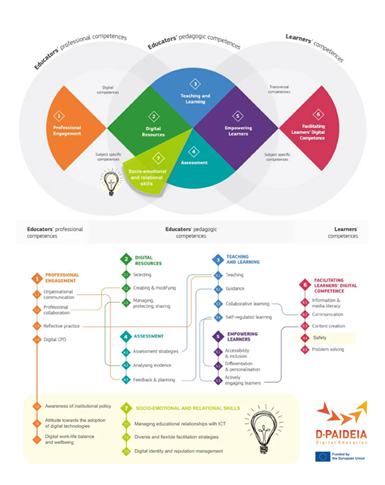
In 2023, the University of Florence led the development of the D-PAIDEIA Pedagogical Digital Competences Qualifications Framework, building on DigCompEdu and updating it to reflect the pedagogical, social, and emotional needs that emerged during the pandemic. The framework defines what educators should know and be able to do at different proficiency levels, supporting continuous professional development in an evolving digital landscape.
After an extensive literature review, D-PAIDEIA partners identified a set of emerging needs related to the social and relational dimensions of teaching with technology. Then validated these insights through a consultation involving more than 150 teachers and 30 international experts. Their contributions highlighted how specific digital competences shape educators’ daily responsibilities and professional wellbeing.
Based on this evidence, we propose strengthening two areas of DigCompEdu:
1 . Professional Engagement, with three additional competences
2. Pedagogical Competences, with a new socio-emotional and relational section
New competences in the Professional Engagement area
We suggest integrating three elements that reflect the contemporary challenges of digital education:
Awareness of institutional policies:
this competence helps educators align their digital choices with national and international guidelines, fostering responsible use of technological resources. It also supports lifelong learning by encouraging informed decisions—for example, the use of open-source tools.
Attitude toward digital technology adoption:
this competence promotes an open, reflective, and experimental mindset. Educators are encouraged to explore new tools, evaluate existing practices, and make evidence-based decisions about the pedagogical value of digital technologies.
Digital wellbeing and work–life balance:
this element emphasises healthy and sustainable digital practices. It includes understanding the risks of digital overload, managing online time effectively, and safeguarding mental and physical wellbeing—for instance, by exercising the “right to disconnect.”
New section in the Pedagogical Competences area: Socio-emotional and Relational Skills
This new section includes three key elements:
1. Managing educational relationships with ICT: Engaging respectfully and effectively with students, colleagues, and families in online or hybrid environments, while supporting relational dynamics—particularly for SEND students and those from disadvantaged backgrounds.
2. Diverse and flexible facilitation strategies:
Adapting communication and interaction styles to face-to-face, blended, hybrid, or fully online settings, taking into account the specificities of computer-mediated communication and students’ relational needs.
3. Digital identity and reputation management:
Understanding how digital identity affects social and educational interactions. Managing one’s online presence and contributing responsibly to virtual learning environments by sharing professional and educational resources.
Read the full proposal here.
The next pillar focused on moving from framework to practice through the development of a dedicated Curriculum. Guided by the question of how to prepare teachers for challenges that did not exist a decade ago – such as digital wellbeing, online safety, and socio-emotional skills in virtual environments – the D-PAIDEIA consortium translated the updated DigCompEdu framework into a practical, future-ready curriculum. Developed through collaborative design, expert review, and cultural adaptation, the curriculum consists of five structured modules and 27 learning objectives, combining online flexibility with blended learning approaches that emphasise interaction.
More than a collection of activities, the curriculum provides a professionalisation model that schools can adapt for continuing professional development, workshops, or initial teacher education.
Learn more here.
From Diagnosis to Action: The Guide and the Action Plan Template
The next pillar focused on supporting educational institutions in developing Pedagogical Digital Strategies through a whole-school approach. Building on the D-PAIDEIA framework and curriculum, the project developed a practical method for school leaders to design, implement, and monitor pedagogical digital strategies. The method includes step-by-step guidance, needs assessment tools, templates, and examples, and was piloted in 100 schools across Europe. Using established European tools such as SELFIE, institutions identified teachers’ needs and received targeted support to develop and monitor tailored strategies. Based on insights from the pilot phase, the method was refined and translated to enable use in different national contexts.
Learn more about our guide for school leaders to support implementation here.
D‑Paideia partners invite schools, teacher training institutions, policy makers, and European education networks to adopt the framework in professional development and institutional planning, ensuring that educators are prepared for the demands of the digital age while safeguarding learners’ well-being.
Explore the complete D-PAIDEIA journey and read all four newsletters here:
Newsletter 1: https://www.d-paideia.eu/newsletter-1/
Newsletter 2: https://www.d-paideia.eu/newsletter-2/
Newsletter 3: https://www.d-paideia.eu/newsletter-3/
Newsletter 4: https://www.d-paideia.eu/newsletter-4/

Katsiaryna Palishchuk is a Project Manager at All Digital with commitment to creating impactful and sustainable change through European cooperation. She works on EU funded projects focused on digital education, skills development, and social inclusion.