
by Tania Maria Villanueva Cabello, University of Warwick, UK
Stress and burnout are well-known terms in research, not only because they have been studied, but also because they are common experiences resulting from the pressures of conducting independent research and navigating the uncertainties of academia. These factors can significantly affect the mental health of PhD students and postdoctoral researchers, often referred to as early career researchers (ECRs) (Gerson et al., 2025).
It is important to recognise that the challenges ECRs face while preparing to become future research leaders can affect their wellbeing. As a postdoctoral researcher, I can confirm this. In this sense, it is also true that improving wellbeing literacy is now recognised as a key strategy for promoting mental health and wellbeing (Riva et al., 2024).
As a core mission, the whole university approach in UK universities should promote and support the mental health of students and staff throughout university life. Good mental health is central to staff and student engagement, productivity, and creativity (Brewster et al., 2022), which in turn gives purpose to the university.
A pathway though wellbeing literacy which involve participatory practices.
Our project aimed to develop wellbeing literacy for ECRs at the University of Warwick by involving them in the creation process. In listening workshops, we asked two main questions: What challenges do you experience in your research career that affect your wellbeing? If you could learn to improve your wellbeing by discussing these specific challenges, what would be your preferred learning formats? Learning is more effective when it matches your own style; no one learns in exactly the same way. Therefore, to deliver quality wellbeing literacy, it should be based on their needs.
With a participation of 30 PhD students and 20 postdoctoral researchers, our research revealed that, in addition to the widely reported challenges affecting the mental health of ECRs – such as impostor syndrome, work-life balance, job precarity, and uncertainty – factors including being an international researcher, the relationship with their PI or supervisor, the use of social media, competition and comparison within their peer group, and emotion management also impact wellbeing. This showed us the true challenges and realities for those ECRs which impactful on their wellbeing.
From research to an online platform: wellbeing literacy for ECRs.
We listened to interesting ideas from ECRs who wanted to learn about wellbeing and after analysing the data, we recognised that delivering the content should be inclusive and use a range of formats to accommodate all learning preferences and respect diverse needs. To address these specific challenges, we turned them into topics of the resources. With this broader vision, we dedicated time to creating a plan for delivering the information. Based on the themes identified in the data analysis, we decided to divide the resources into sections: Introduction, Understanding the Wellbeing of Early Career Researchers, Navigating Your PhD or Postdoctoral Journey, Challenges Within a Broader Work Environment, Wellbeing Literacy Outside Work, and What to Do Next?
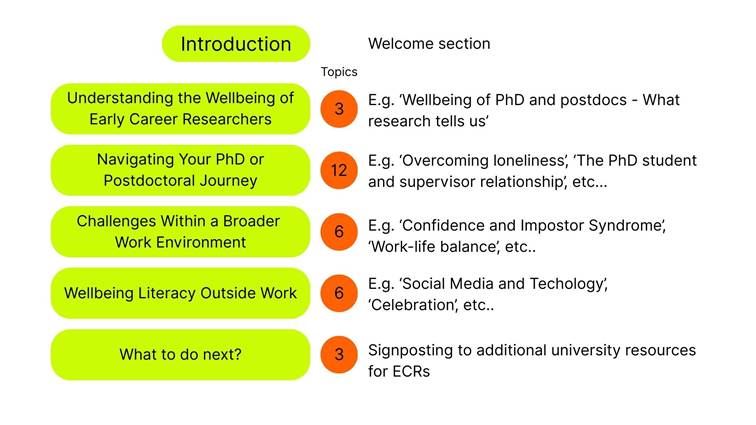
Figure 1. The image provides an overview of the organisation of the sections within the online wellbeing literacy resources, the number of topics in each section, and examples of topics from each section. The online resources contain a total of 30 topics.
To meet academic standards and be supported by published research, as expected by researchers, each topic was designed with core content explaining how a specific challenge affects wellbeing and offering strategies to address that challenge. To accommodate diverse learning formats, the core content is delivered through videos, infographics, visuals, animations, podcasts, or written materials. With strong support from the university’s digital learning experts and the interactive platform available, Rise 360 was used as the web app to tailor the online wellbeing literacy resources.
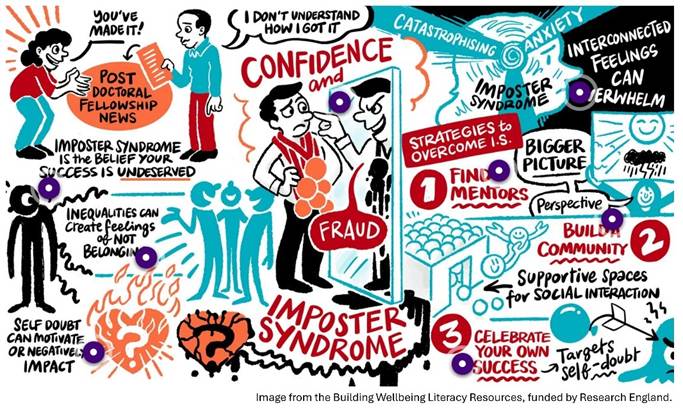
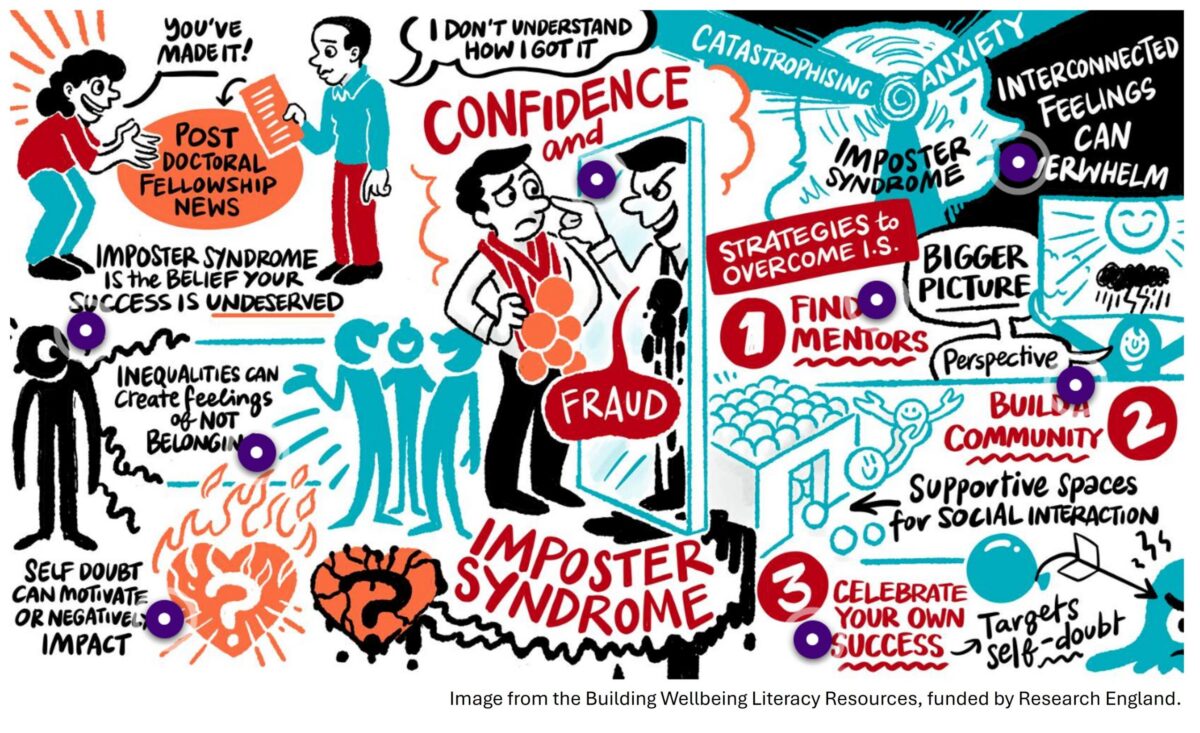
Figure 2. The visual presents the core learning material designed to provide information on the topic ‘Confidence and Impostor Syndrome’. It features a scribe created by independent artist James Baylay, explaining how this challenge can affect wellbeing (left side) and offering strategies to address and overcome it. The hotspots offer additional information related to this topic.
As a final touch for each topic, ECRs may complete an optional activity (reflective journalling or a quiz) and access additional recommended resources, which direct them to external web-based materials related to the topic. All of this is open access and can be tracked and completed in their own time and at their own pace.
Importantly, the ‘What to do next?’ section contains resources already created within the university, serving as a signposting point to inform ECRs about available support.
We believe that by embedding inclusive approaches through the co-creative role of ECRs, this project moves away from the traditional pedagogical model and fosters a more inclusive and supportive research culture that ensures community participation.

Tania Maria Villanueva Cabello, University of Warwick, UK