
by Johan Österberg, Psychological Defence Agency, Sweden.
The following featured article provides a summary of the recently published Manual ‘‘Psychological Defence and Information Influence‘‘ by the Psychological Defence Agency, Sweden.
Overview
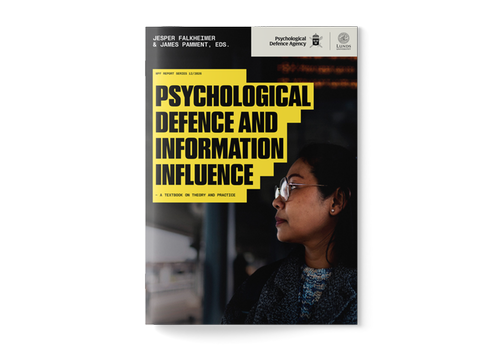
The textbook examines psychological defence and information influence in modern societies, focusing om how states, institutions, and citizens can understand, detect and counter information manipulation such as disinformation and influence campaigns. It is a comprehensive overview of key issues related to psychological defence and information influence written by leading scholars on each topic.
One central argument is that national, and international security today depends not only on military capabilities but also on resilience in the information environment. Democracies must protect open public debate while resisting attempts to manipulate public opinion.
The book is primarily aimed at: university students and teachers, government officials and communicators, researchers and professionals working in security or public communication.
Main themes
1. Fundamentals of psychological defence
The first section introduces the concept of psychological defence, which refers to a society’s ability to protect democratic processes, decision-making and public opinion from manipulation. Key topics include:
- The historical development of psychological defence
- The role of government institutions
- Connections to national security
- Democratic values such as freedom of expression and open information
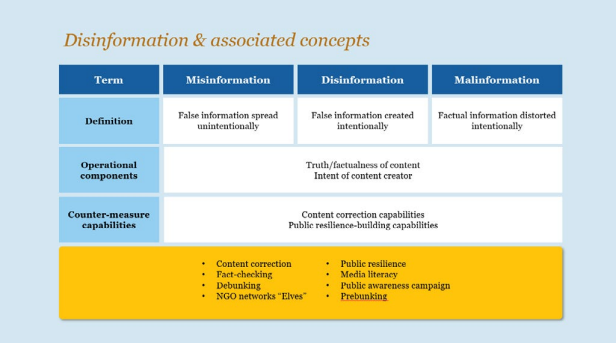
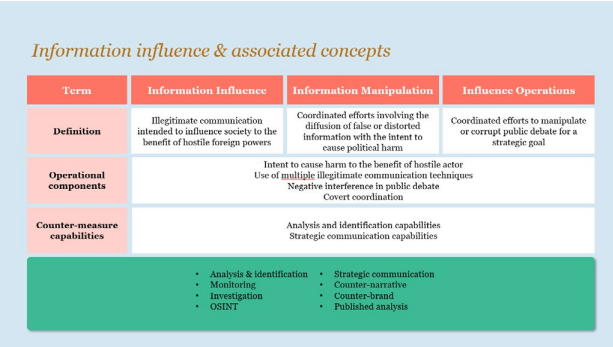
2. Understanding malign information influence
The second section explains how influence operations work. It analyzes methods such as:
- Disinformation campaigns
- Propaganda and strategic narratives
- Manipulation through social media platforms
- The use of both algorithms and digital networks
- Psychological factors such as cognitive biases and emotional framing
A key insight is that influence operations exploit human psychology, including confirmation bias, fear, and identity-based polarization.
3. Case studies in information influence
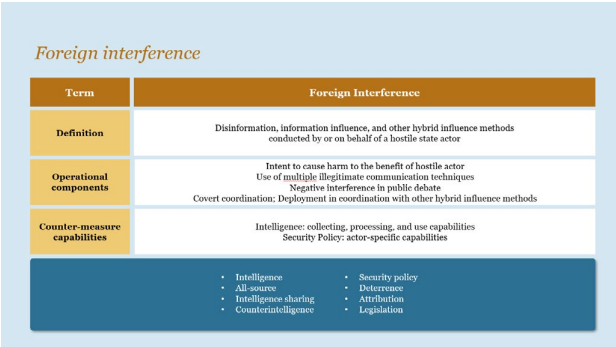
The third part of the book provides empirical examples of information influence. These case studied examine:
- State-led influence campaigns
- Election interference
- Influence operations targeting democratic societies
- The strategic use of media, culture, and digital platforms
The cases illustrate that modern influence operations are often long-term, coordinated, and hybrid, combining political, technological, and psychological strategies
4. Countermeasures
The final section focuses on how societies can counter information influence.
Important strategies include:
- Media literacy and critical thinking education
- Transparent and effective public communication
- Intelligence and open-source investigation measures
- Identifying and attributing influence campaigns
- Strengthening societal trust and democratic institutions
The book argues that resilient societies are the strongest defence against information manipulation. The main conclusion of the book is that information has become a strategic domain of conflict. Democracies must develop both institutional systems and an informed public capable of recognizing manipulation in order to protect open societies.
Author
Johan Österberg has a PhD in psychology and is a research and training coordinator, Myndigheten för psykologiskt försvar (Psychological Defence Agency), Sweden.