by Giulia Crisanti, La Sapienza University, Italy.
Between January and February 2026, at Sapienza University of Rome, we offered a course aimed at high school students on the theme “Media-Pop. Interpreting Popular Narratives and Political Conflicts Through Films, TV Series, and Social Media.” The course was part of the nationally funded research project, Circulating Populist Sentiments in 21st Century Film and TV Fiction in Italy (coordinated by Prof. Dominic Holdaway), which examines the role of cinema and TV series in shaping populist political cultures in contemporary Italy.
Based on the results of our research, together with a few colleagues, we sought to provide young students from different Roman schools with valuable tools for recognizing the triangular relationships that exist between:
- the circulation of seemingly “neutral” entertainment media products such as comedy films, television series, advertisements, and social media content,
- the spread of stereotypical, identity-based and divisive public narratives,
- and social patterns of political polarization and cultural marginalization.
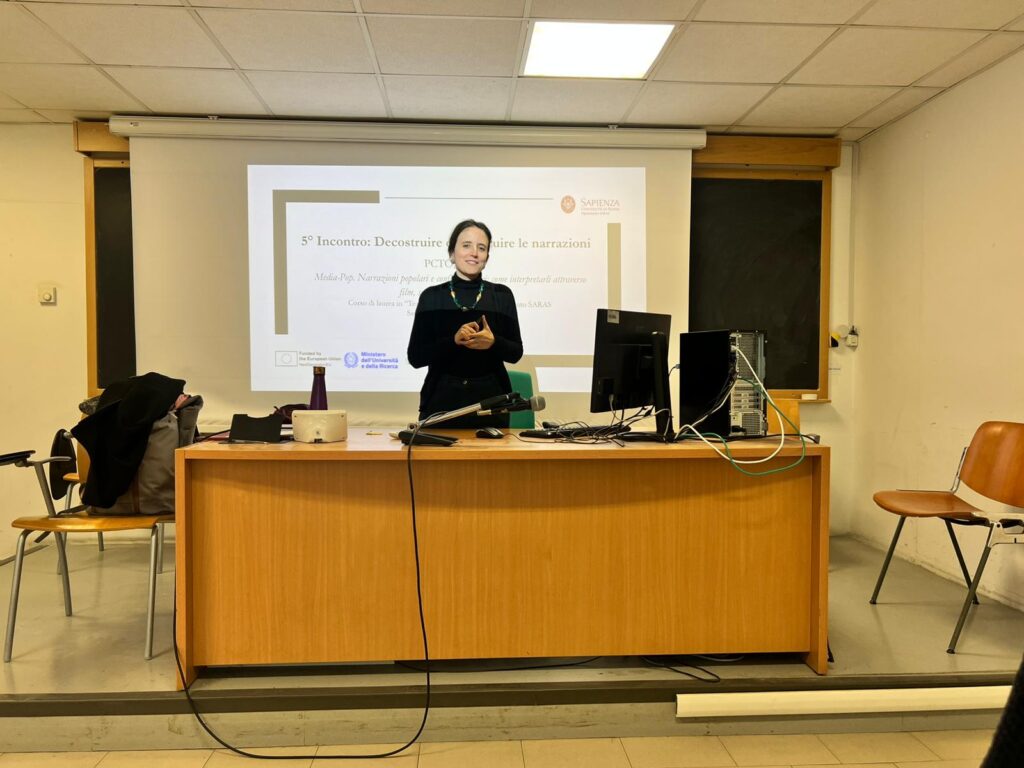
Overall, 15 students attended the course. During six thematic lectures, we engaged in critical reflection on the intertwining of media and popular political cultures to raise awareness of the political and cultural impact of audiovisual products, and the regulations governing their production and circulation, especially in relation to the spread of nationalist and xenophobic public narratives.
We began the course by introducing students to the categories of “populism” and “popular,” highlighting their ambivalent and pervasive nature and, above all, reflecting with the class on the significant role played by audiovisual products in the circulation of “banal” and oppositional identity narratives (Us vs. Them). Throughout the subsequent meetings, we focused on specific case studies, including the relationship between media and forms of gastropopulism; the way in which television series contribute to the construction of collective imaginaries about different European national identities; the role of advertising in the construction of polarizing narratives; the analysis of Italian and European regulations relating to audiovisual production, and therefore the role of cultural policies in promoting local and national identities.
In each lecture, we planned a series of interactive exercises to engage students directly in recognizing populist discourse across various media. The course consistently ended with a mock trial, in which we asked students to put themselves in the shoes of legislators. We divided them into two groups and asked them to identify, discuss, and negotiate criteria for public funding of European audiovisual productions, with the common goal of promoting diverse national cultures and local identities.
Although with varying degrees of attention, all the students showed constant interest and good levels of participation. Each of them engaged with the proposed topics, demonstrating a growing ability to recognize and deconstruct the relationship between national identities and the circulation of imaginaries grounded in trivializations and oppositional logics (us/others) across a variety of media platforms and audiovisual products. At the same time, by progressively increasing the space for group activities and debates, we sought to stimulate peers’ dialectical and negotiation skills.
We share the belief that academic research should translate into social and civic engagement; as part of this, we also included our course in the broader “public outreach project” of the SARAS Department dedicated to Peace and Conflict in the Third Millennium. Journey to the Borders of Europe (coordinated by Prof. Alessandro Saggioro).

Giulia Crisanti is a postdoctoral research fellow at La Sapienza University in Rome, where she took part in the projects “Circulating populist sentiments in Film and TV Fiction in Italy” and “Atlas of Italian Local Televisions.” She holds a PhD in Modern History from Fordham University. Her research interests include the history of Italy-U.S. relations and cultural exchanges, studies of business history, the history of Americanization and globalization in Europe, media history, and food history.