by Mathy Vanbuel, ATiT, Belgium.
The International Broadcasting Convention (IBC2025), held in Amsterdam from 21 to 24 September, once again confirmed its reputation as one of the world’s leading events for media, entertainment, film and broadcast technology. I was one of the more than 43,000 visitors who spent at least one day at the exhibition, with more than 1,300 exhibitors showing their newest products and services. IBC is enormous and the crowd is dense. Half an hour before closing time on Saturday, when I ran into a familiar face at one of the booths, he told me I looked like a zombie. That was a fair description, and it illustrates the sheer intensity of this event. What follows is not an attempt to report on everything (that would be impossible) but rather a snapshot of some impressions.
Traditionally, IBC has been a showcase of new and shiny broadcast equipment, but this year’s edition showed a deeper transformation. The shift from hardware-driven innovation to software, artificial intelligence, and cloud-based workflows has become dominant. For educational media production and distribution, this is highly significant, as the technologies on display are increasingly relevant beyond film and television, reaching directly into our physical and online learning spaces.
Artificial intelligence was everywhere, so much so that it is not even a separate keyword or category in the exhibition planner. Companies find it increasingly difficult to define their products in existing categories because many are doing entirely new things.
The areas that interested me most were production hardware (cameras, lenses, lighting, rigs, audio gear, stage tools), post-production (editing, visual effects, colour grading, compositing), software and workflow automation (orchestration, process automation, pipelines), storage and archives, media asset management, and finally distribution and delivery.
Besides the familiar hardware manufacturers like Sony, Canon, Panasonic and Blackmagic, it was striking to see the number of providers of technologies for virtual sets, such as robot cameras, camera tracking and automation tools. Very impressive is Sony’s Spatial Reality system. One elegant, smaller product I spotted at Astera’s booth was the SolaBulb, a zoomable LED Fresnel bulb that weighs half a kilo and costs just over 2000 Euros for a set of 4. With its architectural design and adjustable beam, it is suitable for a wide range of production situations, including smaller educational production studios or on-location sets.
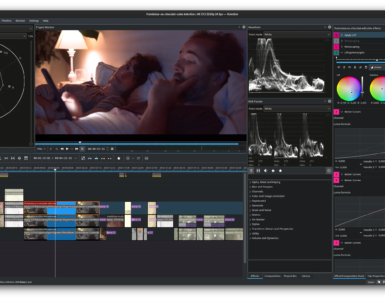
In the post-production category, Adobe was demonstrating how AI is now under the hood of many of its products, such as Premiere Pro, After Effects, Frame.io, and Substance 3D. Adobe also showed Premiere running on the iPhone. This emphasis on mobile-first editing reflects the way learners increasingly create and consume video on their phones, and points towards a further democratisation of professional editing tools.
Systems for managing large volumes of media were well represented, with companies such as Limecraft, Kaltura, Enghouse, Axle AI and MomentsLab. These combine traditional media asset management with AI-powered recognition of faces, objects and logos, as well as automatic transcription in multiple languages. For educators producing video-rich learning materials, such tools promise an end to the painstaking task of cataloguing and tagging content. Imagine a university’s video archive where lectures, experiments or student projects can be instantly searched and repurposed — not by memory or file names, but by the people, text and audiovisual objects they contain. A good illustration is Temasek Polytechnic in Singapore, where MomentsLab has already streamlined media access for staff and students. Limecraft presented its enhanced Limecraft Panel for Adobe Premiere Pro, which now supports uploading and exchanging full sequences directly from within Premiere.
Underlying many of these advances is the cloud, particularly through the growing presence of Amazon Web Services (which seemed to be present everywhere), Google and other cloud service providers. An eyecatcher on the AWS stand was the generative AI hologram that responds to human input, while on the Google booth in the IBC Accelerator area, they demonstrated an orchestrator that understands and integrates multiple agents to automate and control complex workflows in for example the newsroom, but the underlying architecture can be deployed in other production situations too.
One of the major talking points at IBC2025 was how agentic AI is beginning to transform the technical side of media production. On the creative side, tools are emerging that can automatically edit footage, cut trailers, pull out highlights and even enhance image and audio quality. What makes these developments particularly noteworthy is that they are designed for people without advanced technical skills. Small production companies and media partners, for example, can now interact with an AI in plain language and see it generate professional-looking video content. For education, where digital learning environments often rely on multiple platforms that rarely communicate smoothly, the ability to orchestrate systems into a coherent whole could be transformative. From automating lecture recording distribution to integrating transcription, summarisation and student-facing publication, these technologies point towards a future where educators may spend more time teaching and less time fighting the systems.
At the same time, behind the scenes, a different type of AI is quietly reshaping workflows. These systems, invisible to viewers, ingest large amounts of content, tag it with accurate metadata, check compliance, and handle rights and distribution with minimal human intervention. Instead of multiple disconnected systems, orchestration agents act as conductors, ensuring every part of the production and distribution pipeline works together efficiently.
What distinguished IBC2025 from earlier editions was the clear impression that innovations like these are no longer the exclusive domain of broadcast professionals. The convergence of AI, cloud and collaborative platforms means that educators now have access to tools capable of reshaping media production for teaching and learning. Whether through AI-generated video summaries, orchestration platforms, or high-quality but affordable production equipment, the trends point directly to the future of education as much as to entertainment. The buzz at IBC was less about the latest camera and more about how storytelling, media creation and automation are changing the way we communicate and share knowledge. Stay tuned for further innovations at the intersection of media and pedagogy.
Author

Mathy Vanbuel, ATiT, Belgium
Mathy is currently serving as Media & Learning Association President.