by Ines Springael, Breda University of Applied Sciences, the Netherlands.
This article is part of the “Centres for Teaching and Learning” series, a collection of interviews and articles exploring the diverse roles and innovative practices of CTLs, presented by the Media and Learning CTL Special Interest Group. In this series, we invite one of our members each month to introduce their CTL, describe the work they do and to highlight some of the challenges they face.
When I took on the leadership of CTL at BUas, I did not inherent a blank slate, but two functioning programmes that had been running in two years, each doing important work, each with its own momentum.
One was our AI Programme, which we had been building and I was leading since 2023. By the time the merge happened, it was operating at scale — around 7,500 users institution-wide using an LLM, with an AI training infrastructure, an ethics and education policy, and a network of AI Pioneers embedded across our five academies. The other was a Community for Teaching and Learning, a more emergent structure built on peer learning networks and grassroots faculty initiatives, with frontrunner ambassadors connecting across disciplines.
Both were valuable. Both had real engagement. But they were operating separately. Competing for faculty attention, duplicating some efforts, and creating confusion about where people should go for support. Educational support at BUas was scattered across the AI Programme, P&O training, academy-based educational designers, and multiple communication roles. Faculty were asking a reasonable question: where do I go for help?
The answer we arrived at was not to choose between the two programmes, or to let one absorb the other. The integration decision was about recognising that each brought something the other lacked and that together they could create something neither could be alone.
What the AI Programme brought was professional infrastructure: the AI Strategy Compass as a guiding framework, a training team, structured experimentation and support, and the capacity to work at institutional scale. What the Community for Teaching and Learning brought was bottom-up energy: peer networks, faculty frontrunners with local credibility, and authentic community connection.
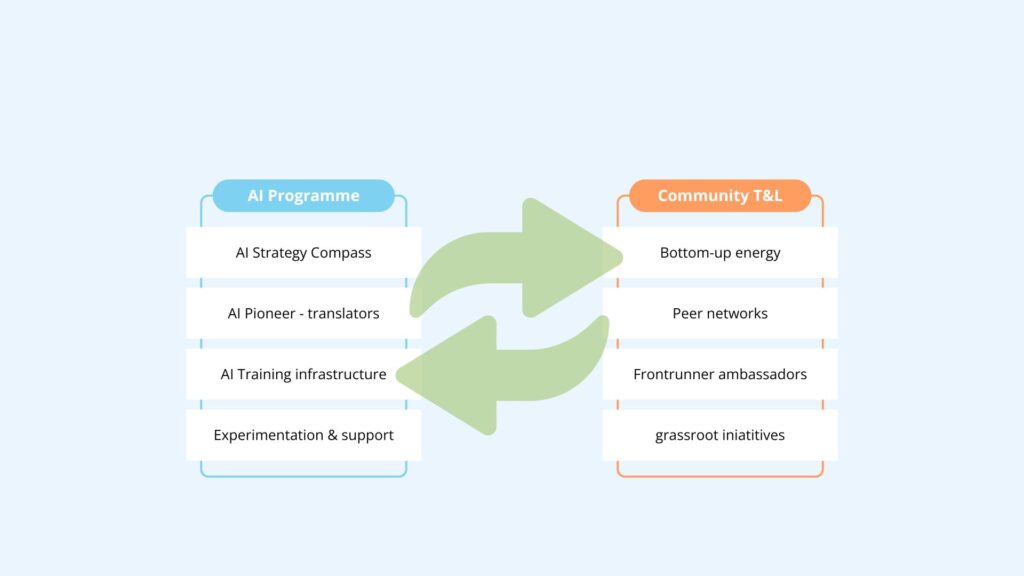
The complementary strengths diagram showing AI Programme vs Community T&L with exchange arrows
The first step in building the merged CTL was not to launch new initiatives. It was to consolidate what was already there. AI trainers were brought into the core CTL team. P&O training is being set up to be integrated into one coherent professional development landscape. Multiple communication roles became unified. Multiple entry points became a clear structure. This consolidation work was essential — without it, we would have been adding complexity on top of fragmentation.
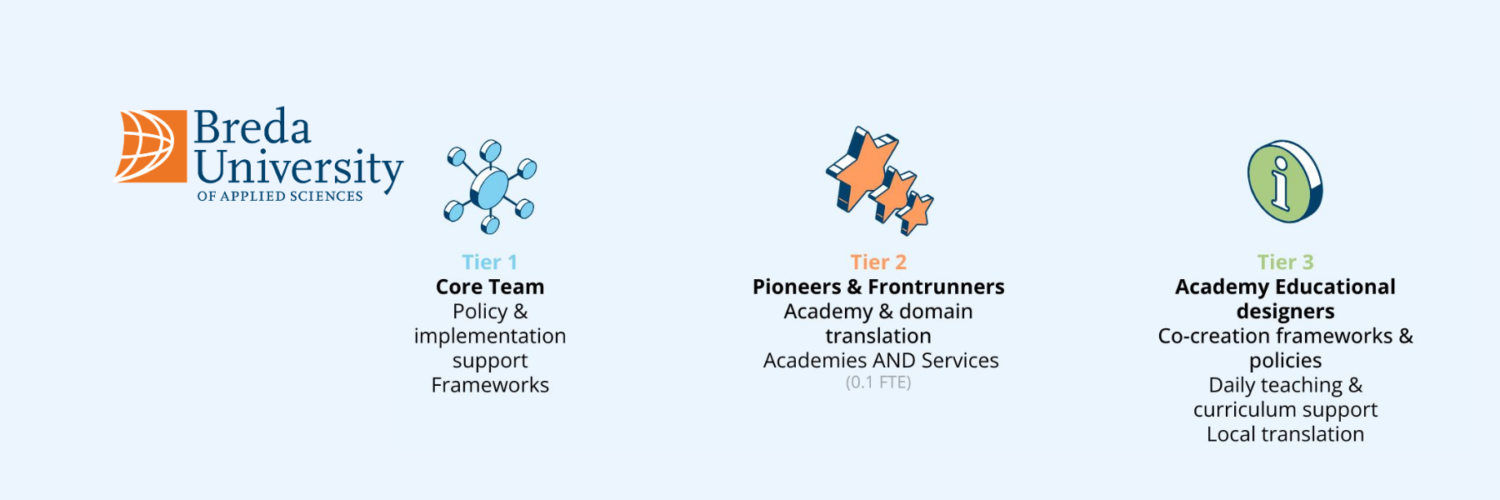
What emerged from that consolidation is a three-tier structure. The core CTL team, spanning professionalisation, educational and research innovation, and knowledge building — sits at the centre: creating policy, frameworks and standards, delivering training, and supporting implementation across the institution. Around that sits a network of Pioneers and Frontrunners, they Are embedded locally across academies and services, each with 0.1 FTE dedicated to this work, positioned to translate the frameworks into local contexts. And connected clearly to both is a third tier of academy-based educational designers, who co-create the frameworks and implementation plans together with the core CTL team while providing daily teaching and curriculum support.
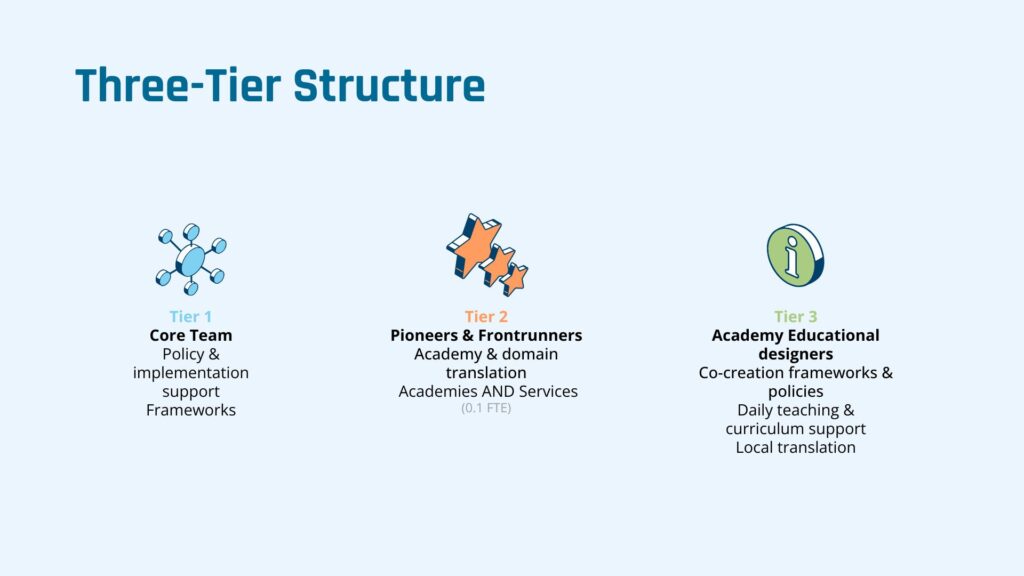
Diagram showing Core Team / Pioneers & Frontrunners / Academy Educational Designers
The scope expanded too. The AI Programme had, by definition, been about AI. The CTL mandate is broader: with AI sustainably embedded as one of six strategic areas alongside teaching quality, community and knowledge sharing, professionalisation, research and innovation, and external impact. The ambition for 2029 is to be the undisputed hub for professional development, knowledge sharing, and educational innovation at BUas .
We are not there yet. The CTL was formally established in May 2026, and we are still learning what the merger means in practice. How do three tiers work together without creating new silos? How do we communicate a broader scope without losing the focus and energy that made the AI programme work? How do we protect space for innovation while also building the standards that an institution needs? These are live questions, not solved ones.
But I think that honesty is part of what makes this story worth sharing. This is not a polished success story. It is real organisational change: messy, iterative, and built on the confidence that we are working with something that was already functioning rather than starting from zero.
The question I want to leave with anyone reading this is not “how do we build a CTL?” It is: what already exists in your institution that could be stronger together? Before you design something new, look for the complementary strengths that are already there, probably in different structures, not yet connected. For us, it was professional capacity on one side and authentic community energy on the other. Merging them created something more sustainable than either could have been alone.
That principle, I think, resonates.
Ines Springael is Programme Lead CTL/AI & researcher at Breda University of Applied Sciences (BUas). She is the author of the AI Strategy Compass and co-organiser of the Teaching and Learning with AI in Europe conference (19–20 October 2026, BUas Campus, Breda). Contact: springael.i@buas.nl
Ines Springael, Programme lead CTL/AI & researcher, Breda University of Applied Sciences, the Netherlands