
by Brian O’Neill, Technological University Dublin and Council of Europe expert, Ireland.
In an era defined by a rapidly evolving digital environment and complex information ecosystems, the capacity of citizens to critically navigate media content has evolved from a vital educational activity into a fundamental democratic imperative.
This is one of the key messages in new policy guidance from the Council of Europe’s Steering Committee on Media and Information Society (CDMSI). Titled National Media and Information Literacy (MIL) Strategies: Practical Steps and Indicators, the guidance document aims to support the development and implementation of national MIL strategies, which serve as a foundation for empowering citizens in the digital age.
The CDMSI, under the authority of the Committee of Ministers, steers the Council of Europe’s work on freedom of expression, media, internet governance, and other information society-related issues, and oversees its work on personal data protection.
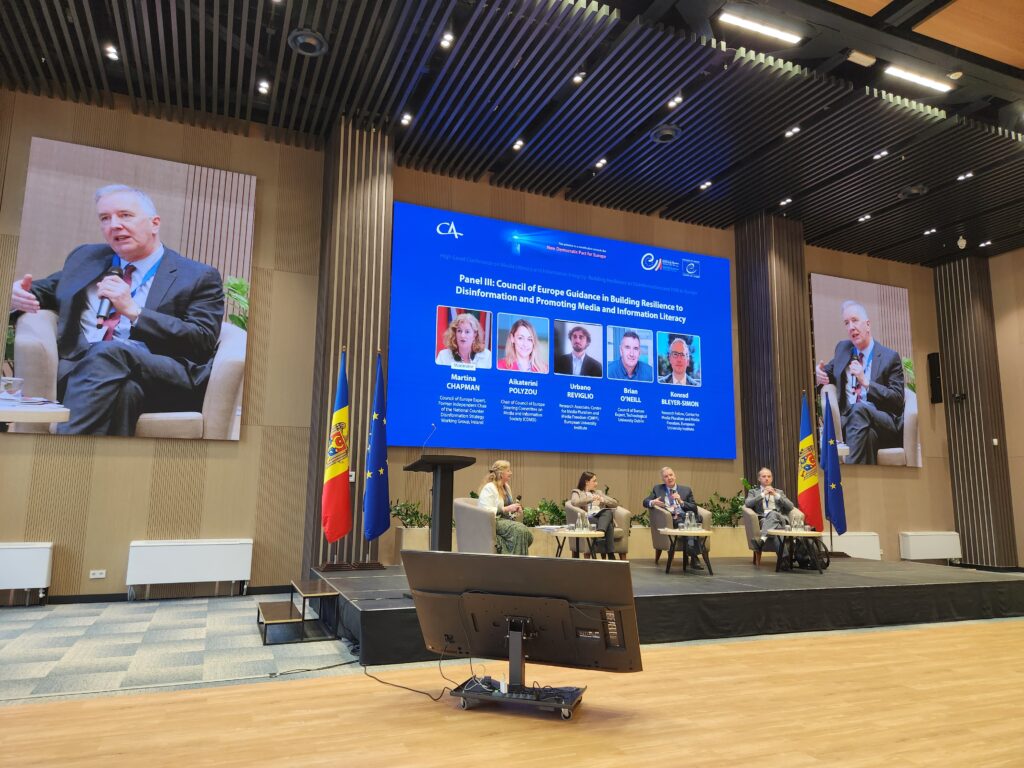
Formally adopted at the CDMSI’s 28th plenary meeting and launched at the high-level conference on Media Literacy and Information Integrity, held in Chișinău under the Moldovan Presidency on 20 March 2026, the document was a key commitment under the committee’s 2024–2027 terms of reference.
The framework forms part of the New Democratic Pact for Europe – an initiative spearheaded by the Secretary General of the Council of Europe to revitalise contemporary democracy by reinforcing public trust, expanding citizen participation, and bolstering institutional resilience. According to the guidance, robust national MIL strategies directly contribute to this democratic renewal by empowering citizens to engage critically with information and to participate actively, continuously and responsibly in accordance with standards of democracy, human rights and the rule of law.
Practical guidance and collaboration
MIL has been a strategic priority for the Council of Europe for the past twenty years. Many of the Council of Europe’s key statements on the media and information environment have emphasised the importance of building societal capacity to support citizens in making informed decisions about the media and information sources they use (both traditional and new digital media) and in using them effectively and responsibly.
To develop practical, actionable guidance on implementing MIL strategies at the national level, the new guidance synthesises the Council of Europe’s collective contributions to MIL policy, drawing on its extensive body of legal texts, recommendations and studies across the media environment.
Five pillars of a national MIL strategy
To facilitate coordinated national MIL strategies, the document organises practical steps around five core priorities or prerequisites. Effective national strategies are urged to address all five components simultaneously to build a successful multi-stakeholder alliance.
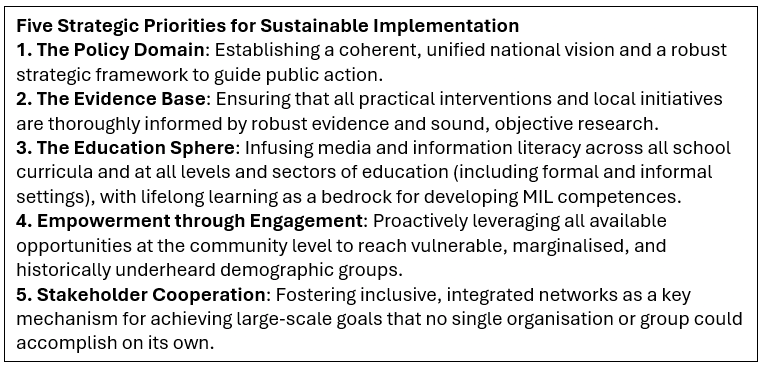
Each topic includes practical steps for implementation, supported by references to Council of Europe instruments to guide development. Indicators, in the form of descriptors, assist in the practical interpretation of each topic and also serve as a checklist for assessing overall implementation levels in accordance with the framework.
A human-centred digital transformation
Central to the approach to MIL outlined in the policy guidance is the notion of a human-centred digital transformation focused on the core elements of communication, human meaning, and signification. This is elaborated further in Part II of the document, the explanatory memorandum providing the conceptual and contextual foundations for national MIL strategies and their alignment with a humanistic emphasis on individual agency and critical autonomy. From the Council of Europe’s perspective, this is inextricably bound up with its mission of upholding fundamental human rights – especially the right to freedom of expression and information (Article 10 ECHR) – for which MIL is an essential enabler and a precondition.
The document, National Media and Information Literacy (MIL) Strategies: Practical Steps and Indicators (2026), is available on the Council of Europe website.
Author
Brian O’Neill, Emeritus Research Fellow, Technological University Dublin and Council of Europe expert.