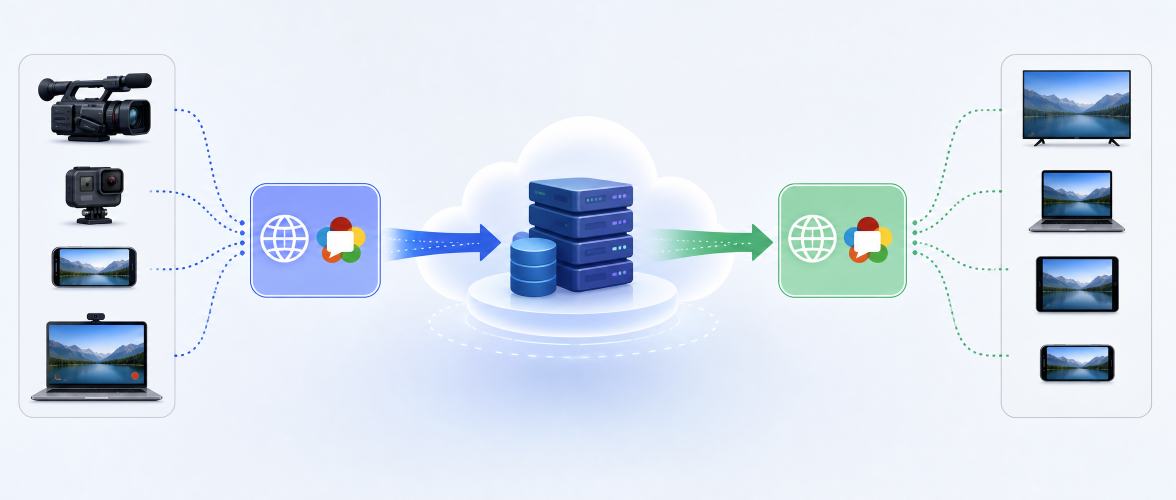
Educational media productions often already use tools such as vMix Call, where remote speakers simply click a link and join a live production from their browser. New open standards called WHIP and WHEP are extending this idea beyond individual products, making browser-based live production more interoperable and easier to integrate with a growing range of production and cloud platforms.
Live streaming is an essential part of university life, supporting lectures, conferences, webinars and hybrid events, but producing professional live video often still requires dedicated hardware and software, complex set up and configuration and powerful computers. New open standards known as WHIP (WebRTC-HTTP Ingestion Protocol) and WHEP (WebRTC-HTTP Egress Protocol) could change that. WHIP and WHEP make it easier to send and receive live video over the internet using a standard web browser. They simplify the connection between cameras, presenters and production systems while maintaining the very low delay needed for interactive teaching and live events thanks to the underlying WebRTC technology.
WHIP and WHEP are finding the first practical applications. OBS Studio now supports WHIP natively, allowing live productions to stream directly using WebRTC with less than one second latency. Cloud platforms such as Cloudflare Stream, Dolby OptiView and Amazon IVS have also adopted the standards. Browser-based live production is becoming increasingly accessible and attractive: a guest lecturer joins a live production simply by opening a browser and clicking on a secure link, without installing specialist software. A journalism student reporting from a campus event could use a laptop or smartphone as a live camera source. Medical students watching a live surgical demonstration could ask questions instantly, thanks to the low delay. Production teams could mix remote speakers, record the event, and then use AI tools to generate subtitles, summaries and chapters before automatically publishing the finished recording to platforms such as Panopto or Moodle. This may not be the reality in the coming year but it is an interesting evolution to follow up also with the technology providers in your organisation.
Image created with OpenArt