Last week, Nicola Bruno joined the European Literacy Coalition Co-creation Workshop in Warsaw to represent the Media & Learning Association.
The two-day meeting brought together stakeholders from across Europe for a series of co-design sessions and participatory discussions focused on strengthening literacy across different sectors.
The co-creation sessions were organised around four parallel workshops, each addressing a key dimension of the future Coalition. Workshop A focused on cross-sector collaboration, exploring how different actors can shape literacy policy together and engage new partners in the Coalition. Workshop B addressed the challenges of the digital era, including the balance between screen and print reading, critical reading skills for young learners, and the role of parents and educators as mediators of critical literacy. Workshop C examined how to improve citizens’ literacy competences across the life course, with attention to motivation, local literacy communities, and support for non-active readers. Workshop D concentrated on strengthening educators’ and other professionals’ competences, fostering cross-disciplinary collaboration, and supporting families in nurturing children’s love for reading.
The outcomes of these discussions will contribute to a EU Literacy Coalition Memorandum currently being developed, which is expected to be presented in Brussels on 22–23 September 2026.
Participants mainly represented the reading promotion sector, including libraries, publishers, and European literacy associations. Alongside them, a group of digital and media literacy organisations also took part, including Media and Learning and All Digital.
A key development emerging from the meeting was the European Commission’s expressed interest in strengthening the role of digital literacy within the broader literacy debate. Discussions highlighted the importance of balancing traditional reading promotion policies with competences linked to digital environments, media literacy, and AI literacy.
During the working sessions, Nicola Bruno advocated for a stronger integration of media literacy and AI literacy into future literacy policies and initiatives at the European level.
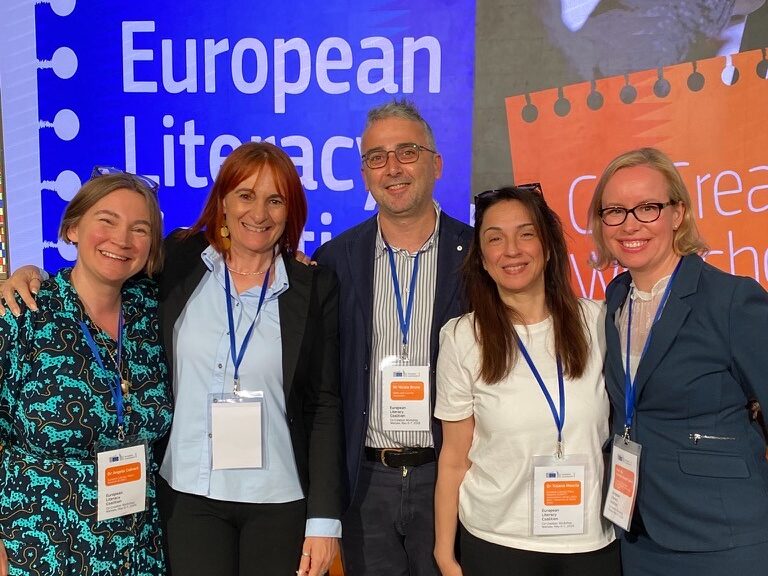
From left: Angela Colbert (University of Sheffield), Jenny Poletti Riz (Università di Modena e Reggio Emilia), Nicola Bruno (Dataninja and Media and Learning), Tiziana Mascia (University of Urbino, Associazione Literacy Italia), Winnie-Karen Giera (University of Potsdam)