by Mathy Vanbuel. Media and Learning Association
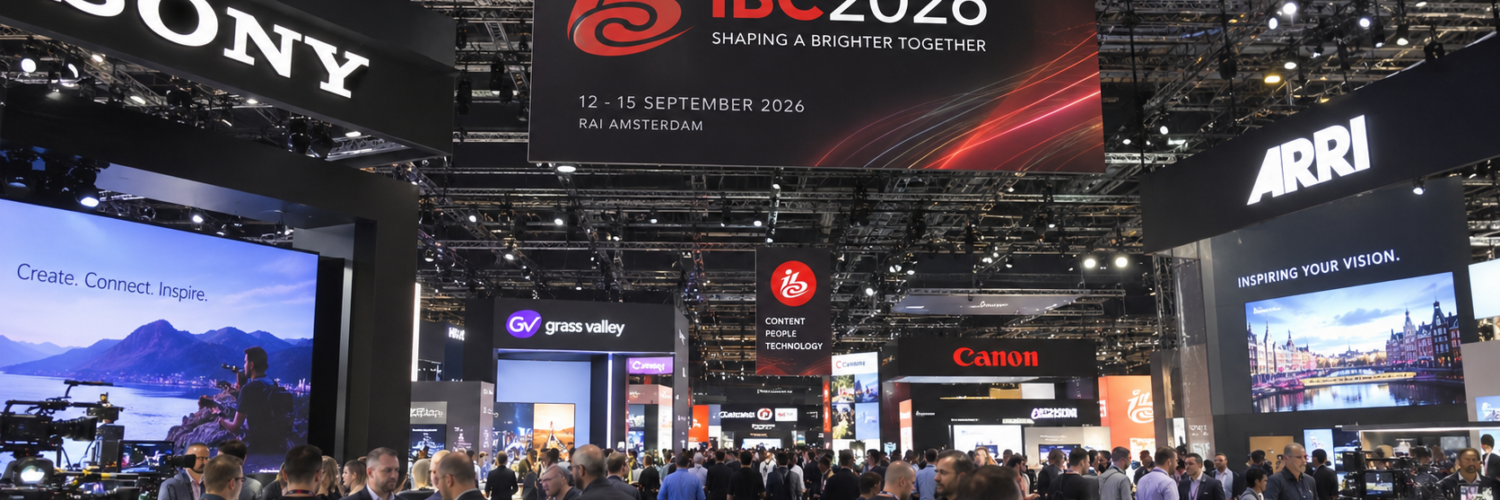
Walking around IBC2026 in Amsterdam, my main impression was not one spectacular new technology. It was that many technologies we have been talking about for years – AI, IP video, remote production, PTZ cameras, virtual studios and software-based production – are finally becoming easier to combine and, importantly, easier to use. That matters for higher education. Universities produce lectures, interviews, podcasts, webinars, events, simulations and promotional material, but rarely have the production teams or budgets of broadcasters. At IBC, I saw a clear movement towards doing more with fewer people. Here is a short nut certainly not exhaustive selection of what caught my attention.
PTZ cameras are a good example. They continue to get better at automatically following and framing presenters. Panasonic Connect, a Media & Learning Association sponsor, showed its latest camera and production developments alongside KAIROS. Canon and Sony are moving in much the same direction. For me, reliable automatic framing is more interesting for education than yet another increase in resolution. If one person can operate several cameras in a lecture theatre or studio, that can really change what a university can afford to produce.
Audio remains equally important. Sennheiser continues to develop its Spectera digital wireless system and tools for easier management and monitoring of wireless audio. Universities may not need all the sophistication of a major broadcaster, but making microphones easier to manage across studios, lecture theatres and events certainly has value. Good educational video still starts with good sound. Both Sennheiser and Canon were referring to recent large scale deployments in Dutch universities.
Automation was visible everywhere. multiCAM Systems is interesting because it can automatically select camera shots based on who is speaking. I can see obvious applications in recording lectures and panel discussions, but also in medical and nursing simulation and teacher training, where several participants may need to be recorded without a large production crew.
Vizrt also caught my attention. TriCaster continues to bring switching, recording, streaming, graphics and increasingly automation into one production environment, while browser-based control makes these systems more accessible. NDI, which is the core technology of Vizrt, is particularly relevant for universities because video sources can be moved around an existing IP network. That opens interesting possibilities for connecting studios, classrooms and even different campuses without building a traditional broadcast infrastructure. Vizrt’s CaptureCast also connects this type of production workflow with platforms already familiar in education, including Kaltura, Panopto and Opencast. Virtual production continues to mature as well. Zero Density demonstrated its Reality virtual production platform and camera-tracking technology. What interests me here is not necessarily creating spectacular television-style virtual worlds. A relatively small university studio could become a lecture studio, news studio, interview set or simulation environment simply by changing the virtual setting. Particularly interesting for our sector is that Zero Density offers universities and higher education institutions free access to its Reality software for educational purposes.
Perhaps the most important wider trend is the move towards IP and remote production. Cameras, studios and production teams no longer necessarily need to be in the same location. For universities with several campuses, this is particularly interesting. A central media team could support recordings and events at different locations without having to send a complete production crew everywhere.
AI was, unsurprisingly, everywhere. What I found encouraging was that the discussion seems to be moving away from simply putting “AI” on every product. The useful applications are becoming clearer: automatic camera operation, transcription and subtitling, searching media archives, creating clips, improving images and sound and taking repetitive production tasks away from people. NDI and NVIDIA, for example, are exploring real-time AI-powered multilingual production. For an international university, the possibility of producing a lecture once and making it accessible in several languages is obviously interesting, even if human checking will remain essential.
There was another impression: on Monday, the exhibition felt noticeably quieter than I was used to in my previous visits to IBC. From a visitor’s point of view, that was actually rather pleasant. It was easier to navigate the halls, spend time looking at products and, most importantly, have proper conversations with exhibitors without having to compete with large crowds. The quieter final day may perhaps also reflect a professional media market in which organisations are thinking more carefully about investment, staffing and how long equipment can remain useful. Universities are certainly familiar with that reality. One small disappointment was that by around 15:00 on Monday quite a few exhibitors were already starting to pack up.
My main takeaway from IBC2026 is positive for higher education. The most interesting developments are not necessarily the biggest screens, the highest resolutions or the most spectacular demonstrations. They are technologies that make professional media production simpler: automatic tracking, remote production, IP workflows, better audio, virtual studios and sensible uses of AI. For educational media production, the question is no longer simply “Can we produce this?” but rather “Can we make the workflow simple and affordable enough that we can produce it regularly, with the people and budgets we actually have?” From what I saw in Amsterdam, that is increasingly where the industry is heading.
See you in ISE or IBC next year to see if the trend persists!