by Juuso Kojo, University of Oulu, Finland.
For the past two years, my colleagues and I in the Finnish EduMedia project have been asking a simple-looking question: if every higher education institution has the studios, the cameras, the editing software, and motivated teachers who say they want to make pedagogical media, why isn’t more of it being made?
We thought we knew the answer. We thought it was a skills gap. So, we built a course.
From the start, we wanted the course to do more than teach tools. Drawing on Richard Mayer’s work on multimedia learning, we treated pedagogical media as a cognitive tool, not just a digital surface added to teaching: something that can reduce learners’ load and support understanding when designed well. We also wanted teachers to see themselves not just as users of existing media or clients of studio production, but as independent makers of pedagogical media. And because speaking in a lecture theatre is not the same as speaking to a camera, we included coaching in digital presence and on-camera performance, still rarely covered in faculty development.
The premise was that competence is the ultimate time-saver. A teacher who has mastered the whole workflow, from concept through script to AI-assisted editing, can produce high-quality media efficiently and independently. We believed in that premise, and for two years we in partnering institutions, the University of Oulu, Laurea UAS, and Haaga-Helia UAS put it to the test.
Eighty teachers have come through the course across two runs. About forty completed it in full. Eighteen finished a piece of media.
That number, eighteen out of eighty, is what made us stop and think. These were not teachers who had failed. They were motivated enough to sign up, engaged enough to give us strong feedback, competent enough by the end of training to make what they had planned. And yet most of them did not get that far. When we asked why, the answer was remarkably consistent, almost word for word: “I would use these skills if I had the time. Right now, my time is limited, and I must prioritize.”
It turns out this pattern is not new. In 2015, Mary Sarah-Jane Gregory and Jason Lodge called academic workload allocation “the silent barrier” to technology-enhanced learning in higher education. Silent because, unlike infrastructure or training shortages, it is rarely where the institutional conversation begins. Universities discuss platforms and policies. They talk much less about how teacher hours are counted. Pedagogical media production — scripting, storyboarding, recording, editing, versioning, all happening before a single student sees the finished product — is exactly the kind of design-and-development work that traditional workload models, built around contact hours, struggle to recognise.
So, our original premise needs an amendment. Competence is the ultimate time-saver, but only where institutional structures allow that time to be deployed. Without that, training builds capacity with nowhere to go.
Now, what might begin to shift the barrier? In our project, we saw several practical ways to ease media production, though most remain partial answers. One useful example is that teachers can “feature” in each other’s productions, much like musicians do. A podcast or short video built by one colleague becomes a guest spot for another, and the same content can travel into a different course or programme. The per-teacher cost falls, but the more interesting effect is the informal cross-disciplinary network that grows along the way.
Another partial answer is to move some production support out of a single central media unit and into the faculties themselves. This means someone who knows the discipline, sits near the teachers, and can help make something in an afternoon rather than after a booking process. Centralised studios still have their place, for example, for large online programmes. But everyday pedagogical media production works better with help that is close at hand.
But the foundational change is this: pedagogical media production needs to appear in workload allocation as recognised work, with hours attached to specific people and specific outputs. Without this, all the other changes remain workarounds. Putting all this into the workload models is the easier part. The harder question is how institutions make room for it — a question of priorities, funding, and recognition that deserves its own article.
I made this case at Media & Learning 2026 in Leuven in June, and the conversations afterwards confirmed that this is not a Finnish problem alone. The barrier remains silent because we rarely ask where this work belongs in our workload models, or what choices would make that time real. If your institution is asking that question, I would be interested to hear what you are learning.
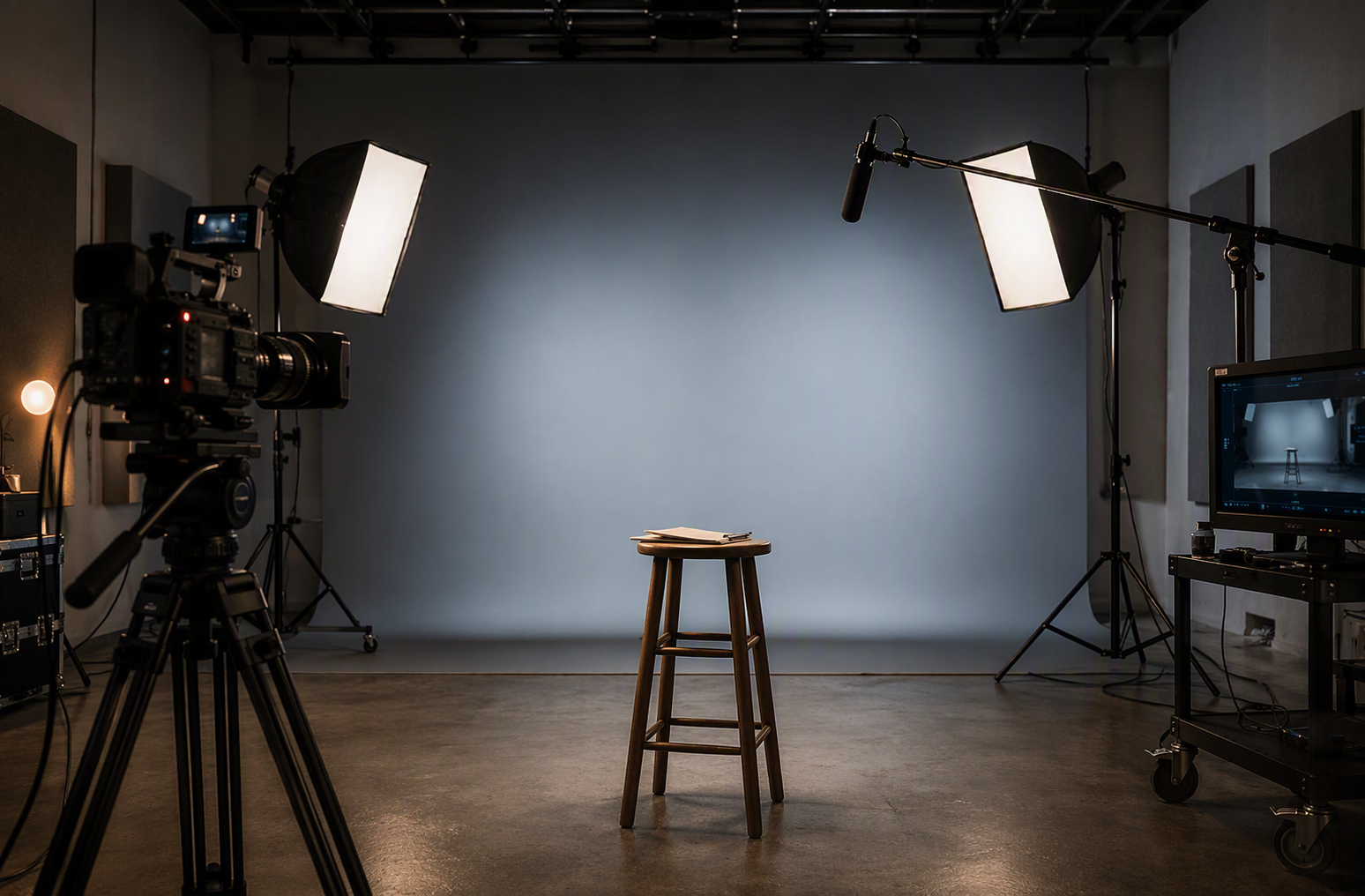
Image: Microsoft CoPilot Designer
Editor’s note: This article is written based on the author’s presentation ” From Studio Bottlenecks to Teacher-Producers: A Skills & Support Map for Scaling Pedagogical Media on Shrinking Budgets” during the Media & Learning conference in Leuven, June 2026.
Juuso Kojo is an educator and digital pedagogy specialist at the University of Oulu’s Faculty of Education and Psychology, where he mentors teachers and leads teaching digitalisation efforts. With over twenty years of experience across all levels of education, his work centres on practical, pedagogy-first approaches to digital transformation — covering generative AI, media production, digital learning environments, and micro-credentials. A key focus is understanding why pedagogical innovation so often stalls in practice, and developing realistic tools and frameworks that work within teachers’ everyday constraints. He shares his work at Finnish and international conferences and writes for both research and practitioner audiences.