This article is part of the “Centres for Teaching and Learning” series, a collection of interviews and articles exploring the diverse roles and innovative practices of CTLs, presented by the Media and Learning CTL Special Interest Group. In this series, we invite one of our members each month to introduce their CTL, describe the work they do and to highlight some of the challenges they face.
This month’s interview is with Sanna Eronen from the OPE Centre, University of Oulu, Finland.
In an increasingly complex higher education landscape, teaching quality and educational development have become strategic priorities for universities. Centres for Teaching and Learning (CTLs) help higher education institutions translate these priorities into practice by supporting staff development, educational innovation, and continuous improvement. At the University of Oulu, OPE serves as the university’s strategic hub for pedagogical support and development.
Can you describe your CTL?
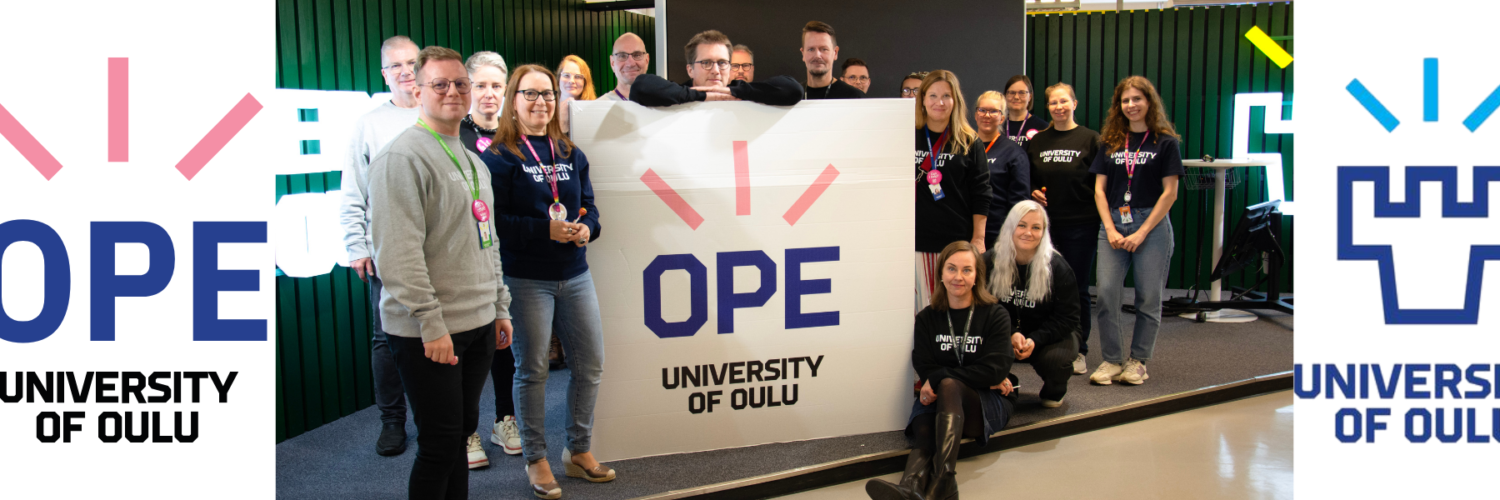
When we established the Centre for Pedagogical Support and Development (OPE) at the University of Oulu in 2025, we wanted to create more than a centralised support service. Our aim was to build an expert partner for educational change: close enough to academic staff to understand everyday teaching, and well-positioned enough to contribute to institutional development.
OPE brings together higher education pedagogy, digital teaching and learning, curriculum development, teaching and learning technologies, online course production and media services. This breadth matters because many teaching challenges today sit precisely at the intersection of pedagogy, technology, curriculum and media.
What were you aiming to build when OPE was established?
From the beginning, we built OPE to work on three interconnected levels: individual support, community-level development and organisational influence. We support teachers through training, consultations and help with pedagogical and digital-pedagogical questions; work with teaching teams, degree programmes and curriculum development; and contribute to strategic development and the university community’s capacity to learn, renew itself and value teaching.
For a CTL, this positioning matters. If a centre is seen only as a helpdesk, its strategic role remains invisible; if it is seen only as a strategic unit, it risks becoming distant from teaching. OPE aims to hold these roles together: useful in everyday teaching, trusted in development work and recognised as a contributor to cultural change.
What kind of context does OPE operate in?
OPE works within the University of Oulu’s wider educational development ecosystem. Our work is guided by the university’s strategy and the University Pedagogy Programme, which sets out steps for advancing teaching, strengthening pedagogical competence and increasing the recognition of teaching across the university.
We collaborate closely with Education Services, ICT Services, faculty-based actors, university pedagogy specialists, and national and international networks such as the Finnish Network for Higher Education Pedagogy and the KOUKE network for higher education experts and developers. This ecosystem matters because pedagogical support is rarely just an individual service: it is also about building shared structures, common language and sustainable conditions for educational development.
How is pedagogical support organised at your university?
Our support covers teaching design, implementation and assessment; pedagogical and digital-pedagogical competence; curriculum and programme-level development; digital tools and learning analytics; online course production and media services; and the pedagogically and ethically sustainable use of AI in teaching. What makes the model distinctive is not only the range of services, but the way these areas are intentionally connected.
OPE acts as a connector across the university: between central services and faculties, digital support and pedagogical development, media production and course design, and individual teachers’ needs and programme-level priorities. This role is especially visible in curriculum work and support for degree programmes, where pedagogical questions are part of broader conversations about coherence, assessment, workload, digital environments, generic skills and the future direction of education.
What does the support look like in everyday practice?
In everyday practice, OPE offers open training sessions and events for collaboration and sharing, consultations, tailored support, guidance on teaching systems and digital environments, and responses to service requests. But our approach is not only reactive. We actively go where the conversations already are: to faculties, degree programmes, development groups and teaching teams.
For us, approachability is built through presence, not simply promised in service descriptions.
What kinds of expertise are needed in a centre like OPE?
Working in OPE calls for hybrid expertise. We need people who understand pedagogy, digital teaching, assessment, curriculum development, learning environments, media production and online course design — and who can translate between these areas.
A question about a video, an AI tool, Moodle, assessment or curriculum design is often also a question about learning, workload, accessibility, engagement and educational quality. This is why OPE combines pedagogical, digital and media expertise in one centre rather than treating them as separate services.
Many centres struggle with questions of resources and expectations. How do you approach this?
We approach resources and expectations by being deliberately visible, approachable and willing to move. We do not wait for people to contact us; we visit faculties, meet people in their own contexts and make pedagogical support part of ongoing academic conversations.
During the spring, we met all degree programme directors and organised AI-related support activities for every faculty. This outreach takes effort, but for us it is essential: if a pedagogical centre wants to matter, it must show up. Visibility also helps us prioritise: it gives us a better understanding of what teachers, programmes and faculties actually need.
What has helped OPE gain traction?
Several things: our consultative way of working with everyday teaching challenges, growing partnerships with faculties and degree programmes, a networked approach across support services, opportunities to recognise teaching expertise, and a research-based approach to development. Our active engagement in national networks also helps us connect local development with broader conversations on advancing teaching in higher education.
A distinctive part of our role is the connection between pedagogical support and university pedagogy development. In 2025, OPE was given responsibility for coordinating and monitoring the University Pedagogy Programme and for developing university pedagogy training in collaboration with the Faculty of Education and Psychology. The programme provides a shared framework for strengthening teaching identity and competence, supporting educational development and increasing the appreciation of teaching as a core part of academic work.
We also want to strengthen the research basis of educational development. The university-level Teaching Research Network, launched in 2025, brings together people interested in research-informed teaching development and makes visible that teaching development is not only practical support, but also knowledge-building within the academic community.
And what challenges have you encountered?
One clear challenge is the growing need for everyday teaching support. Feedback collected from autumn 2025 onwards shows that staff value low-threshold consultation and practical training that directly supports course and teaching development. At the same time, workload pressures, limited time for pedagogical development and the rapid growth of AI-related support needs are increasing expectations.
For CTLs across Europe, this is likely to feel familiar: expectations are expanding while teachers’ time and institutional resources remain limited. The challenge is to remain accessible and practical without losing the capacity to contribute to longer-term educational change.
What advice would you give to institutions developing pedagogical support structures?
Our experience suggests that pedagogical support structures become stronger when they combine low-threshold everyday support with strategic development, work through partnerships and create shared structures for teaching expertise. Centres also need to be visible enough to be invited into the real work of teaching and curriculum development.
It is not enough to offer support in principle: people need to know who you are, what you stand for and why it is worth working with you early rather than late. For us, this has meant building visibility, accessible service paths and cross-university collaboration at the same time.
In 2026, our focus is on implementation and impact: making our partnership role and services known and accessible across all eight faculties, strengthening curriculum-related support, pedagogical well-being, aligning our production services with strategic needs, expanding English-language support and reinforcing AI capability in education. Ultimately, our work is about advancing a university culture in which teaching is not treated as secondary to academic work, but recognised, developed and valued as one of its core responsibilities.
“Our name OPE carries a double meaning in Finnish. It echoes both opettaja, teacher, and opetus, teaching. In everyday Finnish, ope is also a warm and familiar way of referring to a teacher. For us, the name captures our purpose: to provide approachable support for the development of teaching competence and teaching itself across the university.”

Sanna Eronen is Director of OPE, Centre for Pedagogical Support and Development at the University of Oulu, Finland. Having worked in a range of pedagogical development and educational leadership roles throughout her career, she now leads university-wide initiatives that support teaching excellence and educational innovation. Since 2025, she has played a key role in building the Centre and shaping its services for educators. Her current interests include supporting faculty development, pedagogical leadership and well-being, and the meaningful integration of AI into higher education.