
This article constitutes the contribution of the Media & Learning Association to the Audiovisual Media Services Directive (AVMSD) public consultation launched by the European Commission on 10 February 2026, on the evaluation and possible revision of the Directive.
The Media & Learning Association represents a broad network of stakeholders active in digital and media literacy across Europe, including civil society organisations, academic institutions, and industry actors. Given the wide scope of the consultation and the diversity of topics covered, this contribution focuses specifically on Section IV – Protection of viewers, and in particular on media literacy provisions under Articles 28b and 33a of the AVMSD.
No input is provided on other sections of the consultation, as they fall outside the primary areas of expertise of the Association’s membership. This targeted contribution aims to provide evidence-based insights and recommendations on how the AVMSD can more effectively support the development of media literacy in Europe, particularly in the context of evolving digital environments and the growing role of video-sharing platforms.
Section 4: Protection of viewers
Media literacy (Articles 28b and 33a)
Explanation: Article 33a of the AVMSD establishes that Member States shall promote and take measures for the development of media literacy skills and report on their implementation to the Commission. Article 28b establishes the provision of effective media literacy measures and tools among the measures to be adopted by video-sharing platforms.
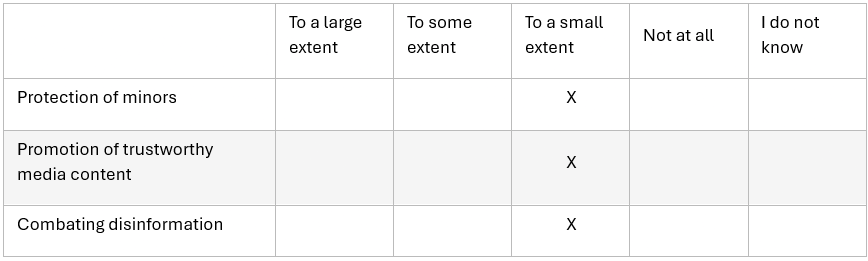
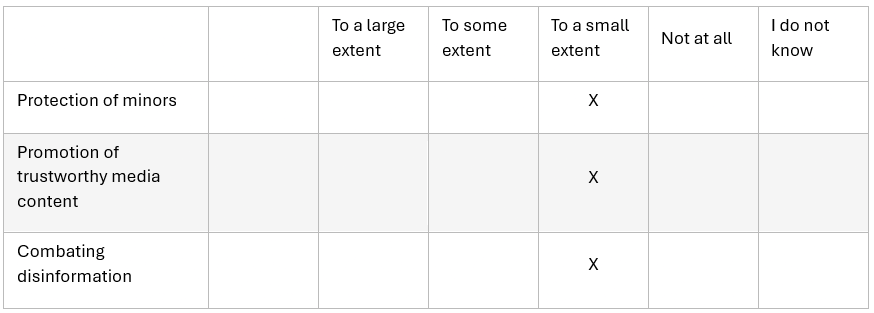
To what extent do you consider that measures taken by media market players under the current provisions on media literacy (Art. 28b and Art. 33a) are effective for the achievement of the following objectives?
By audiovisual media services
By video-sharing platforms
Please provide examples of measures that have been effective or ineffective and explain why.
The central challenge facing media literacy in Europe is not a lack of activity, but rather a lack of coherence, sustainability, and long-term vision.
Across Member States, the landscape is dominated by short-term, project-based initiatives, typically funded through limited, non-renewable cycles. While these projects often generate valuable outputs, they rarely lead to sustained impact. Once funding ends, activities frequently cease, resulting in repeated cycles of reinvention rather than cumulative progress.
This structural fragmentation has two major consequences. First, organisations spend disproportionate time and resources on securing funding rather than building durable infrastructures, communities of practice, and long-term strategies. Second, it prevents the development of robust, longitudinal evidence of impact, which is essential for informing policy and scaling effective interventions.
A growing body of evidence demonstrates that media literacy interventions can effectively improve critical thinking, source evaluation, and resilience to manipulation. However, the most impactful approaches are often difficult to scale. Addressing this requires a shift towards: train-the-trainer models, enabling multiplication of impact and formats that extend beyond formal education systems.
Despite these advances, the current European media literacy ecosystem remains disproportionately focused on school-age populations. Adults, and especially older adults, remain significantly underserved, even though they are among the groups most exposed to disinformation, particularly on video-sharing platforms, messaging applications, and television.
This imbalance represents one of the most significant gaps in current policy and practice. Addressing it requires:
- targeted programmes for adult and lifelong learning
- intergenerational approaches
- collaboration with civil society organisations beyond the education sector
Both audiovisual media services and video-sharing platforms have predominantly opted for short-term, non-structural campaigns. A short awareness video distributed by a broadcaster and seen by millions does not, by itself, change media literacy levels in any measurable way: exposure alone does not translate into learning.
Similarly, platform-led initiatives, including branded campaigns, microsites, or in-feed messaging, tend to prioritise visibility over measurable competence development.
This has led to a persistent gap between reach and impact, compounded by limited transparency and a lack of independent evaluation. As a result, current measures under Articles 28b and 33a can only be considered effective to a limited extent.
Self-regulation and professional standards. Unlike fact-checkers — who, through the IFCN Code of Principles (and the European EFCSN), have built a recognised mechanism to safeguard independence, methodology and accountability — media literacy practitioners in Europe operate without any equivalent standard. This creates two problems: it leaves practitioners structurally vulnerable to capture by funders (including VSPs), and it makes it harder for policymakers to distinguish independent, evidence-based providers from PR-driven activities.
We strongly recommend that the AVMSD review encourages the development of a European code of conduct / self-regulation framework for media literacy organisations, defining minimum standards on independence, transparency of funding, evidence-based methodology and evaluation. Such a framework — co-developed with the Media Literacy Expert Group, EDMO and the practitioner community (including networks such as the Media and Learning Association) — would strengthen the field as a credible policy partner and protect it from instrumentalisation. This framework could build on the existing EDMO Guidelines for Effective Media Literacy Initiatives already endorsed by almost 100 organisations active in Media Literacy.
With regard to the development of media literacy skills in the online environment, please select your preferred policy option:
Minimum specific obligations for VSPs: This approach would entail the introduction of AVMSD-related minimum specific media literacy obligations for VSPs, such as implementing tools or features to improve media literacy or providing age-appropriate content guidance, in addition to measures foreseen under Article 35 DSA as regards VLOPs.
The status quo and a non-binding guidance approach have demonstrably failed to produce VSP measures of meaningful scale and quality. Six years after the 2018 revision, VSP-led media literacy activity remains dominated by short-term campaigns whose reach metrics are not matched by evidence of competence change.
Article 28b should therefore establish minimum specific obligations for VSPs, structured along four lines:
(i) In-product media literacy by design. VSPs should be required to embed media literacy features directly into the user experience: contextual labels on manipulated or AI-generated content (aligned with the AI Act transparency obligations), source provenance signals, friction prompts before sharing potentially misleading content, and accessiblereporting flows usable by minors themselves. Media literacy cannot remain a separate, downstream activity disconnected from the interface where exposure actually happens.
(ii) Structural, multi-annual support for independent organisations. Funding for media literacy from VSPs must move from discretionary, reputationally driven grants to structured, multi-annual mechanisms with transparent allocation criteria and arm’s-length governance — for example through pooled funds managed independently of the funding platforms. Crucially, eligibility for such funding should be conditional on adherence to a European code of conduct / self-regulation framework for media literacy organisations (analogous to the IFCN Code of Principles for fact-checkers), defining minimum standards on independence, transparency of funding, evidence-based methodology and evaluation. Without such a framework, structural VSP funding risks reproducing the capture dynamics it is meant to overcome.
(iii) Explicit attention to under-served populations. Current VSP measures are overwhelmingly youth-oriented and school-adjacent, mirroring the wider European ecosystem. The adult population, and older adults in particular, remains the largest blind spot despite being among the most exposed to manipulated content on video and messaging platforms. Minimum obligations should explicitly require VSPs to design and support measures targeting adult and intergenerational audiences, in cooperation with civil society organisations active in lifelong learning.
These obligations should be developed with the Media Literacy Expert Group and reflect the European Democracy Shield’s emphasis on building societal resilience. They must complement, not substitute, public investment in formal and non-formal education.
With regard to the reporting obligation of Member States on the implementation of the media literacy provision, please select your preferred policy option:
Standardisation of Member States’ reporting: This option would entail a standardised approach for Member States’ reporting under Article 33a, for example through the use of digital tools and harmonised templates.
The current diversity of national reports under Article 33a makes it virtually impossible for the Commission, researchers and practitioners to compare progress, identify good practices, or measure the impact of EU funding.
A standardised reporting template — developed in cooperation with ERGA, the Media Literacy Expert Group, EDMO and the practitioner community — would substantially raise the policy value of these reports. It should include:
- Quantitative indicators: public funding allocated (with distinction between project-based and structural funding), reach segmented by age group (with explicit reporting on coverage of adult and older-adult populations, currently the largest gap in the European ecosystem), teacher training coverage, and continuity of funded initiatives over multi-annual cycles.
- Qualitative indicators: evaluation methodologies used, evidence of competence or behaviour change, integration into formal curricula, and cooperation with independent media literacy organisations adhering to recognised professional standards (such as a future European code of conduct for media literacy organisations, which we strongly recommend the Commission promote alongside the AVMSD review).
The template should be lightweight and digitally native (structured, machine-readable data) to avoid administrative burden, and reports should be published in an accessible EU repository so that civil society, academia and the practitioner community can build on them. Standardisation should not flatten national specificities but make them legible, comparable and actionable.
Media & Learning Association, 29 April 2026