by Paul Harison, European Broadcasting Union.
Across Europe, public broadcasters are becoming some of the most important allies in the media literacy space. From classroom visits to fact-checking services, Public Service Media (PSM) organisations are expanding their media literacy activities at a critical moment.
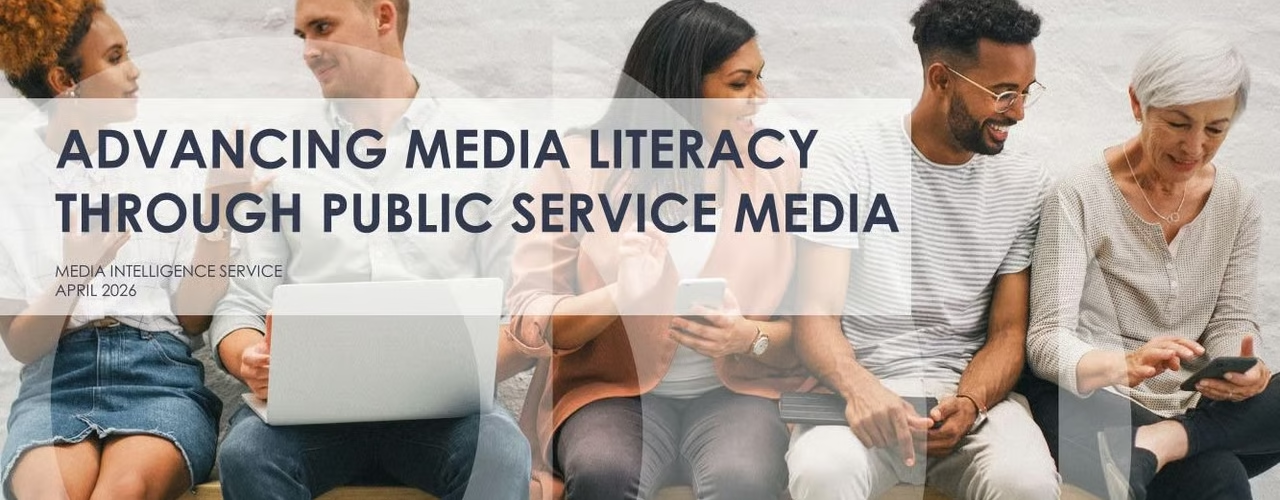
A new report from the European Broadcasting Union (EBU), “Advancing Media Literacy Through Public Service Media“, published in April, shows the scale of that effort for the first time since 2023. Drawing on survey data from 32 member organisations across 37 markets, it paints a picture of public broadcasters stepping up to support citizens across Europe.
The scale of the problem
The data is clear: only 60% of Europeans aged 16 to 74 had adequate digital skills in 2025, up from 54% in 2021, but still below the EU Digital Compass target of 80% by 2030. While progress continues, significant work is needed to be done. AI adds urgency, as most adults see digital skills as essential for responsible AI use, yet nearly two-thirds feel technology is advancing faster than they can keep up. Misinformation is a major concern, amid growing public anxiety about AI’s impact on journalism and the reliability of information.
Young people are at the centre of the debate. While most European adults favour social media bans for under-14s, academics are pushing back, arguing that bans alone are no substitute for genuine digital literacy education. The priority, they say, should be equipping children, parents and teachers with real skills.
What broadcasters are doing
At least 58 PSM organisations are now working on media literacy, with over 180 activities identified between 2023 and 2026. Children and educational institutions are the main focus: 93% of organisations collaborate with schools, and 87% target children as a key audience. PSM organisations rarely work alone. In our survey, 88% collaborate with national and regional partners, ranging from government bodies and regulators to media literacy alliances, local libraries, museums and adult education associations.
Their media literacy work spans school workshops, classroom visits, fact-checking services, AI awareness campaigns and youth safety programmes. Educational events alone account for roughly 40% of all recorded activities.
Within PSM organisations, the commitment is growing: three-quarters of EBU members rated media literacy as extremely or somewhat important in 2026, and every single respondent expects it to be a priority within five years.
PSM organisations remain strongly committed to news literacy, with a growing focus on helping citizens understand media content, up from 80% in 2023 to 94% in 2026. Online safety, cyberbullying and democratic participation are also increasingly on the agenda. Work on general digital skills has dipped slightly, from 77% to 67%, though generative AI stands out as the topic most organisations are preparing to tackle in the coming years.
Examples from across Europe
Across Europe, EBU members are developing innovative tools and resources. There is much great work being done by our members, but here is a flavour of what members have been working on.
In Sweden, SVT’s “Valkompass” (Voting Compass) is a widely used online tool helping voters identify which parties and candidates best match their views on key political issues. SVT worked with political scientists and media partners to produce this tool, which provided over 1.7 million matches since its launch in 2014. In Slovenia, RTVSLO’s “Digitalno Pametni” (Digitally Smart) series uses short videos and well-known public figures to tackle online safety, hate speech and social media use with young audiences.
Austrian broadcaster ORF produces “ZIB Magazin Media Wissen“, a monthly podcast tackling disinformation through in-depth expert interviews and analysis. In Italy, RAI’s “Digital World” programme explores fake news and disinformation through special episodes featuring journalists, academics and EU representatives.
Spain’s RTVE runs “VerificaRTVE“, a fact-checking service supported by public campaigns, student workshops and university partnerships to promote critical thinking and digital literacy. In Ireland, TG4 features in the report for two initiatives: the national collaborative Be Media Smart campaign, which encourages citizens to Stop, Think and Check, and “Iriseoirí an Lae Amárach“, a hands-on journalism training programme for students.
What comes next
The EBU is establishing a network of PSM staff to share ideas, exchange information, and develop pan-European solutions. If you work for a PSM organisation and would like to participate, please contact Paul Harrison.
Author
Paul Harrison, Project Manager, EBU Media and EBU Strategy Services – Corporate Development & Strategic Initiatives.