by Maria Diana Piele, University of Bucharest, Romania.
After-school assignments have turned into a masterclass in outsourcing over time. Two decades ago we were discussing the transition from physically browsing books to searching on Internet. Today, even searching and browsing the various sources offered by Google are no longer attractive due to artificial intelligence (AI). Tools like ChatGPT are reshaping paradigms and common educational activities (Parker et al., 2024).
Why does today’s student use AI?
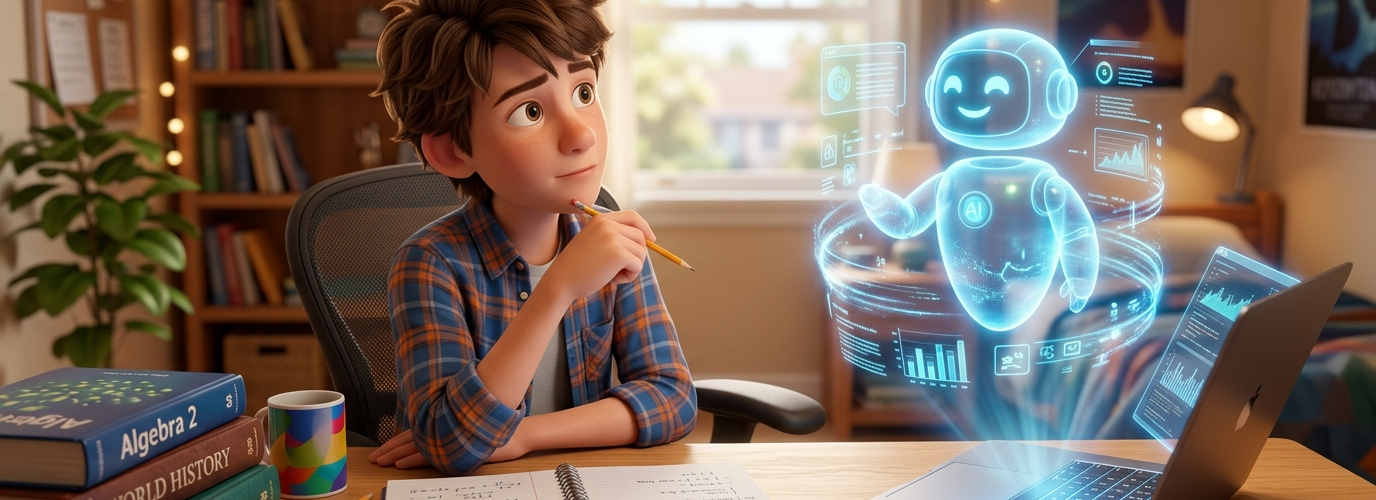
AI offers the student time reduction, effort minimization, and questionable assurance of the certainty of the content produced. These tasks, when completed correctly, can also lead to top grades or other rewards in the classroom. Some readers would now say that ”hero” teachers know how to ask questions or give assignments that cannot be done with AI. That is correct and sometimes… even applicable. However, we must consider that homework reflects various gaps in the classroom. Moreover, disciplines are different, some may appeal more to human thinking, while others require accurate information.
What is the magic of AI?
Homework with AI provides the illusion of competence. An interesting mental cycle occurs. The content generated by AI is correct and logical, and the students believe they understand. The teacher also believes that the students have understood. Moreover, time resources in teaching activity often does not allow the teacher to verify the cognitive effort behind each student’s homework. The system then offers a reward, even verbal, so that the students are motivated to continue this partnership with the AI.
What do we lose the most with AI?
The loss of creativity is one of the significant effects of AI. This is what happens when accessing information becomes boring. Ideas need to remain in a state of incubation for a while, to branch out, and even to allow errors of thought to emerge in their own mental labyrinth. When doing homework, students need to develop their own beliefs. It’s not about the work handed to the teacher, but about the sketches behind it, about the underlining and scribbling on the paper; so it’s also about the process. Another loss, which some of us can sometimes associate with a gain, is related to the experience of good stress. Learning in general requires neural effort. We don’t get the idea in a few seconds, sometimes it takes more time. Thus, AI eliminates this frustration and the brain becomes lazy. Since homework is done during free time at home, students tend to prefer AI help to have time for something else.
Can this loophole be closed?
You know that saying about keeping your enemy close? AI doesn’t need a war against it and we need a balanced relationship. Classroom activity could focus more on practice and thinking effort, while homework could do the documentation part. Even with AI-generated texts, students might be asked to write them on a sheet of paper, place them in colorful mind maps, or even give oral presentations on the content taken by any method. Therefore, it has been shown that homework transformed into collaborative activities in the classroom reduces the harmful effects of AI (Zadeh, 2026). This can even be integrated into certain assignments. Specifically, teachers can ask their students to give AI tools multiple assignments themselves, correct them, and check the complexity of the details they can reach. Monitoring and evaluation also means learning. Although the use of AI is relatively detectable, ethical issues still arise in placing it in an educational context (Ibrahim et al., 2023). Finally, why not take this loophole as a challenge in class activity? Let’s tell students to treat AI as a more rigid colleague, whom they themselves can guide through their own voice and cognitive thinking.
What exactly can we do?
Despite understanding AI, some teachers are truly feeling overwhelmed by its dominance in school assignments. Here are some implications to keep in mind when working with students:
- Embrace the flexible integration of AI. If we ban it, we lose our students’ motivation and the opportunity to teach them the ethical use. Some students would even be surprised that their teachers are not worried about this.
- Redirect the weaknesses of AI towards the valuable aspects of the human being. Try asking students to “inject” their own values, their own sense of humor, their moral outrage, strong positions, or passions into the tasks. This will also make you a charismatic teacher.
- Refine academic success in your classroom. Instead of asking yourself “How good is the final result?”, you should ask yourself “How much of the assignment is about my student?; How much work and progress did my student make from point A to point B?”. AI delivers instant perfection; but it doesn’t know the student the way you can.
- Change the format of homework sometimes by asking for hand-drawn sketches, video or audio content.
- Create a shared online space where, for certain assignments, each student’s idea can be passed on and no other student can use it.
- Connect your students with authentic reality. When you ask for an essay about traditions, rephrase the request. Ask them to talk to their parents or grandparents about it. Have them conduct an interview. Have them make posters to present content for homework. Even ask them to draw pictures and don’t underestimate their appeal even to teenage students. Request a complementary solution to a math problem. In many sciences, the beauty lies in the fact that you can reach the top by multiple paths.

Maria Diana Piele is a PhD candidate and assistant professor at the Faculty of Psychology and Educational Sciences, Teacher Training Department, at the University of Bucharest in Romania.