by Blaise Pascal Andzongo, EDUK-MEDIA, Cameroon.
In many African countries, young people are navigating increasingly complex digital environments where misinformation, online manipulation, and harmful content circulate rapidly. Yet access to media and information literacy (MIL) education remains uneven, particularly in Francophone Africa. Since 2017, EDUK-MEDIA has been working to address this challenge by strengthening MIL capacities across Central and West Africa through training, advocacy, research, and the creation of educational resources.
Founded in Cameroon and now active in six countries (Cameroon, Chad, Burundi, Togo, the Central African Republic, and France) EDUK-MEDIA is a non-profit organisation dedicated to promoting critical thinking and responsible digital citizenship. Its work focuses on four main areas: training trainers and educators, producing pedagogical resources, conducting research on digital practices and disinformation, and advocating for the integration of MIL into educational systems.
Over the past years, EDUK-MEDIA has trained more than 500 trainers and educators across ten African countries and produced around thirty educational resources in French dedicated to media and information literacy. These resources are designed for teachers, youth workers, journalists, and civil society actors working both in formal and non-formal education settings.
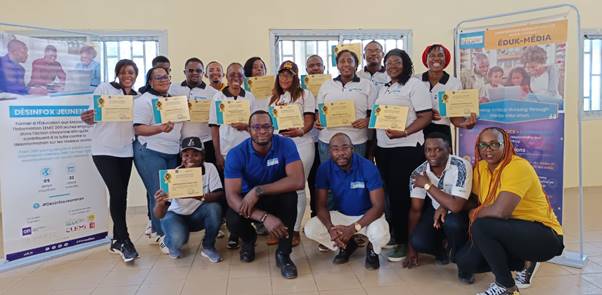
Training workshop with educators or youth facilitators in Cameroon
One of EDUK-MEDIA’s most significant current initiatives is its advocacy work for the integration of MIL into national education systems. Through the Cameroon Média Plus project, funded by the European Union and implemented alongside CFI Médias and the International Federation of Journalists (IFJ), the organisation is working with public authorities in Cameroon to support the introduction of MIL into school curricula.
In May 2025, EDUK-MEDIA organised, with the support of UNESCO and CFI, an international conference on integrating MIL into Cameroon’s educational system. The event brought together policymakers, educators, journalists, researchers, and civil society organisations to discuss strategies for developing national MIL policies and strengthening teacher training.
This advocacy work extends beyond Cameroon. EDUK-MEDIA is also supporting governments in countries such as Burundi in the development of national MIL strategies adapted to local realities and educational priorities.
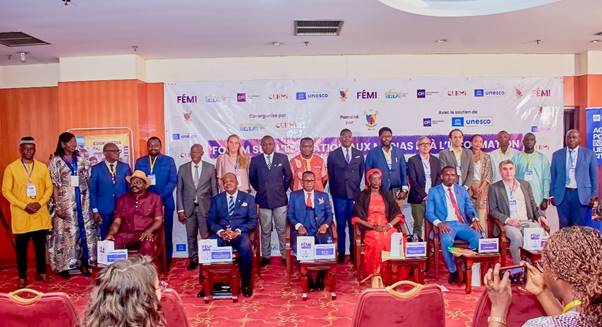
Internation Forum on MIL, may 2025, Cameroon
Another important dimension of EDUK-MEDIA’s work is research on disinformation and digital practices. In partnership with the French organisation Savoir Devenir, EDUK-MEDIA is currently conducting a regional study on gendered disinformation in Central and West Africa. The research covers five countries — Cameroon, Chad, Central African Republic, Togo, and Côte d’Ivoire — and aims to identify how gender-sensitive disinformation circulates, the narratives it promotes, and its social impact on women and vulnerable communities.
At a time when online hate speech and gender-based digital violence are increasing globally, this project seeks to contribute to a better understanding of local dynamics while supporting the development of adapted educational and policy responses.
EDUK-MEDIA is also investing in innovative media formats to foster dialogue and awareness around disinformation. In partnership with the Brussels-based research organisation GRIP (Research and Information Group on Peace and Security), the association is currently producing a podcast series on disinformation. The podcast highlights testimonies and experiences from actors in five countries where EDUK-MEDIA operates: Cameroon, Burundi, Togo, Chad, and France.
The objective is not only to document the realities of misinformation in different contexts, but also to create transnational conversations around media literacy, peacebuilding, and digital resilience.
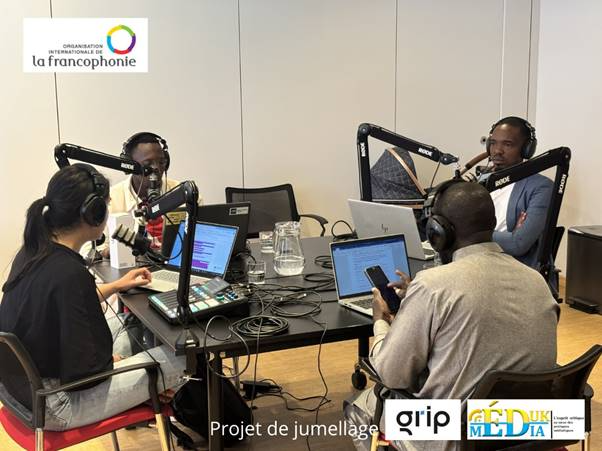
Podcast recording session in Brussels
EDUK-MEDIA’s commitment to international cooperation and Francophone collaboration was further recognised in 2023 when the organisation received the Media and Information Literacy Award during the International Journalism Forum in Tours, France.
The organisation is also actively involved in the Francophone Network for Media and Information Literacy (REFEMI), where it currently serves as Vice-President. Alongside partners from several Francophone countries, EDUK-MEDIA contributed to the development of a competency framework for MIL trainers and facilitators across the Francophone world — a tool designed to support the professionalisation and expansion of MIL initiatives internationally.
In contexts where disinformation increasingly affects democratic debate, social cohesion, and public trust, EDUK-MEDIA believes that media and information literacy must become a fundamental component of education systems and citizenship education.
Through local action, regional cooperation, and international partnerships, EDUK-MEDIA continues to work toward a more informed, critical, and resilient digital society across Africa.
Author
Blaise Pascal ANDZONGO, Founder EDUK-MEDIA, Cameroon