by Christian Hoppe and Markus Weber, TU Darmstadt, Germany.
Choosing the right degree programme poses a complex challenge for young people. Given the enormous variety of options, finding one’s bearings can be difficult. Abstract module descriptions often provide little guidance during this phase; they rarely convey a realistic picture of everyday university life.
At TU Darmstadt, we already successfully utilize Online Self-Assessments (OSAs) to address this. These services support prospective students through a structured combination of informational texts, videos, and subject-specific tasks. However, our experience shows that one essential factor often remains unconsidered: the emotional component. What does the campus look like? What is the atmosphere in the lecture halls and laboratories? What does it actually feel like to study here?
This is precisely where our approach comes in. Based on our experience with interactive 360° teaching and learning scenarios, a new concept for digital academic orientation has been developed: the TUDa Campus Quest.
Didactic and technical advantages of 360° technology
From a higher education didactics perspective, 360° technology offers decisive advantages. The greatest benefit lies in its photorealistic representation of reality. Instead of laboriously modeling virtual 3D worlds on a computer, we capture real learning environments using specialised 360° camera systems. This conserves development resources and brings the authentic campus atmosphere directly to the target audience’s screens.
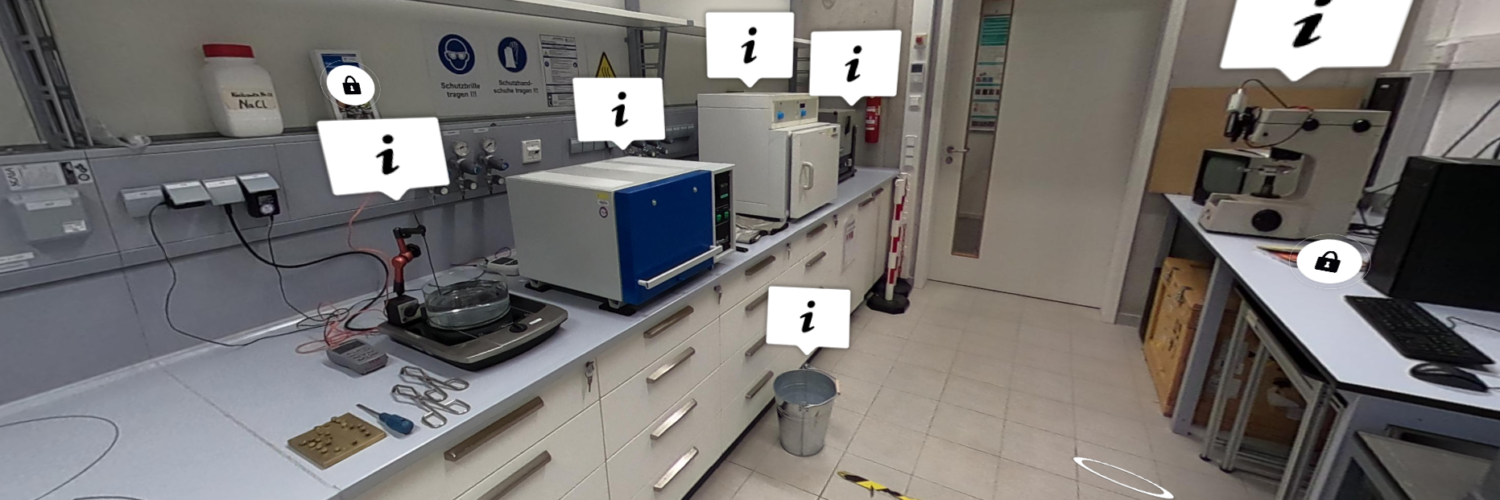
Furthermore, this approach provides access to sensitive or restricted areas. Whether highly specialised research laboratories, large lecture halls, or experimental facilities our 360° tours make it possible to open these spaces to everyone. Similarly, the experiments and trials are designed to be as close to the primary experience as possible. Users get the feeling of standing directly in the laboratory right next to the equipment.
The true strength of the 360° teaching-learning environment lies in its flexible expandability for interaction. The panoramas are purposefully enriched with videos, audio elements, H5P modules, or three-dimensional objects. This provides the foundation for a well-thought-out gamification concept that sustainably increases learners’ motivation and engagement. The system operates entirely platform-independent and functions on PCs, tablets, or immersively via VR headsets.
From static spaces to active learning environments
With the TUDa Campus Quest, we succeed in transforming static spaces into interactive learning environments. Prospective students do not just view the rooms passively; they explore them actively and solve subject-specific tasks from everyday university life. In doing so, we deliberately avoid a traditional exam atmosphere. Instead, we rely on a playful, quest-like character featuring a storyline, problem-based riddles, and a reward system.
The goal is to realistically simulate a typical day in a specific department. Players are accompanied by a comic-style avatar character who guides them through the day and offers didactic support when needed. The game design follows a linear narrative structure, is designed for a moderate difficulty level, and utilizes a “no-fail” design. Failure is therefore impossible, ensuring that frustration thresholds are not overwhelmed and motivation remains high. The average playtime is 30 to 45 minutes.
The typical workflow is divided into four core phases:
Campus Orientation:
Supported by audio and text, players navigate from the bus stop to the correct lecture hall.
The Lecture:
In the lecture hall, they meet the instructors. The tasks are based on the content of real university lectures but are didactically reduced for the target audience.
The Laboratory:
Here, an experiment is conducted that links directly to the lecture including a prior laboratory safety check.
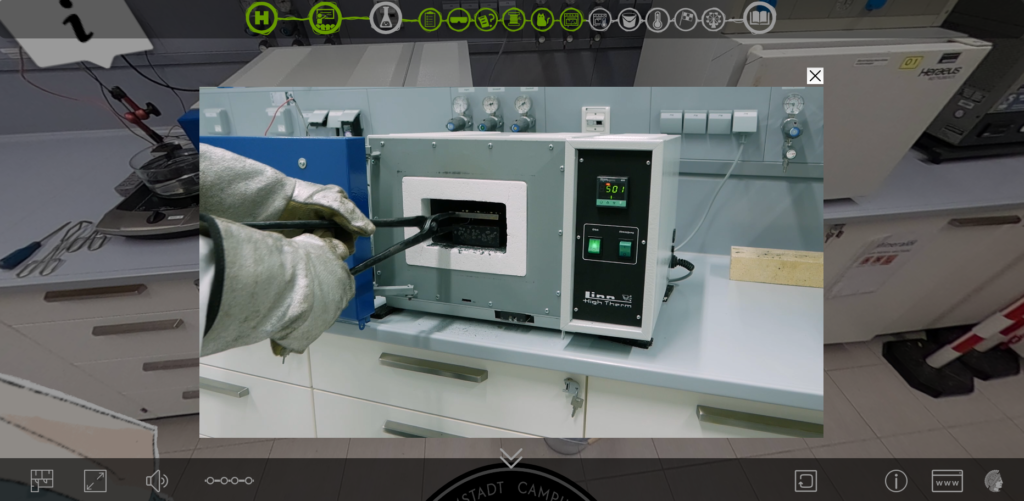
The Learning Lab:
Finally, the insights gained are reflected upon. In addition, players receive further information about student life and the services offered by the department and the university.
Practical insights and outlook
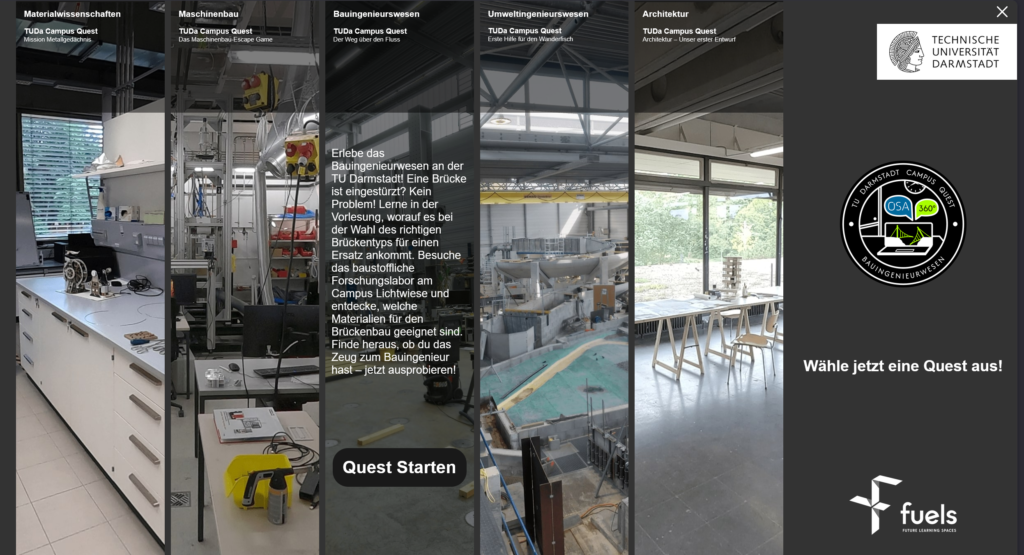
The project currently comprises five different scenarios across four departments: Materials Science, Mechanical Engineering, Civil and Environmental Engineering, and Architecture.
So far, all quests are exclusively available in German.
For more informations click here:
- https://asset.e-learning.tu-darmstadt.de/d/tuda_cq/startseite/
- https://www.e-learning.tu-darmstadt.de/dienstleistungen/projekte_kooperationen/fuels/fuels_artikel_details_55872.de.jsp
Christian Hoppe, Center for Educational Development and Technology – Unit “Digital Teaching and Learning – TU Darmstadt, Germany
Markus Weber, Center for Educational Development and Technology – Unit “Digital Teaching and Learning – TU Darmstadt, Germany