
by Zac Woolfitt, Inholland University of Applied Sciences, the Netherlands.
This assessment model will be presented for discussion at the Media and Learning conference in Leuven in June
Generative AI is challenging higher education to reconsider what assessment actually measures. If students can generate essays, reports, and reflections within seconds, then traditional assessment formats risk becoming increasingly disconnected from authentic learning. At the same time, approaches focused primarily on AI detection and surveillance can undermine trust and shift attention away from the learning process itself.
At Inholland University of Applied Sciences, we have developed an alternative approach to assessment. It focuses less on policing AI use and more on making learning visible through iterative, media-rich, and reflective processes.
The 30 EC course takes place at two living labs: The International Music Industry Lab (Haarlem) and the Urban Leisure and Tourism Lab (Amsterdam). During 20 weeks, students collaborate in interdisciplinary teams on real-world societal challenges, in direct contact with external stakeholders. The labs are open, co-creative learning environments. Students engage with complex “wicked problems” that do not have simple or fixed solutions. The lab context requires students to navigate uncertainty, collaboration, communication, and reflection from the context of their own disciplinary knowledge.
As the assessment model has evolved, it became increasingly clear that evaluating only the final product was insufficient. The emphasis has shifted toward documenting and supporting the learning journey itself.
The assessment is based on Biesta’s three formats of education: qualification, socialization, and subjectification. Assessment is not solely a mechanism for measuring outcomes. The framework attempts to balance knowledge and skills development with professional identity formation, collaboration, and authentic leadership.
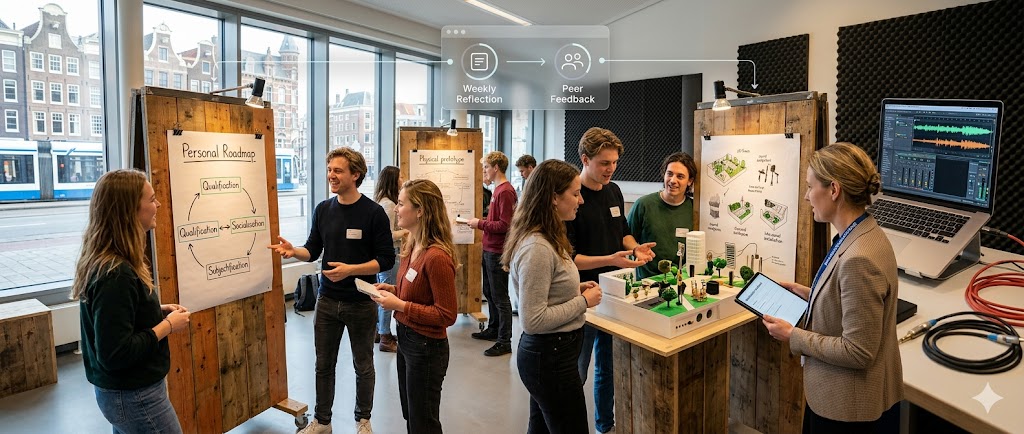
The Personal Roadmap is central to this process. Students document and account for their progress throughout the semester while reflecting weekly on prompts from the LMS. These reflections are supported through three formative and one summative “end of climb” presentations spread across the semester.
The presentations are intentionally iterative rather than high stakes. Students use A3 poster presentations, short pitches, prototypes, and reflective discussions to account for their progress. Peer and expert feedback are collected digitally and shared collectively with the whole group. Students need to be accountable for their learning, since they are communicating this to their peers. This creates transparency and trust within the learning community.
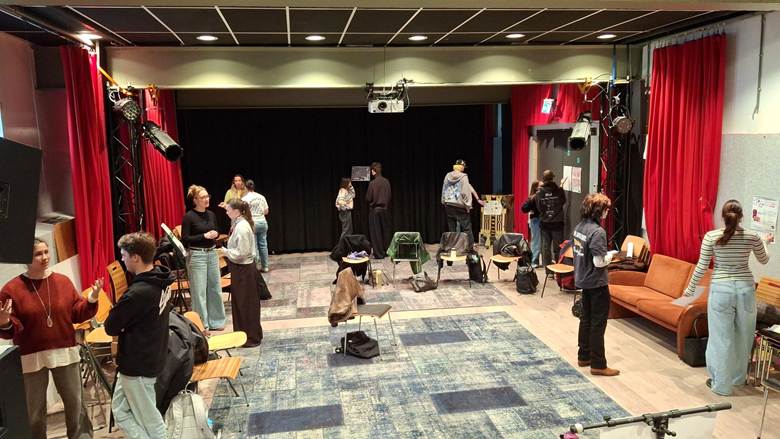
IMI lab – 2026: Formative feedback during one-on-one presentations of your learning to peers, is hard to outsource to AI.
The group projects are media-rich and vary depending on the challenge. Final outputs may include websites, podcasts, videos, campaigns, apps, or physical prototypes. The project group also submit: 1) a Design Rationale that explains key decisions and choices made, and 2) a Group Process Report that documents the collaboration and development over time. A simple diagnostic “Team Tester” tool using anonymized peer ratings visualizes team dynamics helping to identify issues during the process.
One of the most important shifts in this process has been moving the assessment focus from the final artefact produced, toward the visibility and accountability of the iterations during the learning process. Of course, the quality of the final product is still important and students are encouraged to use AI tools. The emphasis is placed on how they respond to and incorporate feedback, justify decisions, iterate ideas, and reflect critically on their own development. This is difficult to outsource convincingly to AI over a sustained 20-week learning journey.
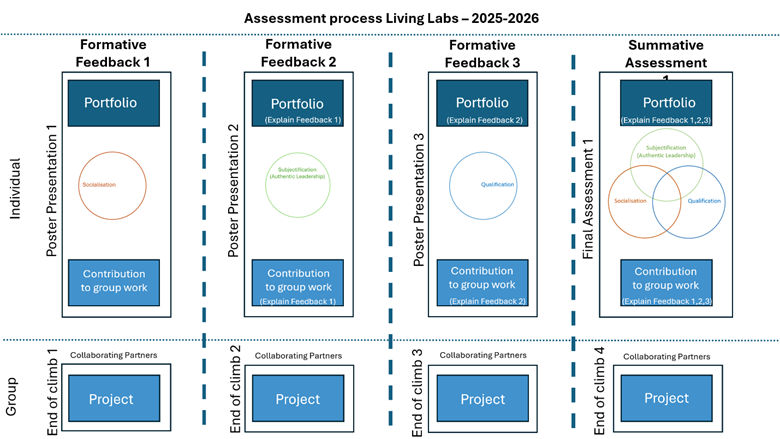
Lab assessment model: 3 x formative feedback plus x 1 summative assessment.
Rather than spending increasing amounts of time trying to detect AI-generated content, assessors engage more directly during the semester with ongoing formative feedback supported by visible evidence of the process. The role of the assessor becomes more focused on supporting learning and less on verification alone.
It remains a fine balance. Trust is not automatic, and transparency can feel uncomfortable for students. Many arrive in the lab expecting to receive clear instructions to find the “right answers”. Staff must adapt to this coaching-oriented role within the assessment process. We evaluate this approach each semester in response to student, staff, and partner feedback.
Students mention that the regular reflective structure helps them better understand their own development, while the shared formative moments contribute to a stronger sense of learning community. For assessors, the process provides a clearer insight into student development while reducing dependence on purely summative evaluation at the end of the semester.
This approach does not claim to solve the wider challenges that AI presents to higher education. It does, however, suggest that assessment may become more meaningful, valuable, and sustainable when the focus shifts from proving authorship toward supporting authentic, visible, and iterative learning processes.
We look forward to getting your critical feedback in Leuven, as we continue to refine this approach to redesign assessment in the age of AI.

Zac Woolfitt, Inholland University of Applied Sciences, the Netherlands