
by Mari-Liis Madisson & Andreas Ventsel, University of Tartu, Estonia.
History is far more than a record of the past. It shapes how people understand themselves, their country, and their place in the world. That is what makes it such a powerful political tool. When someone attacks or distorts a nation’s historical memory, they are not only challenging facts, they are reaching into people’s sense of who they are and where they belong. The effect can be profound. It can pull people together, but it can also divide them, mobilise them, and manipulate them.
Using history for political ends is nothing new. What the digital environment adds is speed and reach. On social media, historical claims circulate in forms that are simplified, emotional, and built to grab attention, a short post or meme, a video clip, a recollection dressed up as personal memory. With history, the manipulation tends to be quieter than an outright lie. Real events get used, but only the convenient parts. Context vanishes. The past gets wired to someone’s present-day agenda.
This shows up most clearly in Russian influence operations. For years the Kremlin’s messaging has chipped away at Ukrainian statehood, Ukrainian identity, and the Baltic memory of Soviet occupation. None of this is accidental. The point is to steer how people read the past, the conflicts of the present, and the political choices in front of them. The same pattern has run in Estonia, where the Second World War, Soviet symbols, and fights over monuments do the work. The 2007 uproar over moving the Bronze Soldier in Tallinn, a Red Army memorial marking a wartime grave, turned into riots, a diplomatic crisis, and one of the first big cyberattacks against a state.
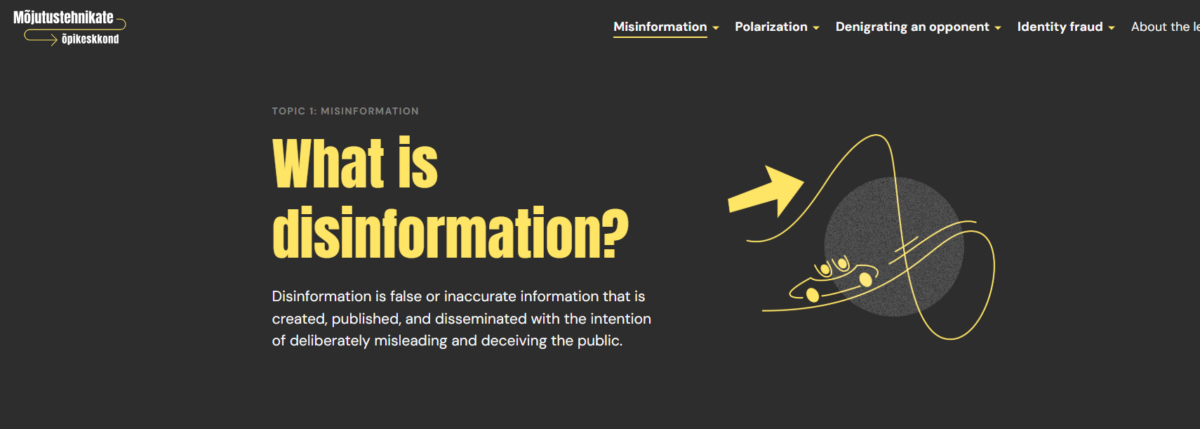
This is why we are expanding the learning platform Õpi ära tundma manipulatsiooni, “Learn to Recognise Manipulation”, with a new module on the politicisation of history. Built originally for media literacy in the Estonian Defence Forces, the platform helps people recognise manipulation in public debate and everyday media. The new module shows how historical events are placed in the service of political messaging, and how to approach such messages critically.
Media literacy here means more than fact-checking. Facts matter, but politicised history calls for other questions too. Why this particular event? What gets left out? Who is cast as guilty, who as the victim? What emotions are the message trying to provoke? Does it open discussion, or harden the divide between groups?
The learning platform rests on three principles. The first is collaboration. Influence operations hit whole communities, not single people, so resilience has to be built collectively too, through discussion, comparing interpretations, and learning to see different perspectives. The second is playfulness, which keeps the topic serious while opening a safe space to experiment and see how manipulative messages work. The third is feedback and dialogue. History stirs strong emotions, so the learning should cool tensions and help people talk.
The module runs in four stages. First, an emotionally engaging example, such as a meme that ridicules Estonian readings of the Soviet period, opens the topic and shows how humour can work as a tool of influence. A joke may look harmless, yet it can reinforce stereotypes and make distorted claims feel acceptable.
The next stage focuses on individual analysis. Learners examine texts where history looks neutral, but facts are selected in a biased way, blame is shifted onto others, and a contrast is drawn between “us” and “them.” The aim is to recognise the moment a historical account turns into political influence.
The third stage moves into pairs, with social media posts that look back on the Soviet era. Nostalgia on its own is something else entirely. A grandmother missing the friends of her youth, someone recalling cheap ice cream or a first apartment, these are ordinary human memories, and people carry wildly different ones. The trouble starts when that longing gets bent into a story about Estonia as a failed state, or used to excuse authoritarian politics. So learners set everyday recollections beside strategic influence messages and learn to tell one from the other.
In the final stage, learners write a fictional social media post of their own, using simplification, emotional language, and appeals to identity. Others then analyse it critically. The exercise shows how easily history can be framed to shape attitudes, deepen divisions, or steer political conclusions.
Living with the politicisation of history asks something harder than walking away from the past or tiptoeing around the painful parts. A democratic society thrives on open, many-voiced argument about its own history. The skill we need is telling honest disagreement apart from an influence operation. That means reading for what has been left out as much as what is said, and seeing how a version of the past quietly steers the choices we make today. Strong media literacy gives ordinary people the confidence to recognise that work and to question it.
Authors
Mari-Liis Madisson is Associate Professor of Semiotics at the University of Tartu, where she studies disinformation, conspiracy theories, and information influence operations. She has co-developed media literacy tools for the Estonian Defence Forces and is a co-author of the forthcoming Conspiracy Theories in the European Digital Sphere (Routledge)
Andreas Ventsel is Professor of Political and Sociosemiotics at the University of Tartu. His research focuses on information influence operations and political communication. He has co-developed media literacy tools for the Estonian Defence Forces and contributed to project S.HI.E.L.D. vs Disinfo.