by Zac Woolfitt, Inholland University of Applied Sciences, the Netherlands.
I attended the Media & Learning Conference 2026 in Leuven (June 17-18) on “Co-creating the future of learning”. Media & Learning 2026: Co-creating the future of learning – Media and Learning Association
(Disclosure, I am on the conference advisory board and have been attending the conference since 2015. You can see my previous conference reports here)
I could only attend a few of the many sessions (see my chocolate cake metaphor at the end!), so this report is purely from my perspective, what I saw. For a complete overview of the conference presentations, please refer to the website. And I am very sorry if I missed your session.
Day 1
Pedagogy first, then AI
Margriet Van Bael (Vice Rector of Education Policy, KU Leuven, Belgium) welcomed us to Leuven. Co-creation between students, academics and support staff requires sharing responsibility for creating meaningful learning experiences: “Students need to become learners of their own learning process.” AI literacy and understanding how AI works while using it critically, safely and responsibly: “AI should support and strengthen human expertise, not replace it”. We must keep focus on human judgement, creativity, ethics and purpose. Meaningful learning is integrating the new technology to a clearly defined and structured pedagogy guided by educational goals.
Reskinnable Realities
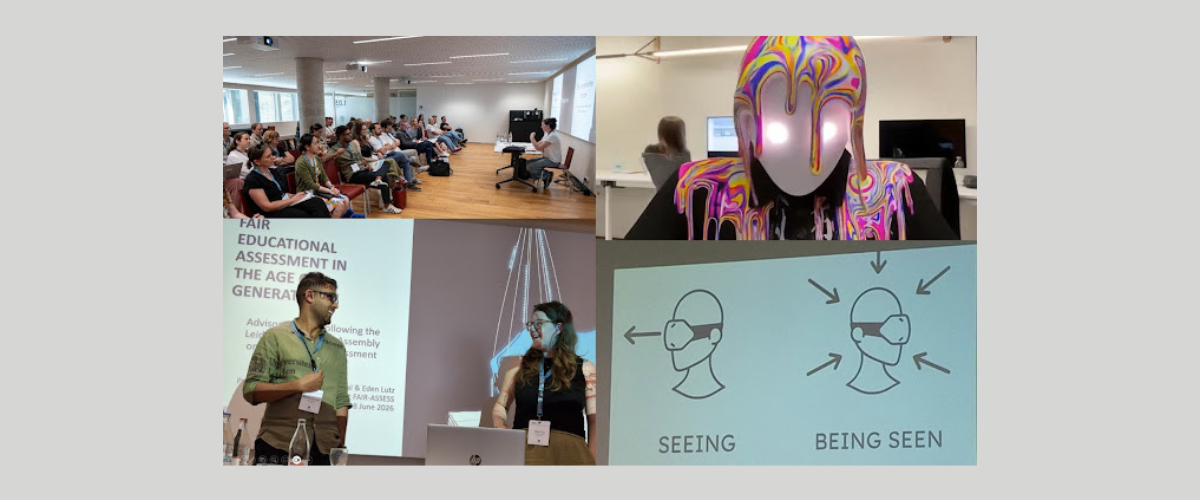
Rob Morgan (Visiting Fellow at King’s College London, UK). I had no idea what a reskinnable reality was. But this was certainly one of the most interesting, and perhaps darker, presentations I’ve seen for a while. Smart glasses allow the user to add a different ‘skin’ to what they see. You can overlay digital content onto the physical world, customise how you see others, and alter how you ‘see’ others without their knowledge. You can choose to ‘dress’ your lecturer as a medieval character, a comic superhero, or view them in a bikini. Real-time. In daily life, and in the classroom, it is becoming more difficult to detect who is wearing smart glasses, when and how they are using them, and which reality they are choosing to project onto those viewed. Questions of consent, privacy, identity and power become increasingly important; “Do you have the right to see the world however you choose – and do others have the right to see you however they choose?”
Unless you’ve tried this technology it is difficult to understand how bizarre and potentially disruptive this is. These are SnapChat filters on steroids. The company Decart say they can ‘Generate video infinitely and in real time. Restyle any video instantly while keeping temporal coherence.’ Watch this video (click on ‘Try Lucy 2.0). Now imagine your students choosing to view you this way during class.
 |
| Lucy 2.0: real-time video conversion (it’s scary!) |
This is reshaping how we access information and how we experience reality itself. We need to prepare for a future in which there is no single shared reality, but rather multiple, personalised and algorithmically mediated realities; “Reality is becoming media, and media is becoming reality.” We need to develop realities literacy (realities plural), the ability to navigate a world where different people see, interpret and experience the same place in very different ways.
Meta Ray-Bans and similar devices are information-gathering tools. They are used to build models of the world and train AI systems. Pokémon Go was a great success. But it was not just a fun game to catch cool Pokémon in the real world. Those millions of users were working for free, in a massive ‘data grab’, to build a very complete map of the world. We were like the GoogleMaps cars driving around neighbourhoods. And Meta’s Ray-Bans will now continue that process. The world we live in becomes a massive 3d space of ‘surfaces’, that we are unknowingly scanning so the data can be processed, mapped, plotted and then modified. ‘The ‘data grab’ is no longer just about online behaviour, but about reality itself’. Who has digital sovereignty and ownership of this? Who benefits from the vast amounts of information being collected? Who gives permission and do you even know what is going on?
Our ethical frameworks, policies and educational practices still have some catching up to with these technology developments (see EU regulation presentation on day 2 below). Learners will arrive in Higher Education from ‘bubbles of culture’, curated by their personal algorithms that has pushed them into niches. It is our role to ensure that the learning environments we offer them are places where they can emerge from their curated world and experience other realities (reality!) through interactions with teachers and classmates.
And remember, even if you decide to ‘opt out’, you can still be unknowingly ‘re-skinned’ and your identity customized by someone else.
Multimodal Learning
Sharon Klinkenberg is a psychometrician, statistician, and educational innovator at the Department of Communication Science, University of Amsterdam, the Netherlands. He presented ideas on Multimodal learning: Where technology meets pedagogy. And you can see his presentation here.
He gave a clear overview on multimodal learning, personalised education, and the role of data and AI in reshaping teaching practice. Personalised and flexible learning environments are increasingly possible and need to be grounded in strong educational design. This requires structured guidance alongside autonomy. It requires rethinking traditional teaching models and moving towards more data-informed educational design. There is a good set of sources in the link above which I’m looking forward to exploring further.
TREnD – Teaching Resilience and Environmental Democracy
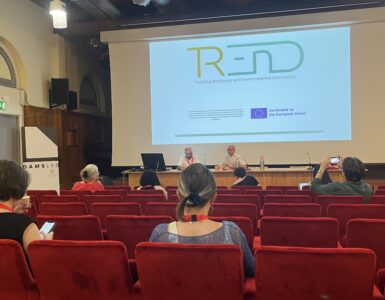
I joined this session to learn more about creating VR products through an international exchange. I’d joined an international VR project last year so was interesting to learn about TREnD (Teaching Resilience and Environmental Democracy). Dario Fazzi (Leiden University) and Gaetano Di Tommaso (Roosevelt Institute for American Studies) presented. They ran a transatlantic programme with virtual exchange using problem-based learning to support Education for Sustainable Development. Their real-world environmental challenges linked areas with post-industrial damage (e.g. Baton Rouge, Texas, and Zeeland). Students worked collaboratively across countries and mapped the areas, creating 3d images. I was interested to know about credit allocation in relation to my own project. How to ensure that students in different courses with different credit requirements participate equally and meaningfully.
The principles of AI in education – Discussion the Fürth Manifesto
In this session we discussed the implications of the 2025 Fürth Manifesto on AI in Education. The panel and audience went through the seven statements and examined the document. Are principles fit for purpose as AI rapidly evolves from a simple tool into an increasingly agentic learning companion? How can education harness the benefits of AI while preserving its core human, ethical, and pedagogical values? We agreed that AI literacy remains essential, but that institutions must move beyond basic awareness towards clearer educational visions, stronger governance, and more intentional approaches to curriculum design, assessment, and student wellbeing.
I see AI as a very bright spotlight that is mercilessly exposing all the imperfections in higher education. We’ve known they were there for years and like the emperor’s new clothes, we accepted the status quo. Now AI is exposing existing weaknesses and tensions within education, from outdated assessment practices to questions about accountability, privacy, and the growing influence of large technology providers. There was strong discussion around the need to make learning processes more visible, rethink what is being assessed, and prepare learners for a future where AI is embedded in everyday study and work. ‘Networked merit’ was discussed as a concept in which students build up merit through their interactions with their network. Spaces need to be safeguarded for reflection, wellbeing, and human interaction. The manifesto is a living document and one that must continue to evolve alongside the technologies it seeks to guide.
In discussion with Stephen Downes
Stephen Downes was involved in developing one of the first Massive Open Online Courses and has developed ideas on Connectivism. I was delighted to be able to join my colleague Lana Scott from MIT to chair the audience discussion with Stephen Downes, who joined us via a video link. Slides and audio of the discussion here.
According to Stephen, personal learning should be a learner-defined environment in which people choose and connect their sources, tools, identities, storage, publishing destinations and collaborators. AI should help us overcome the barriers to personal learning that have led to disappointing technology choices in the past. Different learners should be able to build different environments based on their own needs, values, culture and commitments.
I started by asking Stephen which technology he would Control, Alt and Delete. Although he does not really think that way he prefers to look at things as working ‘with’ systems. He’d like to have control over systems such as RSS so he can read what is interesting to him. He might alter how people interact with each other. Finally, he’d delete advertising, the original fake news!
Personal learning environments in the age of AI should be an “architecture of agency”. He presented nine domains where learners should have meaningful control: identity, sources, annotation, memory/storage, composition, AI services, publishing, social feedback, and governance.
When asked about fostering agency, he stressed that it is fundamentally an attitude. His view on education struck a chord with me since it aligns closely with my own work focusing on personal development in Living Labs. He said that as educators we should foster each individual and help them gain “an understanding of their own values as a person and using that value as a basis for taking action (even futile, hopeless actions), because sometimes those are the best. And for shaping their environment and managing their own experiences, in order to have what is for them, the most meaningful life possible.”
That aligns directly with my own teaching philosophy. However, as he pointed out, this does not align with societal pressure from mass media to conform. It is our duty as educators to model and nurture this agency in learners.
He advised using AI as a critical partner. Instruct it not to assume, not to agree automatically, and to push back when uncertain. As educators, we should meet learners where they are, add value to existing communities, and focus on providing genuine value rather than chasing standardised learning outcomes.
Medea Awards
That evening, the annual Medea Awards were announced. Congratulations to this year’s winners.
Day 2
Shaping the future of learning
Laure Michelon (Lecturer at UCLA AUD California) joined us live from Los Angeles via video. The emerging field of sound architecture can use spatial audio as a design medium to create immersive narratives and new ways of experiencing space. Her student projects demonstrated how sound can be “spatialised” and crafted with the same intentionality as visual design. Audio technologies can expand design thinking and learning experiences. I enjoyed these insights which showed me new ways sound can be used creatively in higher education.
Agne Limante (Legal Officer at the European AI Office) gave a very clear and practical overview of the EU Artificial Intelligence Act and its implications for education. I felt reassured to be part of the EU, knowing that regulation was coming into place to help address some of the urgent issues. E.g., the new EU Article 5 prohibits AI systems where they generate or manipulate realistic material depicting: An identifiable persons’ intimate parts or sexually explicit activity without consent, or Child sexual abuse material
The act focuses on high-risk AI systems, transparency requirements, and prohibited practices such as emotion recognition in educational settings. AI needs to remain safe, trustworthy, and aligned with fundamental rights. Despite what could have been a very heavy session with a focus on regulation, Agne stayed optimistic and upbeat. Her constructive tone showed responsible governance as an enabler of innovation rather than a barrier to it. I look forward to following up on some of the sources in her presentation.
Jeff Van de Poël (AI & Teaching Advisor, University of Lausanne, Switzerland). This was an inspiring and fun presentation. He asked us whether AI will replace teachers and provided us with his concept of the “augmented teacher” who remains firmly in control of pedagogical decisions. He showed us several examples of AI-supported learning activities, debate simulations, and adaptive content creation. I don’t quite know how he does it all, but it seemed fluid and intuitive. He told us just to try it. AI can enhance teaching when we deliberately design and arrange it to do so. The session reminded us to keep a balance between pedagogy, teacher agency, and professional judgement.
Rethinking Assessment and Learning in the Age of AI
I was the first (of five presentations) in this session on the impact of AI on assessment. I explained how we are addressing this issue in Living Labs at Inholland University of Applied Sciences in the Netherlands. See my article here.
I was glad to be in this session because the other four presentations were extremely interesting and I could learn a lot from each of them.

The session was well attended and packed with good examples (Photo Arnaud Absil, Media and Learning Association, Licence: CC BY-SA)
Paschalia Terzi (Georgetown University in Qatar) is a media specialist at the library and covered the rise of alternative assessment through media and information literacy instruction such as story maps and geolocation.
Jonas Schug (Hochschule Bochum in Germany) discussed “The Never-Skilled Generation” and shows how deskilling and cognitive offloading has long-term risks when we use AI-to support our learning. Through a clear set of visuals and models he showed how AI fundamentally alters the dynamic in learning between the task, the output and the grading ‘by-passing’ crucial steps in the learning process. This can lead to the current generation never learning some basic skills because they have always outsourced to AI. Whether for convenience or due to time pressure. He suggested a didactic approach that has open-ended problems, uses learning agents, provides didactic guardrails and delays offering easy solutions. His suggested solution to this was problem-based learning. This is similar to the approach that I am experimenting with at the Inholland Living Labs (see my presentation above) so our stories complimented each other well. He provided a solid list of academic sources that I plan to examine in more detail.
Praneet Khandal & Eden Lutz (Leiden University, the Netherlands) ran a ‘Deliberative Assembly’ to arrive at 32 rules for fair educational Gen AI use in Educational Assessment. The process was highly democratic, and the list of guidelines emerged through careful steps. A few that were highlighted: If programmes allow students to use AI for assignments, the programme still needs to include in the curriculum a plan to ensure students are skilled in the things AI is being used for. Also, students should not be obligated to use GenAI systems in their assessments. Both the process (deliberative assembly) and the outcome (list of proposed guidelines) was extremely relevant and interesting. We can all learn a lot from this open and fair consultation of a carefully collected and diverse cross-section of our educational population.
Dovilė Dudėnaitė -Tierney (Media & Learning Association) presented on the finalization of the Teaching and Learning AI (TaLAI) Policy Guidelines for assessment higher education. For a full overview of the project see www.talaiproject.eu. The objective is to lead the way in innovative pedagogical approaches that integrate AI in higher education in an ethical way. This includes core principles, e.g., Human oversight in grading, transparent communication of grading criteria and transparency in GenAI utilization.
Cognitive overload while supporting digital wellbeing
Tanja Tillmanns (University of Erlangen-Nuremberg, Germany) addressed the issues of cognitive overload while supporting digital wellbeing in higher education. See the research paper here.
This subject is very close to my own heart. A few years ago, health issues due to a stressful digital environment stopped me working. Tanja gave an excellent workshop in which we discussed the impact of the digital world on students, staff and society. We looked at European guidelines from the Erasmus+ project HealthyMindED.
In the guidelines, the importance of connection between teachers and students emerged as central. One guideline focuses on co-creating a ‘digital communication charter’ with students. We should embed digital wellbeing into course design. We should clarify support boundaries (e.g., is it normal for students and staff to answer emails at 2am at night?). This led to some heated discussions about different approaches. We discussed the stress and cultural difference of having cameras on during online sessions (see my 2020 article on this).
Based on the ides in this session, I plan will address the issue of digital health more directly in my own teaching team and faculty. I will also ensure to set up a digital-communication charter with my own classes and teaching teams.
Tanja handled this session extremely well, being open to different input from the audience, slowing down to go into specific questions, where there was disagreement, and keeping a positive tone throughout. An exemplary demonstration of how to run a workshop and to involve many perspectives
Closing discussion
In the closing discussion, two students (Megan Brophy, KU Leuven and Elis Seijdel, VU Amsterdam) joined the panel and audience to share their perspectives. We were particularly grateful for their input since both of them were in the middle of final assessments. As moderator of this session, I got to hear some of the key ideas we had covered over the last two days. It was a positive closing, and the assembled audience and M&L members were in a good frame of mind for the challenges ahead.
Chocolate cake!
As in any conference, there is always too much for one person to take in. It’s like eating a very rich chocolate cake and there is only so much one person can digest. This report is my slice of the cake!
Thank you
Many thanks to the city of Leuven for hosting us.
Many thanks to the conference exhibitors; Audio XL, Elan, Kaltura, Panopto, Ubicast and Wooclap.
Many thanks to Sally, Mathy, Dovi, Shirin and Chloé for their professionalism, kindness and good humour while arranging yet another great conference.
Finally
If you read this far, many thanks. If there are corrections, additional comments or ideas, please contact me at zac.woolfitt@inholland.nl.

Zac Woolfitt, Inholland University of Applied Sciences, the Netherlands.