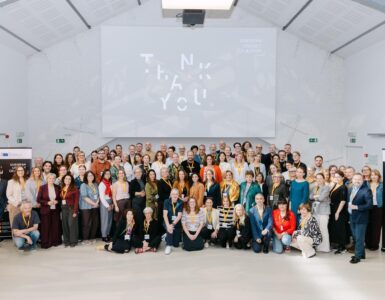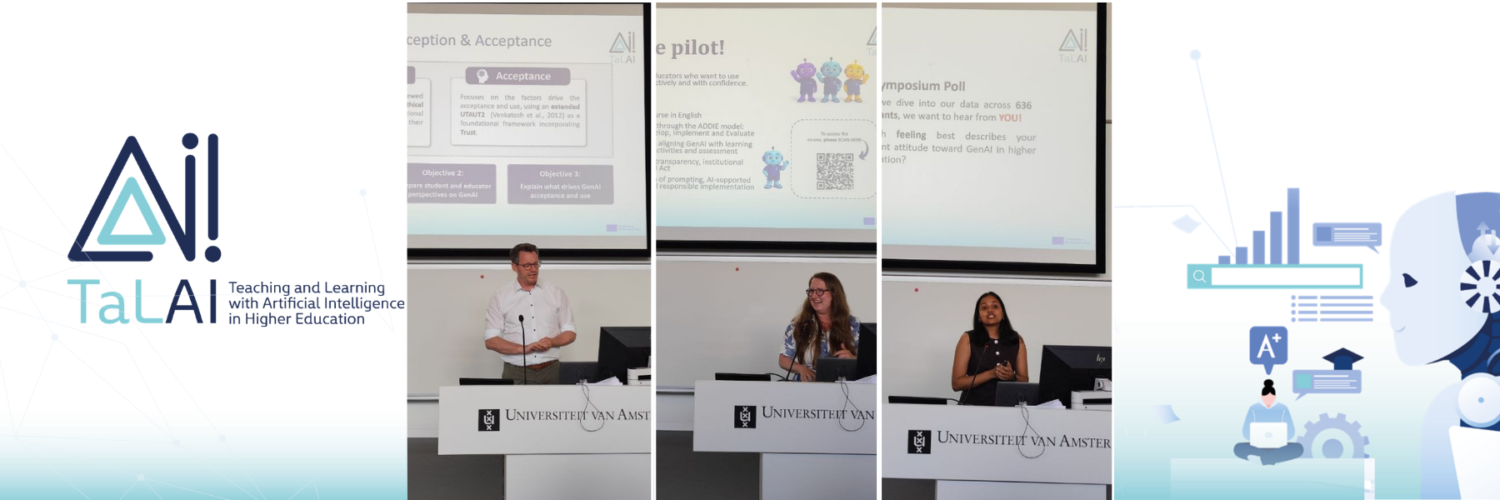
On 29 June 2026, the TaLAI project hosted its closing symposium on GenAI in Higher Education at the University of Amsterdam, bringing together educators, researchers, and policy makers for an afternoon of critical reflection on the role of artificial intelligence in teaching and learning.
The event opened with a keynote from Anco Peeters of Radboud University, who challenged one of the central promises of AI-driven education: that efficiency is always a virtue. Drawing on embodied cognition and pedagogical literature, Peeters argued that many of the frictions GenAI tools aim to remove, sensorimotor, interpersonal, epistemic, and moral, are precisely what makes learning meaningful. His framework offers a timely counterweight to the speed-and-scale logic driving much of the current EdTech market.
The afternoon also featured a presentation of TaLAI project results, a showcase of the UvA AI Chat, an overview of the BKO+ track on Responsible AI in Education, and a presentation of the FAIR-ASSESS project from Leiden University. Together, these presentations painted a picture of a higher education sector actively working to engage with AI on its own terms, critically, practically, and responsibly.
The symposium closed with a keynote from Dr. Marius Dorobantu of VU Amsterdam, who brought a distinctive theological perspective to the conversation, exploring what the GenAI revolution might reveal about language, intelligence, and the nature of human communication.
Learn more about the project: www.talai.eu

Funded by the European Union. Views and opinions expressed are solely those of the author(s) and do not necessarily reflect those of the European Union or the DAAD National Agency. Neither the European Union nor the DAAD National Agency can be held responsible for them. Project Number: 2023-1-DE01-KA220-HED-000153155